Sarga 119
अनसूयाप्रीतिदानम् — Anasūyā’s Blessing and the Forest Path
अयोध्याकाण्ड
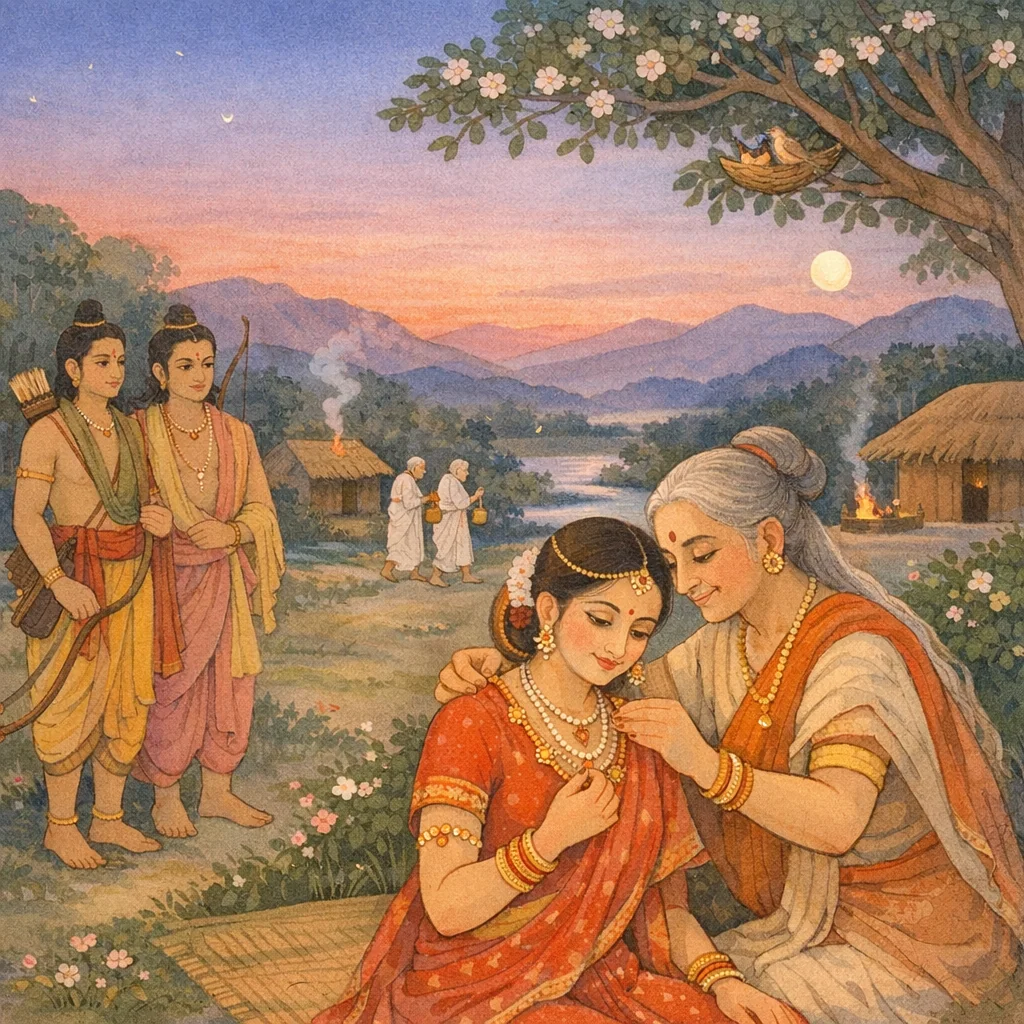
This sarga closes the Anasūyā episode and transitions the party deeper into the forest. After hearing Sītā’s detailed, sweetly articulated account—especially her svayaṃvara—Anasūyā responds with maternal affection, kissing Sītā’s forehead and embracing her. She grants permission to depart, then requests that Sītā be adorned in her presence, conferring divine ornaments and garments as prīti-dāna (gifts of love). Sītā, now radiant like a divine maiden, bows reverently and goes to Rāma; Rāma and Lakṣmaṇa rejoice at the rare honor shown to her. The narrative then shifts into a lyrical dusk-to-night tableau: sunset, birds returning to nests, sages returning from ablutions with water-pitchers, agnihotra smoke, thickening forest perception, nocturnal beings stirring, and moonrise amid stars. After a holy night of hospitality among accomplished ascetics, Rāma and Lakṣmaṇa take leave at dawn. The forest-dwelling ascetics warn them of man-eating, shape-shifting rākṣasas and blood-drinking predators who endanger ascetics, and they indicate a safe path used by sages gathering fruits. Blessed by the brahmin-ascetics, Rāma enters the forest with Sītā and Lakṣmaṇa, likened to the sun entering a mass of clouds.
Shlokas
Verse 1
अनसूया तु धर्मज्ञा श्रुत्वा तां महतीं कथाम्।पर्यष्वजत बाहुभ्यां शिरस्याघ्राय मैथिलीम्।।।।
Righteous Anasūyā, having heard Sītā’s great account, drew the princess of Mithilā into her arms and kissed her upon the head in affection.
Verse 2
व्यक्ताक्षरपदं चित्रं भाषितं मधुरं त्वया।यथा स्वयंवरं वृत्तं तत्सर्वं हि श्रुतं मया।।।।रमेऽहं कथया ते तु दृढं मधुरभाषिणि।
You have spoken sweetly and wonderfully, with every syllable and word clearly expressed. I have heard your entire account of how the svayaṃvara took place. O sweet-speaking Sītā, I truly delight in your narration.
Verse 3
रविरस्तङ्गतश्श्रीमानुपोह्य रजनीं शिवाम्।।।।दिवसं प्रतिकीर्णानामाहारार्थं पतत्रिणाम्।सन्ध्याकाले निलीनानां निद्रार्थं श्रूयते ध्वनिः।।।।
The radiant sun has set, and the auspicious night draws near. Birds that had scattered far and wide for food during the day now settle at twilight to sleep, and their calls can be heard.
Verse 4
रविरस्तङ्गतश्श्रीमानुपोह्य रजनीं शिवाम्।।2.119.3।।दिवसं प्रतिकीर्णानामाहारार्थं पतत्रिणाम्।सन्ध्याकाले निलीनानां निद्रार्थं श्रूयते ध्वनिः।।2.119.4।।
Whether an ascetic is found impure from leftover food, or careless and unguarded, the demons devour such dharma-practising hermits in this great forest. O Rāghava, restrain them and prevent it.
Verse 5
एते चाप्यभिषेकार्द्रा मुनयः कलशोद्यताः।सहिता उपवर्तन्ते सलिलाप्लुतवल्कलाः।।।।
And these sages too, wet from their ablutions, return together carrying their water-pots, their bark garments soaked with water.
Verse 6
ऋषीणामग्निहोत्रेषु हुतेषु विधिपूर्वकम्।कपोताङ्गारुणो धूमो दृश्यते पवनोद्धतः।।।।
When the sages have duly offered oblations in their agnihotra rites, smoke—tawny like a pigeon’s body—can be seen, lifted and carried by the wind.
Verse 7
अल्पपर्णा हि तरवो घनीभूतास्समन्ततः।विप्रकृष्टेन्द्रिये देशेऽस्मिन्न प्रकाशन्ति वै दिशः।।।।
Though the trees are sparse-leaved, they have grown dense on every side; in this region, where the senses feel strained and uncertain, the directions themselves do not appear clearly.
Verse 8
रजनीचरसत्त्वानि प्रचरन्ति समन्ततः।तपोवनमृगा ह्येते वेदितीर्थेषु शेरते।।।।
Creatures that roam by night are now moving about on every side, and the deer of this forest-hermitage are lying down to sleep around the sacred altar-sites.
Verse 9
सम्प्रवृत्तानिशा सीते नक्षत्रसमलङ्कृता।ज्योत्स्नाप्रावरणश्चन्द्रो दृश्यतेऽभ्युदितोऽम्बरे।।।।
O Sītā, night has begun—adorned with stars; and the moon is seen rising in the sky, wrapped as it were in a mantle of moonlight.
Verse 10
गम्यतामनुजानामि रामस्यानुचरी भव।कथायन्त्या हि मधुरं त्वयाऽहं परितोषिता।।।।
“You may go now—I grant my leave. Be a devoted companion to Rāma; for by your sweet and truthful telling, I have been fully satisfied.”
Verse 11
अलङ्कुरु च तावत्त्वं प्रत्यक्षं मम मैथिलि।प्रीतिं जनय मे वत्से दिव्यालङ्कारशोभिता।।।।
“And now, O Maithilī, adorn yourself here before me. Dear child, bring me joy by appearing radiant with these divine ornaments.”
Verse 12
सा तथा समलङ्कृत्य सीता सुरसुतोपमा।प्रणम्य शिरसा तस्यै रामं त्वभिमुखी ययौ।।।।
So Sītā, adorned thus and radiant like a celestial maiden, bowed her head in reverence to Anasūyā and then went forward to meet Rāma.
Verse 13
तथा तु भूषितां सीतां ददर्श वदतां वरः।राघवः प्रीतिदानेन तपस्विन्या जहर्ष च।।।।
Rāghava—foremost among eloquent men—saw Sītā thus adorned and rejoiced at the loving gifts bestowed by the ascetic woman.
Verse 14
न्यवेदयत्ततस्सर्वं सीता रामाय मैथिली।प्रीतिदानं तपस्विन्या वसनाभरणस्रजम्।।।।
Then Sītā, princess of Mithilā, told Rāma everything and showed him the ascetic’s affectionate gifts—garments, ornaments, and garlands.
Verse 15
प्रहृष्टस्त्वभवद्रामो लक्ष्मणश्च महारथः।मैथिल्यास्सत्क्रियां दृष्ट्वा मानुषेषु सुदुर्लभाम्।।।।
Rāma—and Lakṣmaṇa, the great warrior—were filled with joy on seeing the honour shown to Maithilī, an honour rarely found among mortals.
Verse 16
ततस्तां शर्वरीं प्रीतः पुण्यां शशिनिभाननः।अर्चितस्तापसै स्सिद्धैरुवास रघुनन्दनः।।।।
Thereafter Raghunandana, moon-faced and content, spent that holy night, having been duly honoured by accomplished ascetics.
Verse 17
तस्यां रात्र्यां व्यतीतायामभिषिच्य हुताग्निकान्।आपृच्छेतां नरव्याघ्रौ तापसान्वनगोचरान्।।।।
When that night had passed, the two tiger-like men, after bathing, took leave of the forest-dwelling ascetics who had performed their fire-offerings.
Verse 18
तावूचुस्ते वनचरास्तापसा धर्मचारिणः।वनस्य तस्य सञ्चारं राक्षसैस्समभिप्लुतम्।।।।
Those forest-dwelling ascetics, living by dharma, told the two of them that travel through that region of the forest was overrun by rākṣasas.
Verse 19
रक्षांसि पुरुषादानि नानारूपाणि राघव।वसन्त्यस्मिन्महारण्ये व्यालाश्च रुधिराशनाः।।।।
O Rāghava, in this great forest dwell man-eating rākṣasas of many forms, and wild beasts as well—blood-devouring predators.
Verse 20
उच्छिष्टं वा प्रमत्तं वा तापसं धर्मचारिणम्।अदन्त्यस्मिन्महारण्ये तान्निवारय राघव।।।।
Whether an ascetic is found impure from leftover food, or careless and unguarded, the demons devour such dharma-practising hermits in this great forest. O Rāghava, restrain them and prevent it.
Verse 21
एष पन्था महर्षीणां फलान्याहरतां वने।अनेन तु वनं दुर्गं गन्तुं राघव ते क्षमम्।।।।
O Rāghava, this is the path used by great seers in the forest as they gather fruits. By this route, it is safe for you to pass through this otherwise difficult, perilous woodland.
Verse 22
इतीव तैः प्राञ्जलिभिस्तपस्विभिर्द्विजैः कृतस्वस्त्ययनः परन्तपः।वनं सभार्यः प्रविवेश राघवस्सलक्ष्मणस्सूर्य इवाभ्रमण्डलम्।।।।
Thus blessed with auspicious benedictions by the ascetic brahmins with folded hands, Rama—tormentor of foes—entered the forest with his wife and with Lakshmana, like the sun entering a mass of clouds.
Frequently Asked Questions
The pivotal action is the transformation of hospitality into ethical empowerment: Anasūyā’s prīti-dāna to Sītā is not mere ornamentation but a sanctioned, dharma-aligned strengthening of the exile household, followed by the ascetics’ urgent appeal for protection against rākṣasa violence.
The sarga teaches that dharma is sustained through reciprocal care: the ascetic world offers blessings, counsel, and sacred gifts, while the kṣatriya householder-in-exile assumes responsibility to safeguard vulnerable communities—linking inner virtue to social protection.
Key markers include the tapovana (penance grove), veditīrtha (altar-sites), the agnihotra setting with ritual smoke, and the designated panthā (fruit-gatherers’ path) through an otherwise durga (hard-to-cross) forest—mapping a ritualized landscape of safe movement.