Sarga 112
पादुकाप्रदानम् (The Gift of the Sandals and Delegated Kingship)
अयोध्याकाण्ड
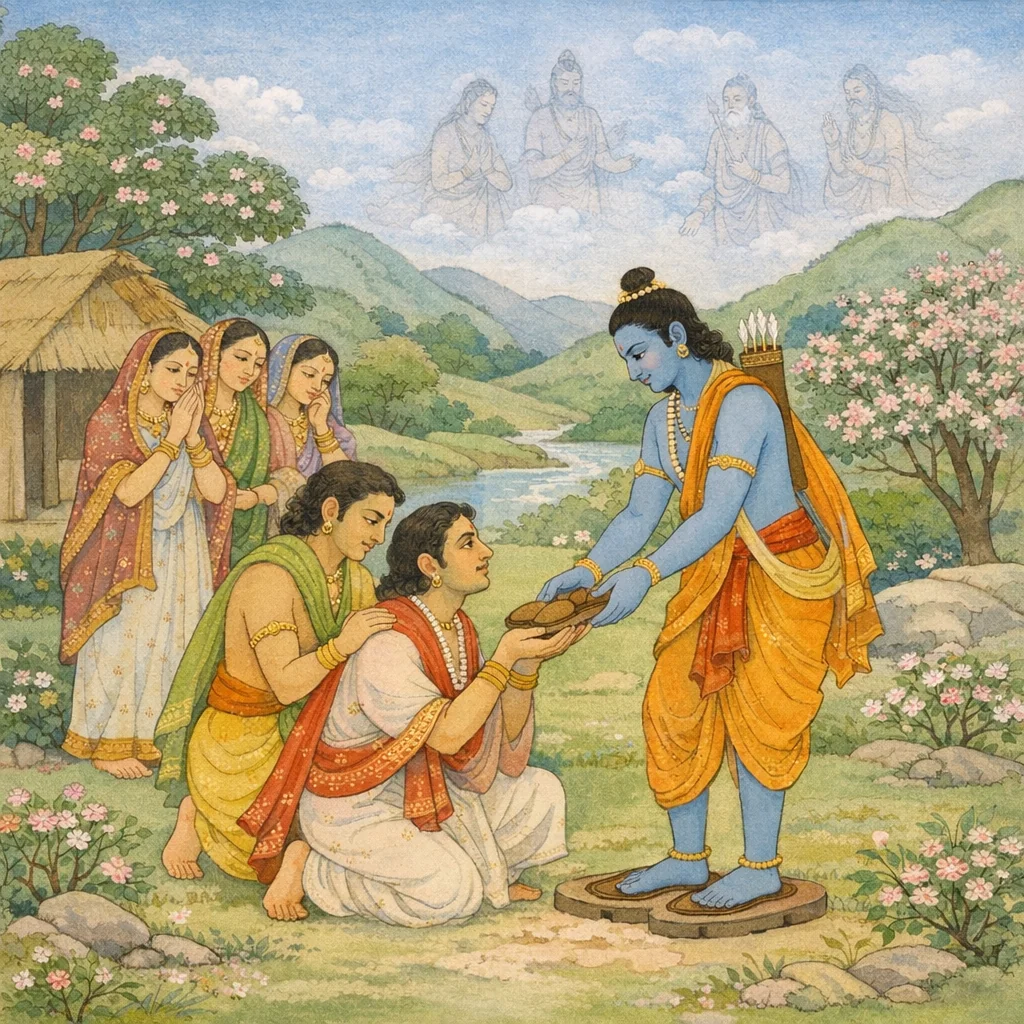
Sarga 112 presents the post-reconciliation settlement at Citrakūṭa: sages invisibly witness and praise the dharmic meeting of the brothers, framing it as auspicious and future-oriented (including the desired end of Daśagrīva/Rāvaṇa). Bharata, trembling yet resolute, petitions Rāma to accept the throne on grounds of rājadharma and kuladharma, confessing his inability to govern alone and noting that relatives, warriors, and subjects look only to Rāma. Rāma answers with affectionate instruction: Bharata possesses innate and trained wisdom, should govern by consultation with ministers and prudent counselors, and must not harbor anger toward Kaikeyī; yet Rāma declares his father’s promise inviolable, using cosmic impossibilities to emphasize steadfastness. Bharata then offers gold-adorned pādukā; Rāma steps into them and returns them as a symbolic locus of authority. Bharata vows austere life outside the city for fourteen years with the kingdom’s administration placed upon the sandals, threatening self-immolation if Rāma does not return on time. Rāma consents, embraces Bharata and Śatrughna, commands protection and non-resentment toward Kaikeyī, and departs after honoring elders; the mothers, choked with grief, cannot bid farewell, and Rāma enters his hut in tears.
Shlokas
Verse 1
तमप्रतिमतेजोभ्यां भ्रातृभ्यां रोमहर्षणम्। विस्मिता: सङ्गमं प्रेक्ष्य समवेता महर्षयः।।2.112.1।।
The great sages who had gathered there were astonished, beholding that hair-raising meeting of the two brothers, both of unmatched splendor.
Verse 2
अन्तर्हिता मुनिगणास्सिद्धाश्च परमर्षयः। तौ भ्रातरौ महात्मानौ काकुत्स्थौ प्रशशंसिरे।।2.112.2।।
Invisible to sight, hosts of sages—along with siddhas and great seers—praised those two magnanimous brothers of the Kakutstha line.
Verse 3
स धन्यो यस्य पुत्रौ द्वौ धर्मज्ञौ धर्मविक्रमौ।श्रुत्वा वयं हि सम्भाषामुभयोस्स्पृहयामहे।।2.112.3।।
Blessed indeed is he whose two sons are knowers of dharma and whose valor is grounded in dharma; for having heard the conversation of those two, we are drawn toward both of them with deep admiration.
Verse 4
ततस्त्वृषिगणाः क्षिप्रं दशग्रीववधैषिणः। भरतं राजशार्दूलमित्यूचु: सङ्गता वचः।।2.112.4।।
Then hosts of sages—yearning for the swift destruction of Daśagrīva—addressed Bharata, the tiger among kings, with these well-considered words.
Verse 5
कुले जात महाप्राज्ञ महावृत्त महायशः।ग्राह्यं रामस्य वाक्यं ते पितरं यद्यवेक्षसे।।2.112.5।।
O you born in a noble lineage—wise, of great conduct, and renowned—accept Rāma’s word, if you hold regard for your father.
Verse 6
सदाऽनृणमिमं रामं वयमिच्छामहे पितुः। आनृणत्वाच्च कैकेय्या: स्वर्गम् दशरथो गतः।।2.112.6।।
We always wish that this Rāma remain free of debt toward his father; and it was by becoming free of obligation to Kaikeyī that Daśaratha went to heaven.
Verse 7
एतावदुक्त्वा वचनं गन्धर्वा: समहर्षयः। राजर्षयश्चैव तदा सर्वे स्वां स्वां गतिं गताः।।2.112.7।।
Having spoken only so much, the Gandharvas along with the great sages—and the royal sages as well—then all departed to their respective abodes.
Verse 8
ह्लादितस्तेन वाक्येन शुभेन शुभदर्शनः।राम स्संहृष्टवदनस्तानृषीनभ्यपूजयत्।।2.112.8।।
Rāma, of auspicious appearance, gladdened by those auspicious words, honored those sages with a bright and delighted face.
Verse 9
त्रस्तगात्रस्तु भरतस्स वाचा सज्जमानया।कृताञ्जलिरिदं वाक्यं राघवं पुनरब्रवीत्।।2.112.9।।
But Bharata—his limbs trembling, his voice faltering, and his hands folded in reverence—again spoke these words to Rāghava (Rāma).
Verse 10
राजधर्ममनुप्रेक्ष्य कुलधर्मानुसन्ततिम्।कर्तुमर्हसि काकुत्स्थ मम मातुश्च याचनाम्।।2.112.10।।
O Kakutstha, considering the kingly code and the continuing tradition of our family’s dharma, it is fitting that you grant my supplication—and my mother’s as well.
Verse 11
रक्षितुं सुमहद्राज्यमहमेकस्तु नोत्सहे।पौरजानपदांश्चापि रक्तान्रञ्जयितुं तथा।।2.112.11।।
Alone, I do not dare to safeguard this vast kingdom, nor can I by myself keep pleased the loyal citizens of the city and the countryside.
Verse 12
ज्ञातयश्च हि योधाश्च मित्राणि सुहृदश्च नः।त्वामेव प्रतिवीक्षन्ते पर्जन्यमिव कर्षकाः।।2.112.12।।
Our kinsmen, warriors, friends, and well-wishers look only to you—just as farmers long for the rain-cloud.
Verse 13
इदं राज्यं महाप्राज्ञ स्थापय प्रतिपद्य हि।शक्तिमानसि काकुत्स्थ लोकस्य परिपालने।।2.112.13।।
O supremely wise one, accept this kingdom and set it firmly in order; O Kakutstha, you are fully capable of governing and protecting the world.
Verse 14
इत्युक्त्वा न्यपतद्भ्रातुः पादयोर्भरतस्तदा।भृशं सम्प्रार्थयामास राममेव प्रियंवदः।।2.112.14।।
Having spoken thus, Bharata then fell at his brother’s feet and, with gentle words, earnestly pleaded with Rāma alone.
Verse 15
तमङ्के भरतं कृत्वा रामो वचनमब्रवीत्।श्यामं नलिनपत्राक्षं मत्तहंसस्वरं स्वयम्।।2.112.15।।
Drawing Bharata into his lap, Rāma himself spoke—Bharata dark-hued, lotus-petaled in his eyes, and sweet-voiced like an intoxicated swan.
Verse 16
आगता त्वामियं बुद्धिस्स्वजा वैनयिकी च या।भृशमुत्सहसे तात रक्षितुं पृथिवीमपि।।2.112.16।।
Dear child, this understanding has come to you—both innate and refined by discipline; with it you are fully able, even to protect the earth.
Verse 17
अमात्यैश्च सुहृद्भिश्च बुद्धिमद्भिश्च मन्त्रिभिः।सर्वकार्याणि सम्मन्त्र्य सुमहन्त्यपि कारय।।2.112.17।।
Consulting with ministers, friends, and wise counsellors, have every undertaking carried out—even those that appear exceedingly difficult.
Verse 18
लक्ष्मीश्चन्द्रादपेयाद्वा हिमवान्वा हिमं त्यजेत्।अतीयात्सागरो वेलां न प्रतिज्ञामहं पितुः।।2.112.18।।
The moon may lose its radiance, the Himālaya may abandon its snow, the ocean may cross its boundary—yet I will not abandon my father’s promise.
Verse 19
कामाद्वा तात लोभाद्वा मात्रातुभ्यमिदं कृतम्।न तन्मनसि कर्तव्यं वर्तितव्यं च मातृवत्।।2.112.19।।
Dear child, whether out of affection or out of greed, your mother acted for your sake; do not let that settle in your mind as bitterness—conduct yourself toward her as toward a mother.
Verse 20
एवं ब्रुवाणं भरतः कौसल्यासुतमब्रवीत्।तेजसाऽऽदित्यसङ्काशं प्रतिपच्चन्द्रदर्शनम्।।2.112.20।।
As Rama was speaking thus, Bharata replied to Kausalyā’s son—radiant like the sun in splendor, and gentle in appearance like the new moon.
Verse 21
आधिरोहाऽर्य पादाभ्यां पादुके हेमभूषिते।एतेहि सर्वलोकस्य योगक्षेमं विधास्यतः।।2.112.21।।
O noble one, place your feet upon these sandals adorned with gold; for these will indeed secure the welfare and safety of all the people.
Verse 22
सोऽधिरुह्य नरव्याघ्रः पादुके ह्यवरुह्य च।प्रायच्छत्सुमहातेजा भरताय महात्मने।।2.112.22।।
Rama, tiger among men and resplendent in glory, stepped onto the sandals and then stepped down; thereafter he presented them to the great-souled Bharata.
Verse 23
स पादुके सम्प्रणम्य रामं वचनमब्रवीत्चतुर्दश हि वर्षाणि जटाचीरधरो ह्याहम्।।2.112.23।।फलमूलाशनो वीर भवेयं रघुनन्दन।तवाऽगमनमाकाङ्क्षान्वसन्वै नगराद्बहिः।।2.112.24।।तव पादुकयोर्न्यस्तराज्यतन्त्रः परन्तप।
Bowing down to the sandals, Bharata spoke to Rama: “For fourteen years, O hero, O delight of the Raghus, I shall wear matted locks and bark garments and live on fruits and roots. Entrusting the administration of the kingdom to your sandals, O scorcher of foes, I shall dwell outside the city, awaiting your return.”
Verse 24
स पादुके सम्प्रणम्य रामं वचनमब्रवीत्चतुर्दश हि वर्षाणि जटाचीरधरो ह्याहम्।।2.112.23।।फलमूलाशनो वीर भवेयं रघुनन्दन।तवाऽगमनमाकाङ्क्षान्वसन्वै नगराद्बहिः।।2.112.24।।तव पादुकयोर्न्यस्तराज्यतन्त्रः परन्तप।
But, O best of the Raghus, if on the day the fourteen years are completed I do not behold you, then I shall enter the consuming fire.
Verse 25
चतुर्दशे तु संपूर्णे वर्षेऽहनि रघूत्तम।।2.112.25।।न द्रक्ष्यामि यदि त्वां तु प्रवेक्ष्यामि हुताशनम्।
But, O best of the Raghus, if on the day the fourteen years are completed I do not behold you, then I shall enter the consuming fire.
Verse 26
तथेति च प्रतिज्ञाय तं परिष्वज्य सादरम्।।2.112.26।।शत्रुघ्नं च परिष्वज्य भरतं चेदमब्रवीत्।
“So be it,” Rama promised; and embracing Bharata with affection, and embracing Śatrughna as well, he then spoke these words to Bharata.
Verse 27
मातरं रक्ष कैकेयीं मा रोषं कुरु तां प्रति।।2.112.27।।मया च सीतया चैव शप्तोऽसि रघुसत्तम।इत्युक्त्वाऽश्रुपरीताक्षो भ्रातरं विससर्ज ह।।2.112.28।।
“Protect your mother Kaikeyī; do not direct anger toward her. You are bound by oath—by me and by Sītā as well, O foremost of the Raghus.” Having spoken thus, Rama—his eyes filled with tears—took leave of his brother.
Verse 28
मातरं रक्ष कैकेयीं मा रोषं कुरु तां प्रति।।2.112.27।।मया च सीतया चैव शप्तोऽसि रघुसत्तम।इत्युक्त्वाऽश्रुपरीताक्षो भ्रातरं विससर्ज ह।।2.112.28।।
“Protect mother Kaikeyī; do not turn your anger upon her. You are bound by an oath—by me and by Sītā.” Saying this, Rama, his eyes filled with tears, took leave of his brother.
Verse 29
स पादुके ते भरतः प्रतापवान् स्वलङ्कृते सम्परिपूज्य धर्मवित्।प्रदक्षिणं चैव चकार राघवम् चकार ते चोत्तमनागमूर्धनि।।2.112.29।।
Then Bharata—valiant and discerning of dharma—reverently worshipped those well-adorned sandals, circumambulated Rāghava, and placed the sandals upon the head of the finest elephant.
Verse 30
अथाऽनुपूर्व्यात्प्रतिनन्द्य तं जनं गुरूंश्च मन्त्रिप्रकृतीस्तथाऽनुजौ।व्यसर्जयद्राघववंशवर्धनस्थिरः स्वधर्मे हिमवानिवाचलः।।2.112.30।।
Thereafter, greeting the people in due order, and likewise the preceptors, ministers, and subjects—and blessing his younger brothers—Rāma, enhancer of Raghu’s line, steadfast in his own dharma like the unmoving Himavān, sent them on their way.
Verse 31
तं मातरो बाष्पगृहीतकण्ठ्यो दुःखेन नामन्त्रयितुं हि शेकुः।स त्वेव मात्रृ़रभिवाद्य सर्वारुदन्कुटीं स्वां प्रविवेश राघवः।।2.112.31।।
His mothers, their throats choked with tears, were unable in their grief even to bid him farewell; but Rāghava himself bowed to all his mothers, and weeping, entered his own hut.
Frequently Asked Questions
The dilemma is whether political stability permits overriding a prior vow: Bharata urges Rāma to take the throne for the kingdom’s welfare, while Rāma refuses because the father’s promise must not be broken, resolving the crisis through symbolic delegation via the pādukā.
Legitimate rule is anchored in truth and restraint: governance must be consultative and welfare-oriented, yet moral credibility arises from unwavering fidelity to vows; authority can be exercised without personal possession through dharmic symbols and disciplined renunciation.
Cultural landmarks dominate: the gold-adorned pādukā as a regnal emblem, circumambulation (pradakṣiṇā) as reverence protocol, the elephant as a public-ceremonial platform, and the ascetic hut (kuṭī) marking the exile setting outside the city polity.