
Bhagavad Gita — Vibhuti Yoga, Shloka 6
Vibhuti Yoga
महर्षयः सप्त पूर्वे चत्वारो मनवस्तथा । मद्भावा मानसा जाता येषां लोक इमाः प्रजाः ॥ १०.६ ॥
maharṣayaḥ sapta pūrve catvāro manavas tathā | mad-bhāvā mānasā jātā yeṣāṁ loka imāḥ prajāḥ || 10.6 ||

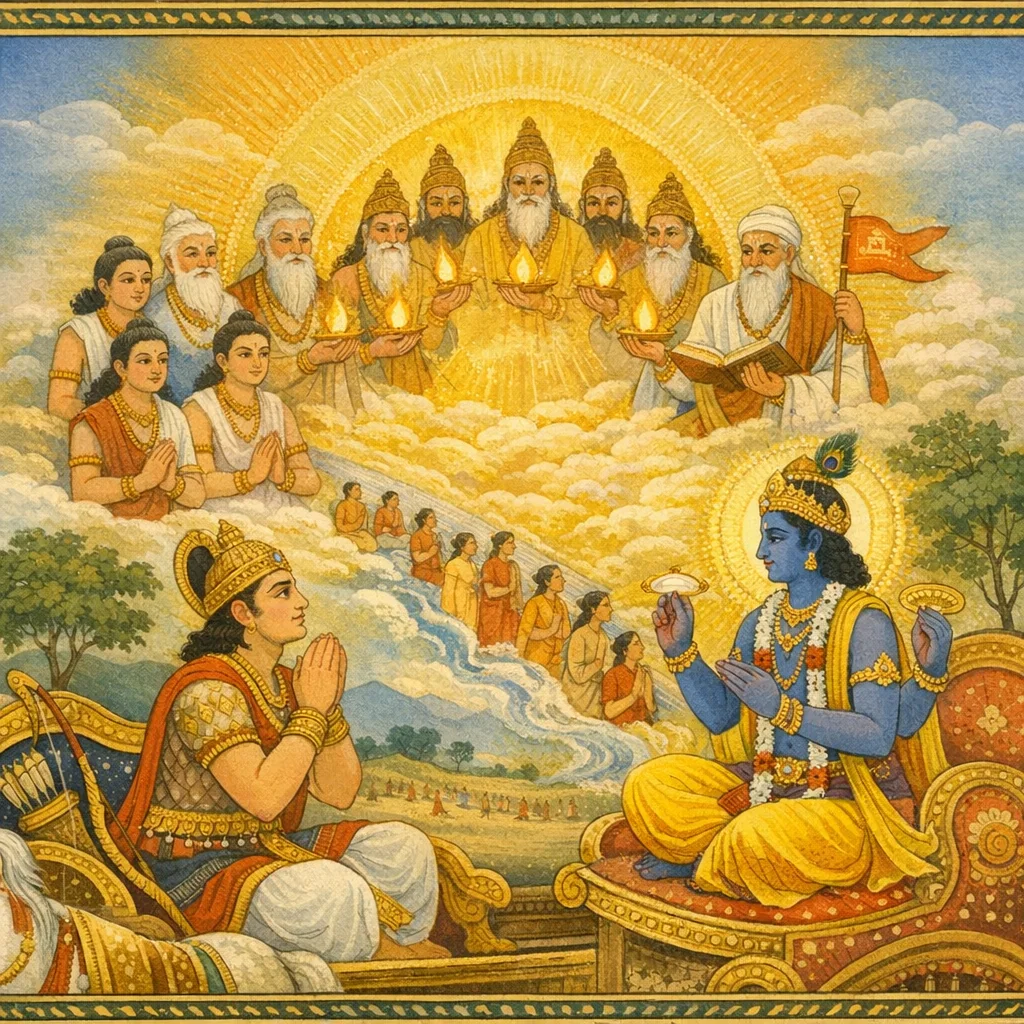
The seven great seers of old, and the four Manus likewise, were born of My mind, endowed with My nature; from them have sprung these creatures in the world.
The seven great seers of old and the four Manus likewise were born of My mind, endowed with My nature; from them these creatures in the world have sprung.
The seven ancient great seers and the four Manus likewise—arising mentally, constituted of My being—of whom these progenies in the world are (born).
The verse draws on Purāṇic/Vedic cosmological motifs: ‘seven seers’ (saptaṛṣi) and ‘Manus’ as archetypal progenitors. ‘mānasā jātāḥ’ (‘mind-born’) is a mythic idiom for non-physical origination, expressing derivation from divine intention/consciousness.
FAQs
The ‘mind-born’ motif can be read as emphasizing the primacy of consciousness and intention in shaping worlds—personally, it highlights how inner orientations generate outward life-patterns.
It depicts the cosmos as emerging from a supreme principle via archetypal intelligences (seers, Manus), expressing a layered creation where order and knowledge are foundational.
This verse grounds Krishna’s forthcoming ‘manifestations’ in a broader cosmological framework, presenting him as the source not only of qualities but also of cosmic progenitors.
As a symbolic reading, it can encourage respect for knowledge lineages and ethical frameworks (associated with seers and Manus) while recognizing their contingent historical forms.