
Bhagavad Gita — Vibhuti Yoga, Shloka 32
Vibhuti Yoga
सर्गाणामादिरन्तश्च मध्यं चैवाहमर्जुन । अध्यात्मविद्या विद्यानां वादः प्रवदतामहम् ॥ १०.३२ ॥
sargāṇām ādir antaś ca madhyaṃ caivāham arjuna | adhyātmavidyā vidyānāṃ vādaḥ pravadatām aham || 10.32 ||

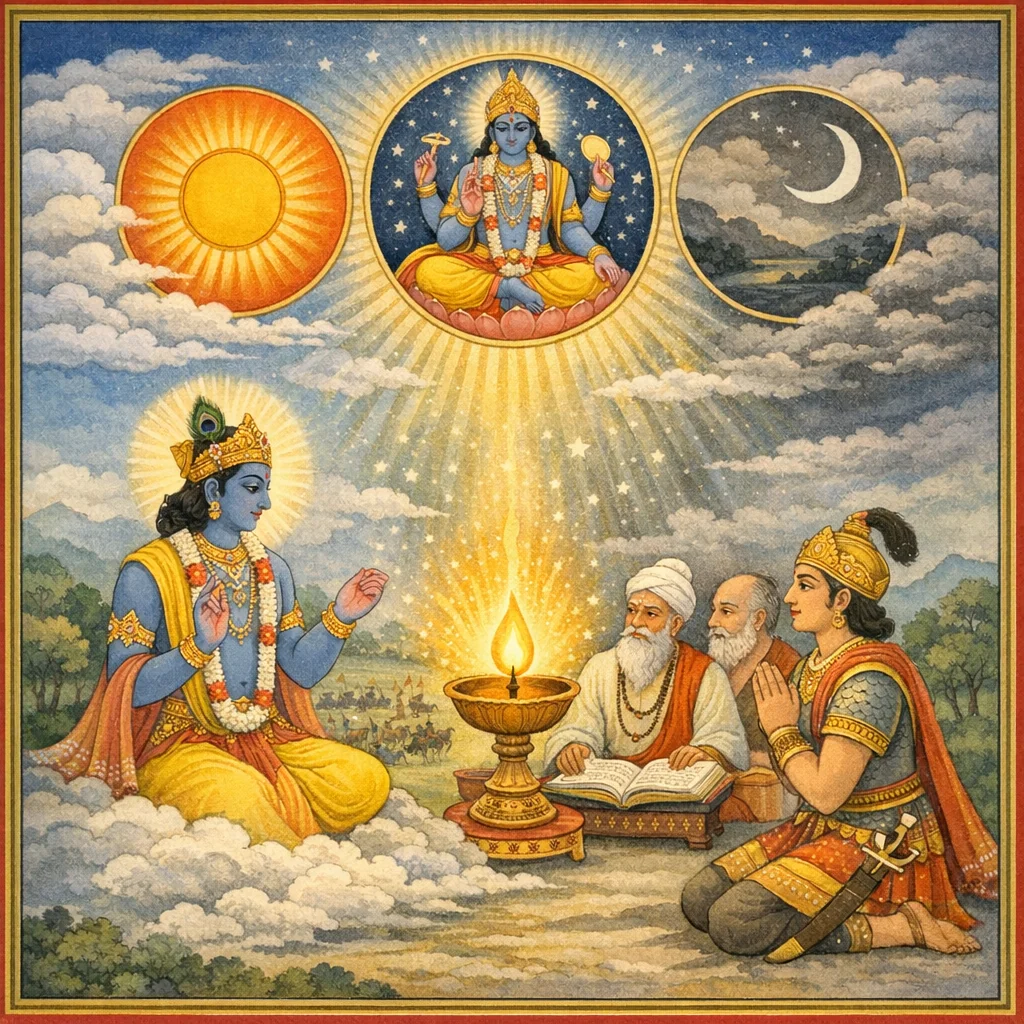
Of creations I am the beginning, the end, and also the middle, O Arjuna. Of knowledges I am the knowledge of the Self; among those who debate, I am true discourse.
Of creations I am the beginning, the end, and also the middle, O Arjuna. Of sciences I am the knowledge of the Self; among disputants I am fair debate.
Of emanations/creations I am the beginning, end, and middle. Among kinds of knowledge I am adhyātma-vidyā (knowledge concerning the self/spirit); among speakers I am vāda (reasoned discussion).
vāda is often contrasted with jalpa and vitaṇḍā in classical Indian logic: it suggests truth-oriented, rule-governed dialogue rather than eristic contention. adhyātma-vidyā may be rendered ‘spiritual psychology’ or ‘metaphysics of the self’ depending on framework.
FAQs
Placing self-knowledge above other knowledges highlights introspection as foundational for coherent action and well-being; vāda models constructive communication.
The divine is identified with the full arc of manifestation—origin, duration, and dissolution—suggesting a non-dual or panentheistic framing depending on interpretation.
This verse shifts from mythic exemplars to intellectual virtues, aligning the Vibhūti list with philosophical culture (adhyātma inquiry and disciplined debate).
It supports dialogue norms: argue to clarify truth, not to win; and treat reflective self-study as a central ‘discipline’ alongside external expertise.