
Bhagavad Gita — Purushottama Yoga, Shloka 6
Purushottama Yoga
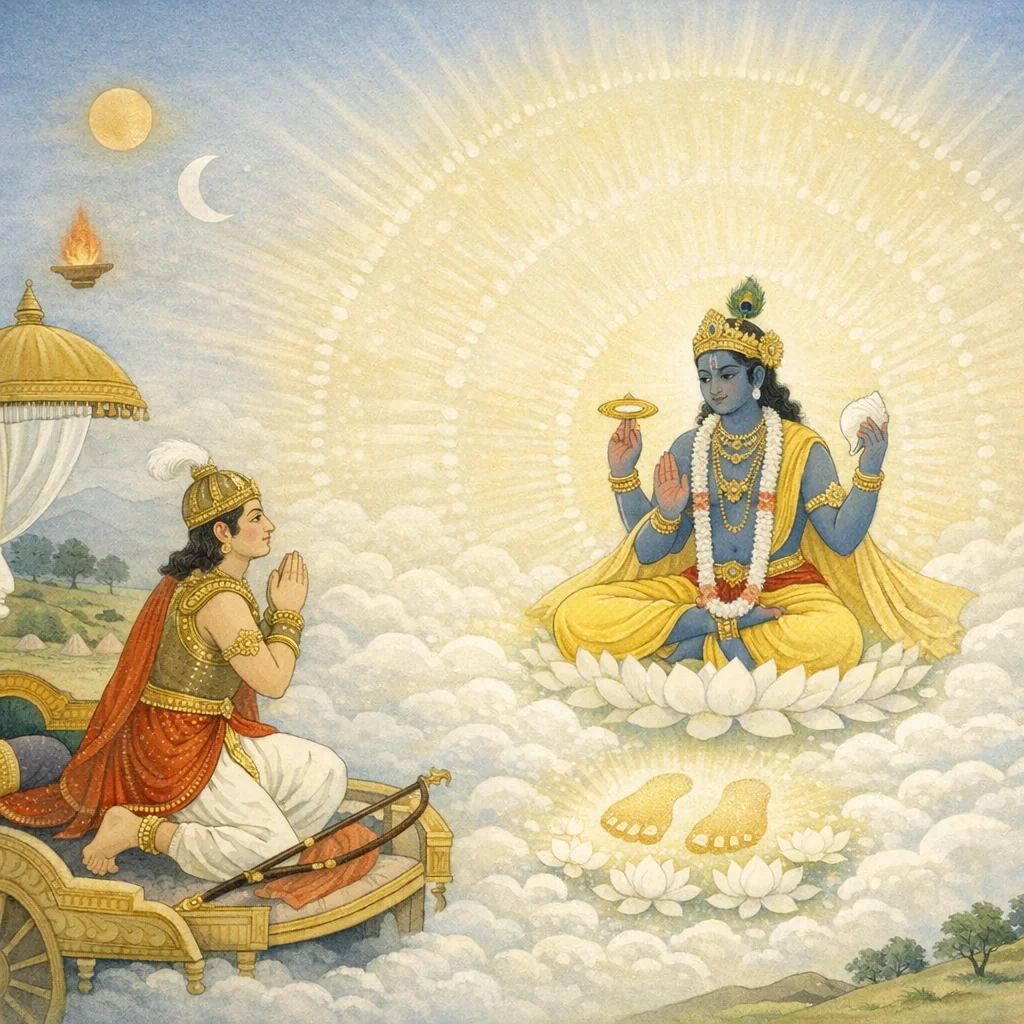
न तद्भासयते सूर्यो न शशाङ्को न पावकः । यद्गत्वा न निवर्तन्ते तद्धाम परमं मम ॥ १५.६ ॥
na tad bhāsayate sūryo na śaśāṅko na pāvakaḥ | yad gatvā na nivartante tad dhāma paramaṁ mama || 15.6 ||

That Supreme Abode of Mine is not illumined by the sun, nor by the moon, nor by fire. Having gone there, none return again; that is My highest dwelling-place.
उस (परम) धाम को न सूर्य प्रकाशित करता है, न चन्द्रमा और न अग्नि। जिसे प्राप्त होकर मनुष्य फिर लौटकर नहीं आते, वह मेरा परम धाम है।
That (abode) is not illumined by the sun, nor by the moon, nor by fire. Having gone there, they do not return; that is my supreme abode.
Across common recensions, the verse is textually stable. Interpretive differences mainly concern what “my supreme abode” (tad dhāma paramaṁ mama) denotes: in devotional (Vaiṣṇava) readings it is a personal divine realm; in more philosophical/Upaniṣadic readings it can indicate a transcendent state beyond sensory illumination and cyclic return. The phrase “do not return” is often glossed as liberation from saṁsāra rather than spatial travel.
FAQs
The imagery of a realm not lit by sun, moon, or fire can be read as pointing to a mode of awareness not dependent on external stimuli. Psychologically, it suggests an inwardly grounded clarity—stability that is not contingent on changing conditions—and the cessation of repetitive cycles of craving and dissatisfaction symbolized by “returning.”
Metaphysically, the verse describes an ultimate principle or state beyond physical illumination and change. “Not illumined” indicates that it is self-sufficient and not an object among objects; “having gone there, they do not return” indicates release from saṁsāra (the cycle of rebirth and limitation). The final clause identifies this as Krishna’s “supreme abode,” which traditions interpret either as a transcendent divine realm or as the highest reality realized in liberation.
Chapter 15 frames existence through the metaphor of the aśvattha (world-tree) and distinguishes the perishable, imperishable, and the supreme person (puruṣottama). Verse 15.6 functions as a description of the ultimate destination associated with realizing the supreme—contrasting the changing world with a final, non-returning attainment.
In contemporary terms, the verse can be used to reflect on goals that are not merely external achievements. It encourages practices and values aimed at durable well-being—such as ethical discipline, contemplative attention, and reduction of compulsive reactivity—interpreting “non-return” as freedom from recurring destructive patterns and persistent inner unrest.