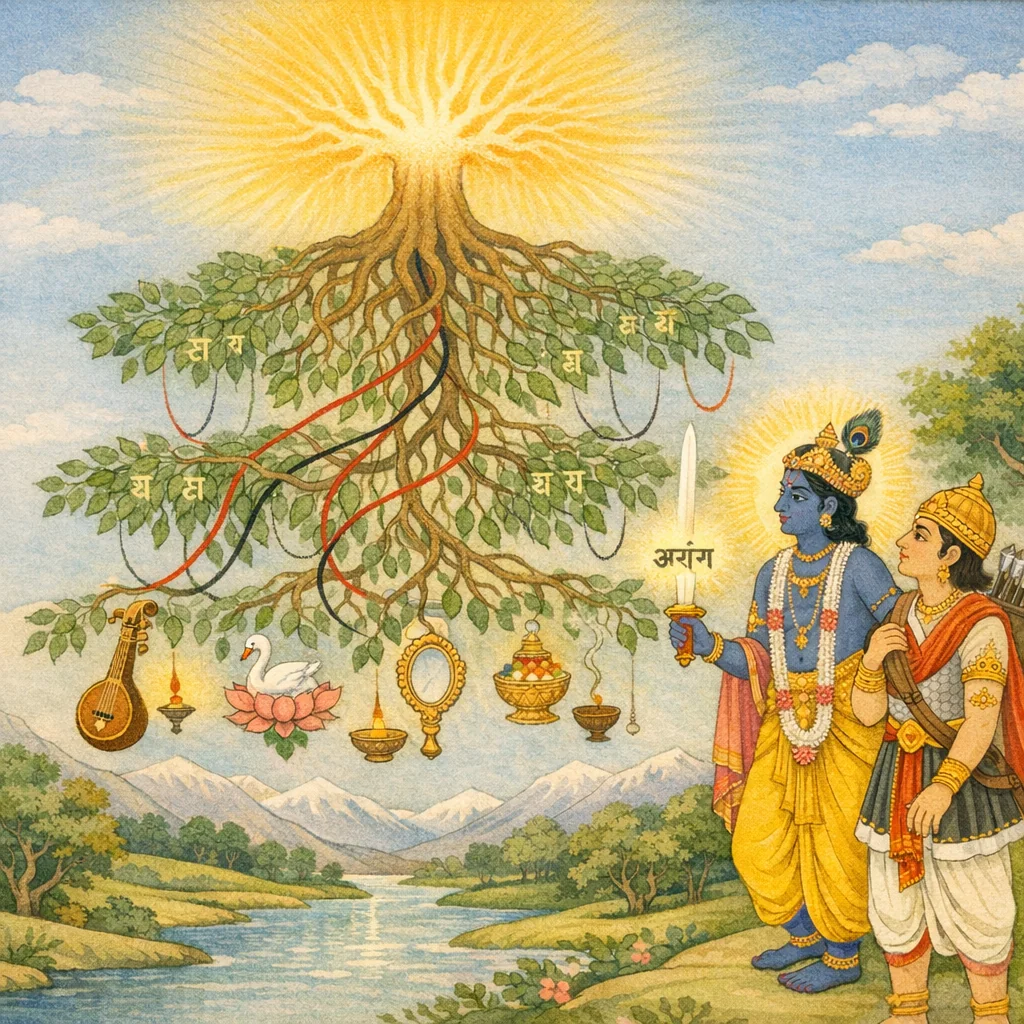
Chapter 15: Purushottama Yoga
पुरुषोत्तमयोग
The Yoga of the Supreme Person
Chapter 15 presents a compact metaphysical inquiry into bondage and liberation through the emblem of the imperishable aśvattha (the inverted cosmic tree). The seeker is guided from a condition of entanglement—where consciousness is dispersed through sense-objects and karma-linked roots—toward discernment (viveka) and renunciation (asaṅga) as the practical means of release. The chapter maps embodiment as the jīva’s participation in prakṛti via mind and the six senses, explaining how the Lord’s presence underwrites perception, nourishment, digestion, memory, knowledge, and even the power of forgetting. It then distinguishes the perishable (kṣara) field of beings from the imperishable (akṣara) witness, culminating in the revelation of the Purushottama: the Supreme Person who transcends both and sustains the three worlds. The ethical resolution offered is epistemic and devotional: know the Purushottama without delusion and orient the whole personality toward that highest refuge, described as the non-returning abode beyond sun, moon, and fire.
Speakers
Key Concepts
Philosophical Constructs
Shlokas in Chapter 15
Verse 1
श्रीभगवानुवाच । ऊर्ध्वमूलमधःशाखमश्वत्थं प्राहुरव्ययम् । छन्दांसि यस्य पर्णानि यस्तं वेद स वेदवित् ॥ १५.१ ॥
The Blessed Lord said: They speak of an imperishable aśvattha tree, with its root above and its branches below; the Vedic hymns are its leaves. He who knows that (tree) is a knower of the Vedas.
Verse 2
अधश्चोर्ध्वं प्रसृतास्तस्य शाखा गुणप्रवृद्धा विषयप्रवालाः । अधश्च मूलान्यनुसंततानि कर्मानुबन्धीनि...
Its branches spread both downward and upward, nourished by the guṇas; the sense-objects are its tender shoots. And its roots extend downward as well, binding human beings through karma.
Verse 3
न रूपमस्येह तथोपलभ्यते नान्तो न चादिर्न च संप्रतिष्ठा । अश्वत्थमेनं सुविरूढमूल- मसङ्गशस्त्रेण दृढेन छित्त्वा ॥
Here its true form is not perceived—neither its end, nor its beginning, nor its firm foundation. Having cut down this aśvattha, deeply rooted, with the strong weapon of non-attachment…
Verse 4
ततः पदं तत्परिमार्गितव्यं यस्मिन्गता न निवर्तन्ति भूयः । तमेव चाद्यं पुरुषं प्रपद्ये यतः प्रवृत्तिः प्रसृता पुराणी ॥
Then that abode should be sought, having gone where none return again; taking refuge in that primal Person alone, from whom this ancient stream of activity has flowed forth.
Verse 5
निर्मानमोहा जितसङ्गदोषा अध्यात्मनित्या विनिवृत्तकामाः । द्वन्द्वैर्विमुक्ताः सुखदुःखसंज्ञैर्गच्छन्त्यमूढाः पदमव्ययं तत् ॥१५.५॥
Free from pride and delusion, having conquered the fault of attachment, ever abiding in the Self, with desires stilled, and liberated from the pairs of opposites called pleasure and pain—such undeluded ones reach that imperishable state.
Verse 6
न तद्भासयते सूर्यो न शशाङ्को न पावकः । यद्गत्वा न निवर्तन्ते तद्धाम परमं मम ॥ १५.६ ॥
That Supreme Abode of Mine is not illumined by the sun, nor by the moon, nor by fire. Having gone there, none return again; that is My highest dwelling-place.
Verse 7
ममैवांशो जीवलोके जीवभूतः सनातनः । मनःषष्ठानीन्द्रियाणि प्रकृतिस्थानि कर्षति ॥ १५.७ ॥
The eternal individual soul in the world of living beings is verily a part of Mine. Abiding in Prakṛti, it draws to itself the senses, with the mind as the sixth.
Verse 8
शरीरं यदवाप्नोति यच्चाप्युत्क्रामतीश्वरः । गृहित्वैतानि संयाति वायुर्गन्धानिवाशयात् ॥ १५.८ ॥
When the Lord (the indwelling soul) obtains a body, and when He departs from it, He takes these (mind and senses) and goes, as the wind carries fragrances from their abode.
Verse 9
श्रोत्रं चक्षुः स्पर्शनं च रसनं घ्राणमेव च । अधिष्ठाय मनश्चायं विषयानुपसेवते ॥ १५.९ ॥
Presiding over the ear, the eye, the sense of touch, the tongue, and the nose—and also the mind—this (soul) experiences the objects of the senses.
Verse 10
उत्क्रामन्तं स्थितं वापि भुञ्जानं वा गुणान्वितम् । विमूढा नानुपश्यन्ति पश्यन्ति ज्ञानचक्षुषः ॥ १५.१० ॥
The deluded do not perceive Him as He departs, as He abides, or as He enjoys (the objects) endowed with the guṇas; but those with the eye of knowledge behold Him.
Verse 11
यतन्तो योगिनश्चैनं पश्यन्त्यात्मन्यवस्थितम् । यतन्तोऽप्यकृतात्मानो नैनं पश्यन्त्यचेतसः ॥ १५.११ ॥
Striving, the yogins behold Him established within the Self; but the unpurified in heart, though striving, do not behold Him—being devoid of true discernment.
Verse 12
यदादित्यगतं तेजो जगद्भासयतेऽखिलम् । यच्चन्द्रमसि यच्चाग्नौ तत्तेजो विद्धि मामकम् ॥ १५.१२ ॥
That radiance which, abiding in the sun, illumines the whole world, and that which is in the moon and in fire—know that radiance to be Mine.
Verse 13
गामाविश्य च भूतानि धारयाम्यहमोजसा । पुष्णामि चौषधीः सर्वाः सोमो भूत्वा रसात्मकः ॥ १५.१३ ॥
Entering the earth, I sustain all beings by My power; and becoming Soma, of the nature of sap, I nourish all plants and herbs.
Verse 14
अहं वैश्वानरो भूत्वा प्राणिनां देहमाश्रितः । प्राणापानसमायुक्तः पचाम्यन्नं चतुर्विधम् ॥ १५.१४ ॥
Becoming the Vaiśvānara fire and abiding in the bodies of beings, united with prāṇa and apāna, I digest the fourfold food.
Verse 15
सर्वस्य चाहं हृदि संनिविष्टो मत्तः स्मृतिर्ज्ञानमपोहनं च । वेदैश्च सर्वैरहमेव वेद्यो वेदान्तकृद्वेदविदेव चाहम् ॥ १५.१५ ॥
I am seated in the heart of all; from Me arise memory, knowledge, and their loss. By all the Vedas I alone am to be known; I am the author of Vedānta and the knower of the Vedas as well.
Verse 16
द्वाविमौ पुरुषौ लोके क्षरश्चाक्षर एव च । क्षरः सर्वाणि भूतानि कूटस्थोऽक्षर उच्यते ॥ १५.१६ ॥
In this world there are two kinds of puruṣas: the perishable (kṣara) and the imperishable (akṣara). All beings are called perishable; the immutable, abiding Self is called imperishable.
Verse 17
उत्तमः पुरुषस्त्वन्यः परमात्मेत्युदाहृतः । यो लोकत्रयमाविश्य बिभर्त्यव्यय ईश्वरः ॥ १५.१७ ॥
But distinct from these two is the Supreme Puruṣa, proclaimed as the Paramātman—He who, pervading the three worlds, sustains them as the imperishable Lord.
Verse 18
यस्मात्क्षरमतीतोऽहमक्षरादपि चोत्तमः । अतोऽस्मि लोके वेदे च प्रथितः पुरुषोत्तमः ॥ १५.१८ ॥
Since I transcend the perishable and am even higher than the imperishable, therefore in the world and in the Veda I am renowned as Puruṣottama.
Verse 19
यो मामेवमसंमूढो जानाति पुरुषोत्तमम् । स सर्वविद्भजति मां सर्वभावेन भारत ॥ १५.१९ ॥
He who, undeluded, thus knows Me as Puruṣottama—he is the knower of all; he worships Me with his whole being, O Bhārata.
Verse 20
इति गुह्यतमं शास्त्रमिदमुक्तं मयानघ । एतद्बुद्ध्वा बुद्धिमान्स्यात्कृतकृत्यश्च भारत ॥ १५.२० ॥
Thus this most secret teaching has been spoken by Me, O sinless one. Knowing this, one becomes truly wise and fulfilled in purpose, O Bhārata.
Frequently Asked Questions
It reframes mental distress as a problem of dispersion into sense-objects and habitual karma-patterns, prescribing asaṅga (non-attachment) and steady inward discernment as the method for restoring clarity and direction.
The chapter distinguishes the perishable domain (kṣara) from the imperishable principle (akṣara) and reveals Purushottama—the Supreme Person—who transcends both while sustaining all existence and illuminating cognition from within.
By providing a clear ontology and a practicable soteriological path: cut the binding tree of entanglement with detachment, seek the non-returning abode, and stabilize life-choices through knowledge of and devotion to Purushottama.
Use the aśvattha model to audit what feeds attention (inputs), reduce compulsive engagement (asaṅga), and anchor decisions in a stable purpose beyond short-term stimulation—supporting leadership, stress management, and ethical consistency.