
Bhagavad Gita — Karma Sannyasa Yoga, Shloka 3
Karma Sannyasa Yoga
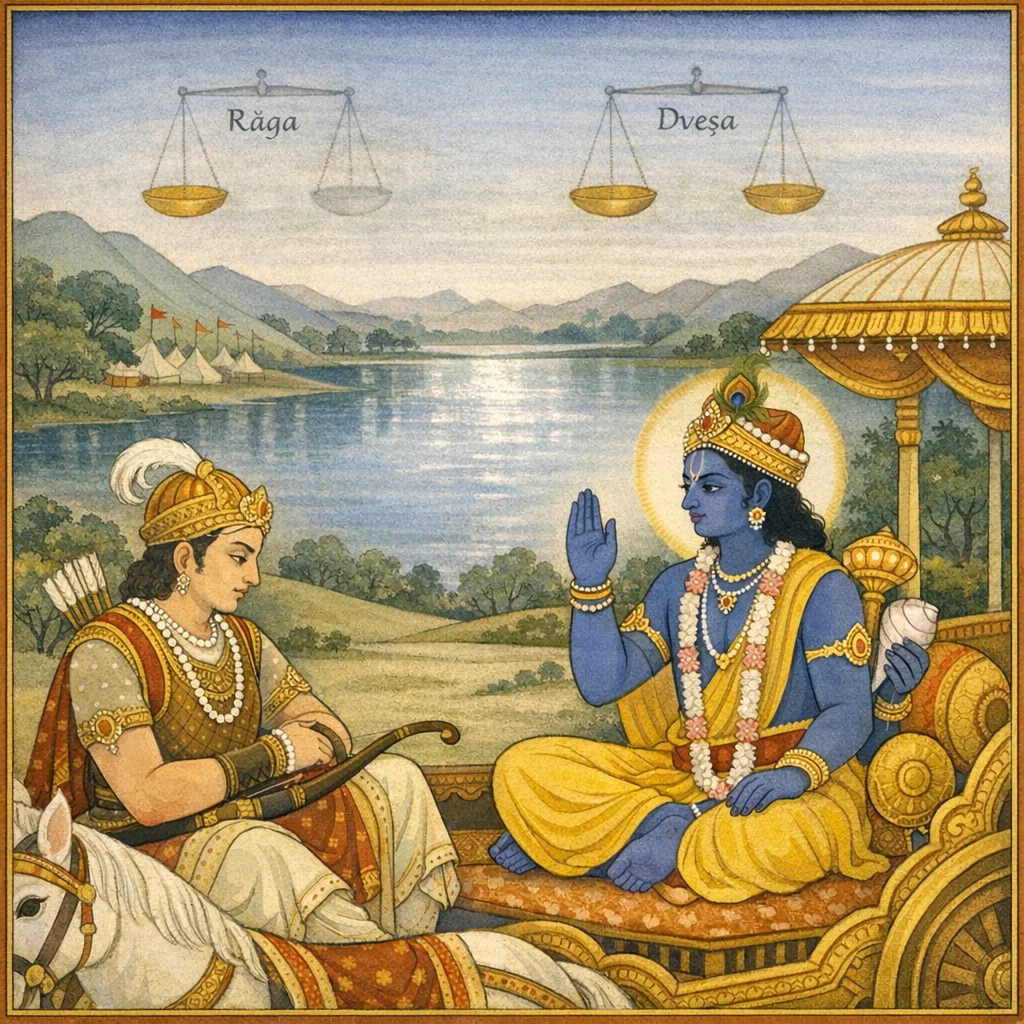
ज्ञेयः स नित्यसंन्यासी यो न द्वेष्टि न काङ्क्षति । निर्द्वन्द्वो हि महाबाहो सुखं बन्धात्प्रमुच्यते ॥ ५.३ ॥
jñeyaḥ sa nityasaṁnyāsī yo na dveṣṭi na kāṅkṣati | nirdvandvo hi mahābāho sukhaṁ bandhāt pramucyate || 5.3 ||

He should be known as a perpetual renunciant who neither hates nor desires; for, free from the pairs of opposites, O mighty-armed, he is easily released from bondage.
He should be known as a perpetual renunciant who neither hates nor desires; for free from pairs of opposites, O mighty-armed, he is easily released from bondage.
Know that person to be a constant renunciant who neither resents nor craves. Free from dualities, O Mahābāhu, one is happily liberated from bondage.
This reframes saṁnyāsa as an inner condition (absence of aversion and craving) rather than merely an external social status. 'Sukham' is often read as 'without difficulty' or 'with ease'.
FAQs
The verse identifies craving and aversion as drivers of stress and compulsive behavior. Reducing these reactions cultivates emotional balance and greater autonomy.
Bondage is sustained by attachments and repulsions rooted in misidentification. Inner renunciation loosens this mechanism, preparing for stable knowledge of the Self.
Krishna clarifies that renunciation is compatible with action: one can be a 'constant renunciant' by transforming one’s inner motivations.
It can be practiced as non-reactivity: notice impulses of dislike or grasping, pause, and act from considered values rather than immediate emotional swings.