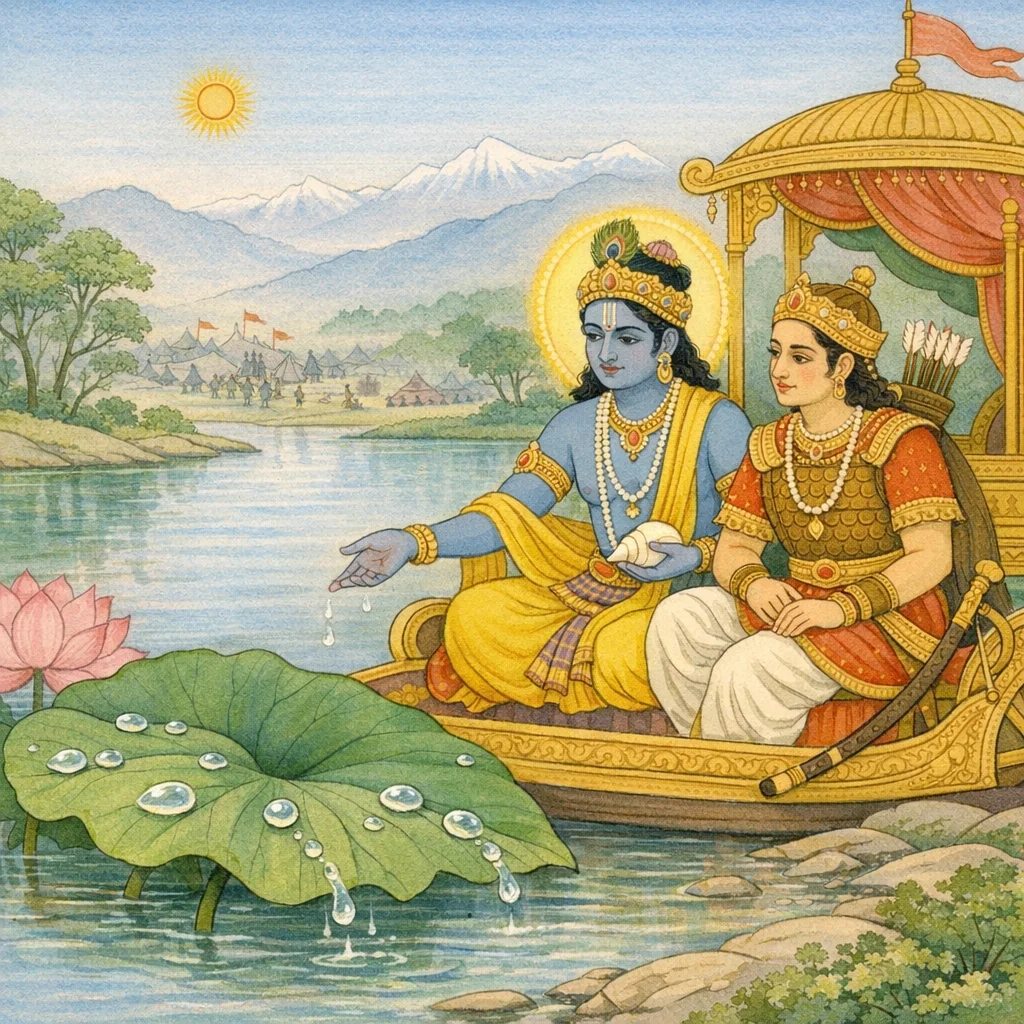
Chapter 5: Karma Sannyasa Yoga
कर्मसंन्यासयोग
The Yoga of Renunciation
Chapter 5 advances a soteriological clarification: whether inner freedom is better attained through formal renunciation (saṁnyāsa) or through disciplined action (karma-yoga). Arjuna’s mind seeks a single, certain path, sensing an apparent tension between withdrawal from works and engagement in duty. Krishna resolves the dilemma by presenting both as capable of leading to the highest good, while emphasizing karma-yoga as more practicable when performed without attachment and with a purified inner instrument. The chapter builds an ethical framework of non-doership, explaining that action belongs to nature (svabhāva) and the senses, while the liberated knower remains untainted like a lotus leaf in water. It then develops the phenomenology of equanimity: the wise see the same Self in all beings and remain steady amid pleasant and unpleasant encounters. The arc culminates in brahma-nirvāṇa—peace grounded in self-mastery, desire-quieting, meditative regulation, and recognition of the Divine as the beneficent Lord of all worlds.
Speakers
Key Concepts
Philosophical Constructs
Shlokas in Chapter 5
Verse 1
अर्जुन उवाच । संन्यासं कर्मणां कृष्ण पुनर्योगं च शंससि यच्छ्रेय एतयोरेकं तन्मे ब्रूहि सुनिश्चितम् ॥ ५.१ ॥
Arjuna said: O Krishna, you praise renunciation of actions and also yoga; tell me with certainty which one of the two is the better.
Verse 2
श्रीभगवानुवाच । संन्यासः कर्मयोगश्च निःश्रेयसकरावुभौ तयोस्तु कर्मसंन्यासात्कर्मयोगो विशिष्यते ॥ ५.२ ॥
The Blessed Lord said: Both renunciation and karma-yoga lead to the highest good; yet, among them, karma-yoga excels over renunciation of action.
Verse 3
ज्ञेयः स नित्यसंन्यासी यो न द्वेष्टि न काङ्क्षति । निर्द्वन्द्वो हि महाबाहो सुखं बन्धात्प्रमुच्यते ॥ ५.३ ॥
He should be known as a perpetual renunciant who neither hates nor desires; for, free from the pairs of opposites, O mighty-armed, he is easily released from bondage.
Verse 4
सांख्ययोगौ पृथग्बालाः प्रवदन्ति न पण्डिताः । एकमप्यास्थितः सम्यगुभयोर्विन्दते फलम् ॥ ५.४ ॥
The childish speak of Sāṅkhya and Yoga as separate; the wise do not. Even by rightly abiding in one, one attains the fruit of both.
Verse 5
यत्सांख्यैः प्राप्यते स्थानं तद्योगैरपि गम्यते । एकं सांख्यं च योगं च यः पश्यति स: पश्यति ॥ ५.५ ॥
The state attained by the Sāṅkhyas is also reached by the yogins. He who sees Sāṅkhya and Yoga as one—he truly sees.
Verse 6
संन्यासस्तु महाबाहो दुःखमाप्तुमयोगतः । योगयुक्तो मुनिर्ब्रह्म नचिरेणाधिगच्छति ॥ ५.६ ॥
But renunciation, O mighty-armed, is hard to attain without Yoga. The sage united with Yoga quickly attains Brahman.
Verse 7
योगयुक्तो विशुद्धात्मा विजितात्मा जितेन्द्रियः । सर्वभूतात्मभूतात्मा कुर्वन्नपि न लिप्यते ॥ ५.७ ॥
The yogin, with purified inner being, self-mastered, senses conquered, whose Self has become the Self of all beings—though acting, he is not tainted.
Verse 8
नैव किंचित्करोमीति युक्तो मन्येत तत्त्ववित् । पश्यञ्श्रृण्वन्स्पृशञ्जिघ्रन्नश्नन्गच्छन्स्वपन्... प्रलपन्विसृजन्गृह्णन्नुन्मिषन्निमिषन्नपि । इन्द्रियाणीन्द्रियार्थेषु वर्तन्त इति धारयन् ॥ ५.९ ॥
The disciplined knower of Truth should think, “I do nothing at all.” While seeing, hearing, touching, smelling, eating, walking, sleeping; while speaking, letting go, grasping, and even opening and closing the eyes—he holds firmly to the understanding that the senses alone move among the objects of the senses.
Verse 9
ब्रह्मण्याधाय कर्माणि सङ्गं त्यक्त्वा करोति यः । लिप्यते न स पापेन पद्मपत्रमिवाम्भसा ॥ ५.१० ॥
He who performs actions, placing them in Brahman and abandoning attachment, is not tainted by sin—just as a lotus leaf is not wetted by water.
Verse 10
कायेन मनसा बुद्ध्या केवलैरिन्द्रियैरपि । योगिनः कर्म कुर्वन्ति सङ्गं त्यक्त्वात्मशुद्धये ॥ ५.११ ॥
Yogins perform action with the body, mind, intellect, and even with the senses alone, abandoning attachment, for the purification of the self.
Verse 11
युक्तः कर्मफलं त्यक्त्वा शान्तिमाप्नोति नैष्ठिकीम् । अयुक्तः कामकारेण फले सक्तो निबध्यते ॥ ५.१२ ॥
The disciplined one, abandoning the fruit of action, attains steadfast peace; the undisciplined one, driven by desire, becomes bound—attached to the fruit.
Verse 12
सर्वकर्माणि मनसा संन्यस्यास्ते सुखं वशी । नवद्वारे पुरे देही नैव कुर्वन्न कारयन् ॥ ५.१३ ॥
Having renounced all actions by the mind, the self-controlled embodied being dwells happily in the city of nine gates, neither acting nor causing action.
Verse 13
न कर्तृत्वं न कर्माणि लोकस्य सृजति प्रभुः । न कर्मफलसंयोगं स्वभावस्तु प्रवर्तते ॥ ५.१४ ॥
The Lord neither creates the agency (doership) of beings, nor their actions, nor the conjunction with the fruits of action; it is one’s own nature (svabhāva) that sets all this in motion.
Verse 14
नादत्ते कस्यचित्पापं न चैव सुकृतं विभुः । अज्ञानेनावृतं ज्ञानं तेन मुह्यन्ति जन्तवः ॥ ५.१५ ॥
The all-pervading Lord takes upon Himself neither anyone’s sin nor anyone’s merit; knowledge is veiled by ignorance—thereby beings are deluded.
Verse 15
ज्ञानेन तु तदज्ञानं येषां नाशितमात्मनः । तेषामादित्यवज्ज्ञानं प्रकाशयति तत्परम् ॥ ५.१६ ॥
But for those whose ignorance has been destroyed by Self-knowledge, that knowledge—like the sun—reveals the Supreme Reality.
Verse 16
तद्बुद्धयस्तदात्मानस्तन्निष्ठास्तत्परायणा: । गच्छन्त्यपुनरावृत्तिं ज्ञाननिर्धूतकल्मषा: ॥ ५.१७ ॥
Those whose intellect is fixed in That, whose self is absorbed in That, who are steadfast in That, who take That as the supreme refuge—purified of sin by knowledge, they attain non-return (freedom from rebirth).
Verse 17
तद्बुद्धयस्तदात्मानस्तन्निष्ठास्तत्परायणा: | गच्छन्त्यपुनरावृत्तिं ज्ञाननिर्धूतकल्मषा:॥ ५.१७॥
Those whose intellect is fixed in That, whose self is absorbed in That, who are steadfast in That, who take That as the supreme goal—having their impurities washed away by knowledge, they attain the state of non-return.
Verse 18
विद्याविनयसंपन्ने ब्राह्मणे गवि हस्तिनि । शुनि चैव श्वपाके च पण्डिताः समदर्शिनः ॥ ५.१८ ॥
The wise behold with equal vision a brāhmaṇa endowed with learning and humility, a cow, an elephant, a dog, and even one who eats dog’s flesh (an outcaste).
Verse 19
इहैव तैर्जितः सर्गो येषां साम्ये स्थितं मनः । निर्दोषं हि समं ब्रह्म तस्माद्ब्रह्मणि ते स्थिताः ॥ ५.१९ ॥
Here itself, creation (the cycle of birth and death) is conquered by those whose mind abides in equality; for Brahman is flawless and equal—therefore they are established in Brahman.
Verse 20
न प्रहृष्येत्प्रियं प्राप्य नोद्विजेत्प्राप्य चाप्रियम् । स्थिरबुद्धिरसंमूढो ब्रह्मविद्ब्रह्मणि स्थितः ॥
Let one neither exult on attaining the pleasant nor be distressed on attaining the unpleasant; steady in understanding, unbewildered, the knower of Brahman remains established in Brahman.
Verse 21
बाह्यस्पर्शेष्वसक्तात्मा विन्दत्यात्मनि यत् सुखम् । स ब्रह्मयोगयुक्तात्मा सुखमक्षयमश्नुते ॥ ५.२१ ॥
With the self unattached to external contacts, one finds the bliss that is in the Self; united with Brahman through yoga, one attains imperishable bliss.
Verse 22
ये हि संस्पर्शजा भोगा दुःखयोनय एव ते । आद्यन्तवन्तः कौन्तेय न तेषु रमते बुधः ॥ ५.२२ ॥
For the enjoyments born of contact are indeed sources of sorrow; they have a beginning and an end, O son of Kuntī—therefore the wise do not delight in them.
Verse 23
शक्नोतीहैव यः सोढुं प्राक्शरीरविमोक्षणात् । कामक्रोधोद्भवं वेगं स युक्तः स सुखी नरः ॥ ५.२३ ॥
He who, while still in this very body—before the body is cast off—is able to endure the surge born of desire and anger, that person is yoked in Yoga; that person is a happy human being.
Verse 24
योऽन्तःसुखोऽन्तरारामस्तथान्तर्ज्योतिरेव यः । स योगी ब्रह्मनिर्वाणं ब्रह्मभूतोऽधिगच्छति ॥ ५.२४ ॥
One whose joy is within, whose delight is within, and whose light of knowledge is within—such a yogin, having become Brahman, attains Brahma-nirvāṇa (the supreme peace).
Verse 25
लभन्ते ब्रह्मनिर्वाणमृषयः क्षीणकल्मषाः । छिन्नद्वैधा यतात्मानः सर्वभूतहिते रताः ॥ ५.२५ ॥
The seers—whose impurities are worn away, whose doubts are cut asunder, who are self-controlled, and who delight in the welfare of all beings—attain Brahma-nirvāṇa.
Verse 26
कामक्रोधवियुक्तानां यतीनां यतचेतसाम् । अभितो ब्रह्मनिर्वाणं वर्तते विदितात्मनाम् ॥ ५.२६ ॥
For ascetics who are free from desire and anger, who are self-restrained and whose mind is controlled, and who have realized the Self—Brahma-nirvāṇa abides all around (ever-present).
Verse 27
स्पर्शान्कृत्वा बहिर्बाह्यांश्चक्षुश्चैवान्तरे भ्रुवोः । प्राणापानौ समौ कृत्वा नासाभ्यन्तरचारिणौ ॥
Having set aside external contacts—keeping the outer objects outside—fixing the gaze between the eyebrows, and making the in-breath and out-breath moving within the nostrils equal (he practices meditation-yoga).
Verse 28
यतेन्द्रियमनोबुद्धिर्मुनिर्मोक्षपरायणः । विगतेच्छाभयक्रोधो यः सदा मुक्त एव सः ॥ ५.२८ ॥
That sage whose senses, mind, and intellect are restrained, who is wholly devoted to liberation, and in whom desire, fear, and anger have vanished—he indeed is ever free.
Verse 29
भोक्तारं यज्ञतपसां सर्वलोकमहेश्वरम् । सुहृदं सर्वभूतानां ज्ञात्वा मां शान्तिमृच्छति ॥ ५.२९ ॥
Knowing Me as the enjoyer of sacrifices and austerities, the great Lord of all worlds, and the well-wisher of all beings, one attains peace.
Frequently Asked Questions
The chapter trains emotional steadiness by shifting identity from reactive outcomes to disciplined process: act without clinging to results, interpret experience as sense-activity within nature, and cultivate equanimity toward pleasant and unpleasant events.
A central metaphysical claim is akartṛtva (non-doership): action belongs to svabhāva and the senses, while the Self remains untouched. When ignorance is removed by knowledge, the same Brahman is recognized in all beings, grounding equal vision (sama-darśana).
Krishna reconciles the apparent conflict by stating that both renunciation and karma-yoga can lead to liberation, but karma-yoga is superior in practice when it purifies the mind through selfless action, enabling stable knowledge and inner freedom.
Use Chapter 5 as a work-and-leadership ethic: commit to high-quality action, detach from compulsive reward-seeking, regulate desire and anger, and practice brief inward resets (breath/attention). This supports clear decisions, reduced stress reactivity, and compassionate fairness through equal vision.