
Bhagavad Gita — Arjuna Vishada Yoga, Shloka 39
Arjuna Vishada Yoga
कुलक्षये प्रणश्यन्ति कुलधर्माः सनातनाः । धर्मे नष्टे कुलं कृत्स्नमधर्मोऽभिभवत्युत ॥ १.३९ ॥
kula-kṣaye praṇaśyanti kula-dharmāḥ sanātanāḥ | dharme naṣṭe kulaṃ kṛtsnam adharmaḥ abhibhavaty uta || 1.39 ||

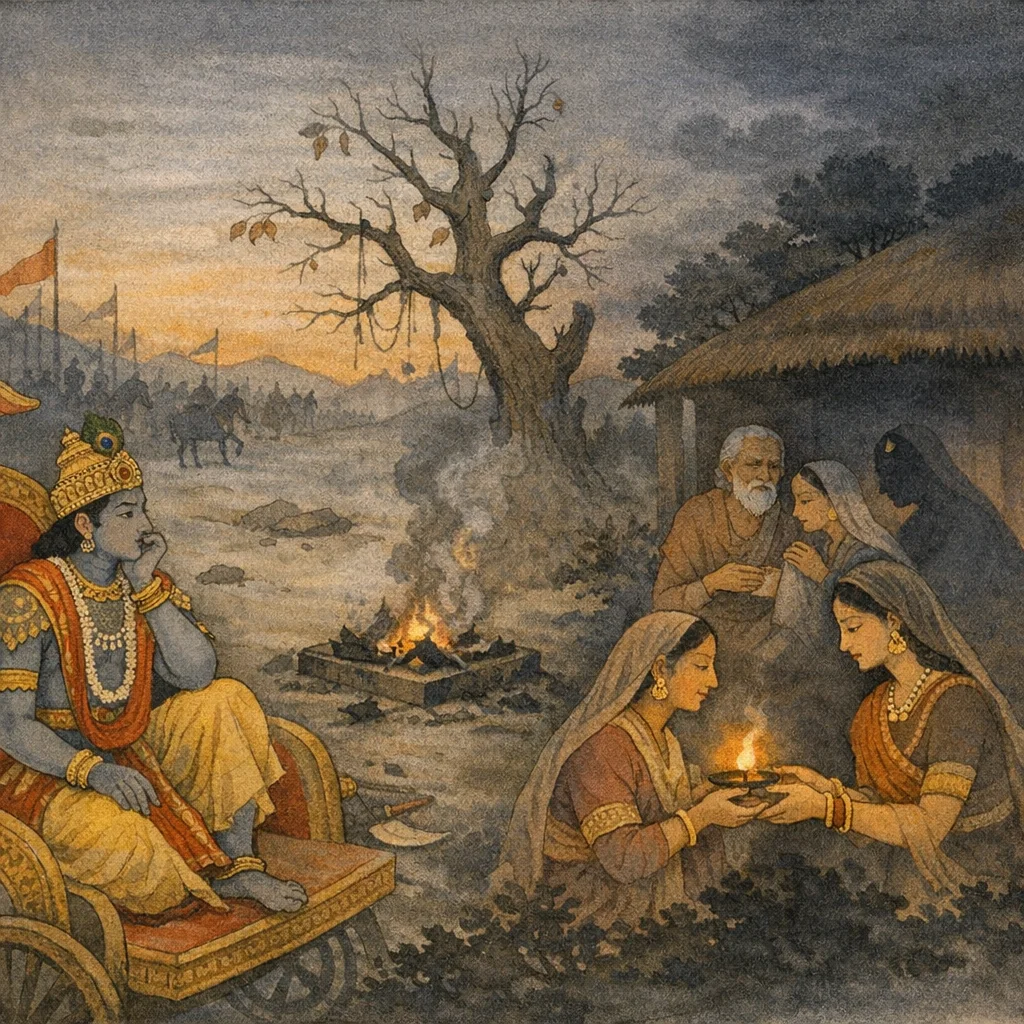
With the destruction of the family, the eternal duties of the family perish; when dharma is destroyed, adharma indeed overwhelms the entire family.
With the destruction of the family, the eternal family-duties perish; when dharma is destroyed, the whole family is overcome by adharma.
When the lineage is ruined, the long-established practices of the lineage perish; when dharma is lost, the entire family indeed is overpowered by adharma.
Kula-dharma refers to inherited rites, responsibilities, and norms. ‘Sanātana’ here indicates long-standing continuity rather than a metaphysical absolute.
FAQs
Arjuna’s fear is not only personal loss but institutional collapse: anxiety increases when one imagines a breakdown of shared norms that provide identity and stability.
Dharma is presented as sustaining order; later, the Gītā will broaden dharma beyond family customs toward a more universalized duty grounded in spiritual insight.
Arjuna argues that large-scale conflict risks disrupting the transmission of duties and practices that maintain familial and social order.
It can be read as a warning about how social breakdown—loss of trust, mentorship, and shared norms—can follow from sustained collective strife.