
Bhagavad Gita — Arjuna Vishada Yoga, Shloka 35
Arjuna Vishada Yoga
एतान्न हन्तुमिच्छामि घ्नतोऽपि मधुसूदन | अपि त्रैलोक्यराज्यस्य हेतो: किं नु महीकृते ॥ १.३५ ॥
etān na hantum icchāmi ghnato'pi madhusūdana | api trailokya-rājyasya hetoḥ kiṃ nu mahī-kṛte || 1.35 ||

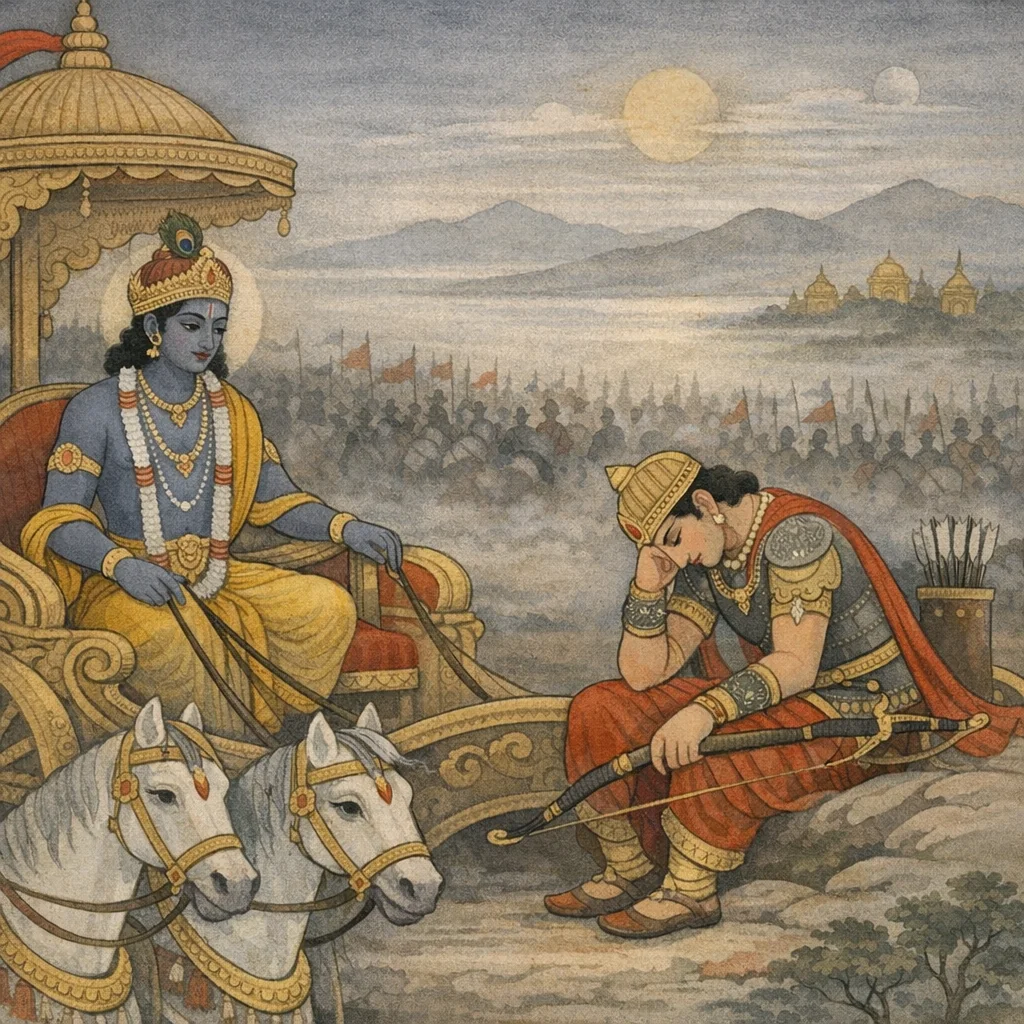
O Madhusūdana, I do not wish to slay these—even if they slay us—not even for the sake of sovereignty over the three worlds; how much less for the earth alone.
O Madhusūdana, I do not wish to strike these—even if they strike (us)—not even for the sake of sovereignty over the three worlds; how much less for the earth (alone).
I do not wish to harm these, O Madhusūdana, even if they were to harm (us); even for the sake of dominion over the three worlds—how much less for the sake of the earth.
‘Three worlds’ (trailokya) is a conventional cosmological expression for maximal power; the contrast ‘how much less for earth’ strengthens Arjuna’s claim that no political gain can justify violating kinship bonds.
FAQs
Arjuna adopts a principled stance: even extreme incentives fail to motivate him, indicating a shift from strategic thinking to moral refusal under emotional strain.
The verse gestures toward renunciation of power as an ultimate aim, but remains grounded in personal attachment; later chapters reframe renunciation as inner non-attachment rather than mere withdrawal.
Arjuna emphasizes that no scale of reward—cosmic or terrestrial—can compensate for violating duties owed to revered and related persons.
It can be applied to ethical leadership: certain actions should not be justified by ‘big wins’ or grand outcomes if they violate core principles and relationships.