
Shloka 17
Karma Yoga — Karma Yoga
यस्त्वात्मरतिरेव स्यादात्मतृप्तश्च मानवः । आत्मन्येव च सन्तुष्टस्तस्य कार्यं न विद्यते ॥ ३.१७ ॥
yas tv ātma-ratir eva syād ātma-tṛptaś ca mānavaḥ | ātmany eva ca santuṣṭas tasya kāryaṁ na vidyate || 3.17 ||

然而,若有人唯以自我(Ātman)为乐,以自我为满足,并安住于自我之中而知足——此人无所当作。
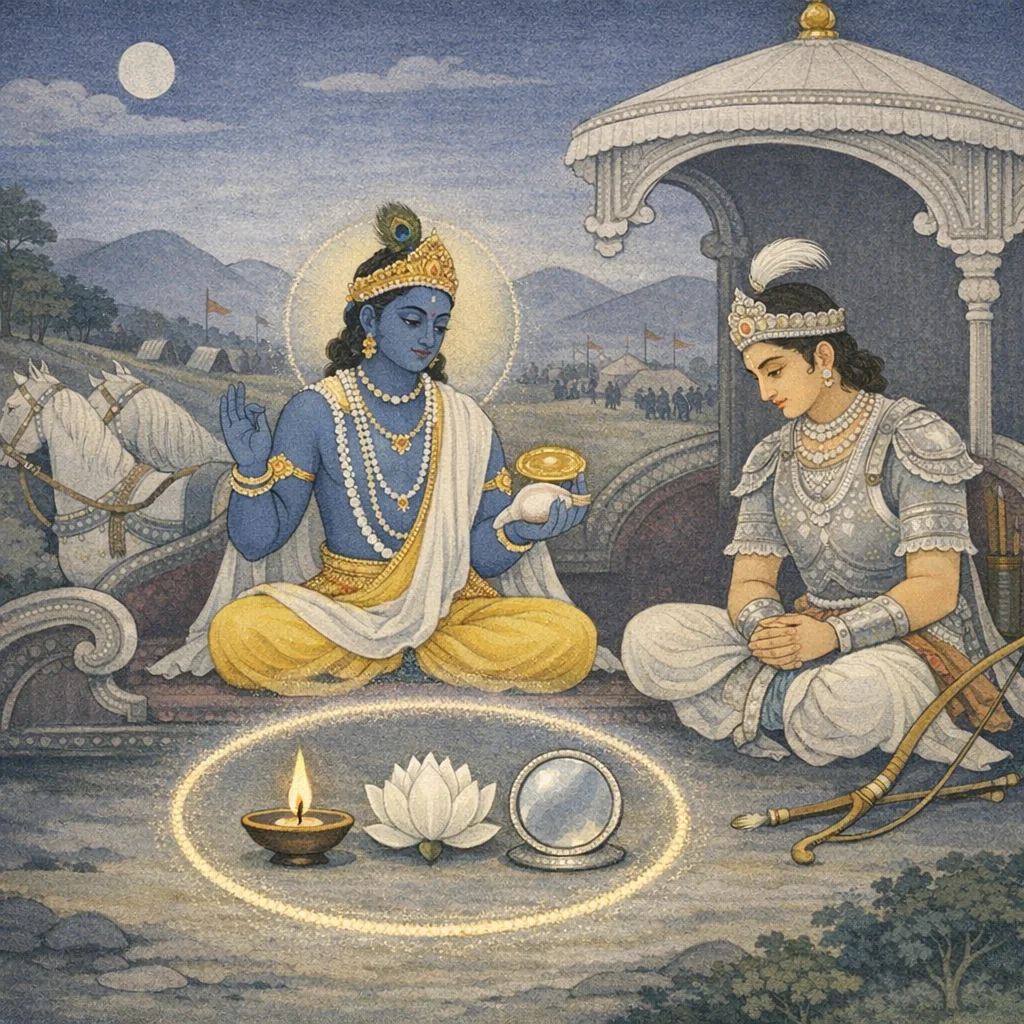
But the person who rejoices in the Self alone, is satisfied with the Self, and is content in the Self—he has no duty to perform.
For the human being who delights only in the self, is fulfilled by the self, and is content in the self, there is no obligatory task.
Traditional commentators often restrict this to the realized knower (jñānī) for whom social obligation no longer binds. Academic readings note the rhetorical function: Krishna distinguishes ordinary agents (who must follow the ‘cycle’) from the rare ideal of self-sufficiency, while still later recommending action for exemplarity (3.20–21).
FAQs
It depicts a stable well-being not dependent on external rewards, suggesting an advanced form of intrinsic satisfaction and reduced reactivity.
The ‘Self’ here functions as the locus of completeness: when fulfillment is grounded in ātman, action is no longer driven by lack or desire.
Krishna anticipates an objection—if knowledge frees, why act?—and answers by describing the exceptional case of the fully contented person.
It can be read as a model of psychological autonomy: cultivate inner stability so that duties are performed from clarity rather than compulsion.