Adhyaya 10
Ādi Parva, Adhyāya 10: Ruru’s Vow and Ḍuṇḍubha’s Appeal (रुरोः प्रतिज्ञा—डुण्डुभोपदेशः)
Upa-parva: Pauloma Parva (Ruru–Pramadvarā Episode)
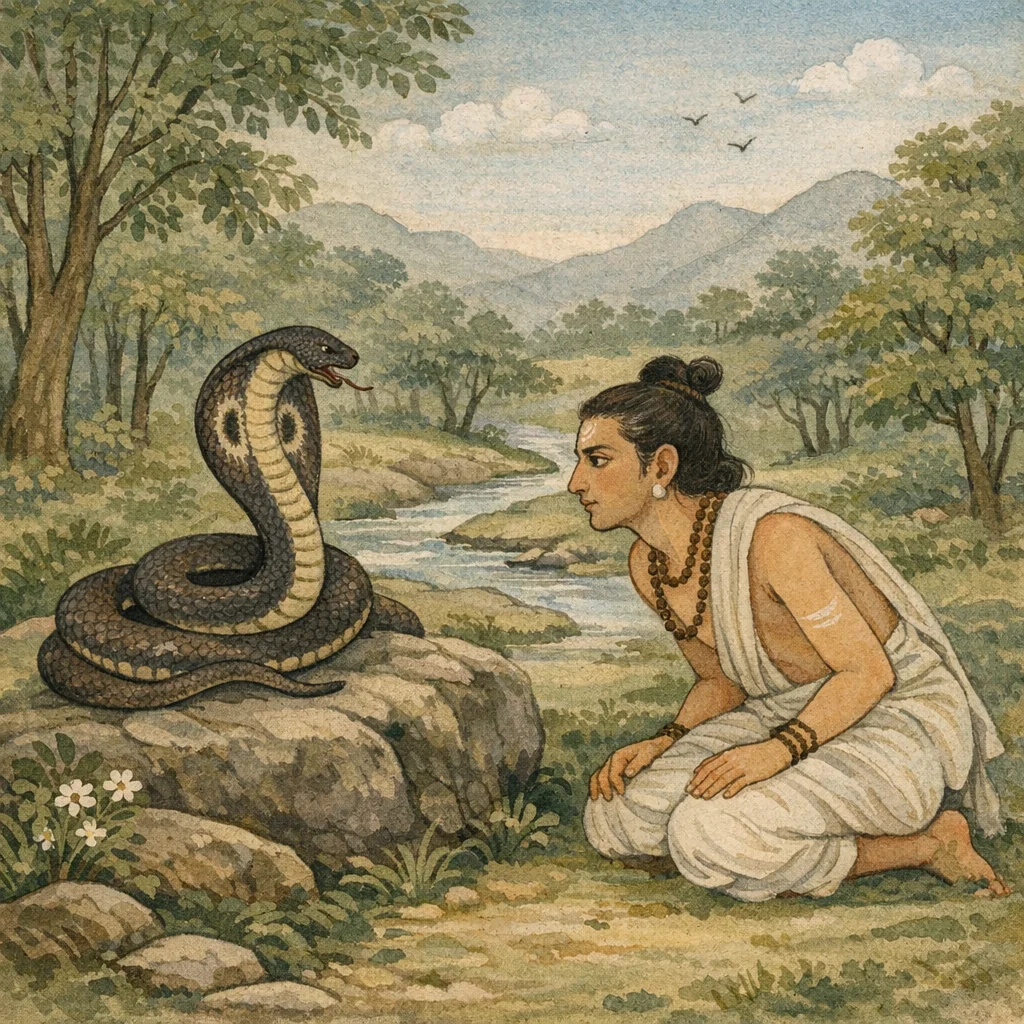
This chapter presents a dialogue structured around grief, retributive intention, and ethical correction. Ruru states that his wife—described as dear as his own life—was bitten by a serpent, leading him to adopt a severe resolution: he will kill any serpent he sees. He then attempts to kill the serpent before him, declaring that the serpent may escape only by surrendering its life. The serpent, identifying itself as Ḍuṇḍubha, responds with a dharma-based argument: other serpents may be responsible for biting humans, but Ḍuṇḍubha is not to be harmed merely due to ‘snake-odor’ or appearance; harms and benefits are not uniform across individuals. The narrator (Sūta) notes that Ruru, alarmed, refrains—mistaking Ḍuṇḍubha for a ṛṣi. Ruru then questions the serpent’s unusual condition, and Ḍuṇḍubha reveals a prior identity as a ṛṣi named Ruru, transformed into a serpent through a brāhmaṇa’s curse. The chapter closes with Ruru asking the cause and duration of the curse, setting up further ethical and causal exposition.
Chapter Arc: Promadvara’s near-loss has turned Ruru into a vow-bound avenger: wherever he sees a serpent, he strikes—his grief sharpened into a single, dangerous purpose. → Ruru encounters a serpent named Dundubha and, true to his vow, rushes to kill it. The serpent speaks—calm, reasoned, and unsettling—warning him that not every snake is guilty, and that blind retaliation itself becomes adharma. → Dundubha reveals a startling truth: he is no ordinary serpent but the cursed rishi Sahasrapad, fallen into snake-form by a brahmin’s imprecation. The intended victim becomes a mirror, forcing Ruru to confront the moral weight of his rage. → Hearing Dundubha’s words and sensing him to be an ascetic rather than a mere beast, Ruru restrains his hand and does not kill him. He questions Dundubha about the cause and term of the curse, shifting from violence to inquiry. → Ruru’s question hangs: why was Sahasrapad cursed, and how long must he endure this serpent-body before release?
Shlokas
Verse 1
(दाक्षिणात्य अधिक पाठका १ श्लोक मिलाकर कुल २४ श्लोक हैं) ऑपन---+र< बक। है २ दशमो<ध्याय: रुरु मुनि और डुण्डुभका संवाद रुस्स्वाच मम प्राणसमा भार्या दष्टासीद् भुजगेन ह | तत्र मे समयो घोर आत्मनोरग वै कृत:
Ruru nói: “Hỡi rắn! Vợ ta, người ta yêu quý như chính sinh mạng mình, đã bị một con rắn cắn. Ngay lúc ấy ta lập một lời thề ghê gớm: hễ thấy rắn nào, ta nhất định giết rắn ấy. Bị ràng buộc bởi lời thề đó, nay ta định giết ngươi; hôm nay ngươi phải bỏ mạng.”
Verse 2
भुजड़ूं वै सदा हन्यां यं यं पश्येयमित्युत । ततोऊहं त्वां जिघांसामि जीवितेनाद्य मोक्ष्यसे
“Quả thật, ta đã thề rằng hễ gặp con rắn nào thì sẽ giết con ấy. Vì vậy nay ta định giết ngươi; hôm nay ngươi sẽ bị lìa khỏi mạng sống.”
Verse 3
डुण्ड्रुभ उवाच अन््ये ते भुजगा ब्रह्मन् ये दशन्तीह मानवान् | डुण्डुभानहिगन्धेन न त्वं हिंसितुमहसि
Ḍuṇḍrubha nói: “Hỡi Bà-la-môn, những loài rắn cắn người trong cõi đời này là những loài rắn khác. Ngài chớ làm hại chúng ta, những ḍuṇḍubha, chỉ vì chúng ta mang mùi (hay dáng vẻ) giống rắn.”
Verse 4
रुरुके दर्शनसे सहस्रपाद ऋषिकी सर्पयोनिसे मुक्ति एकानर्थान् पृथगर्थनिकदुःखान् पृथक्सुखान् । डुण्डुभान् धर्मविद् भूत्वा न त्वं हिंसितुमहसि
Ḍuṇḍrubha nói: “Hỡi Ruru, tuy chúng ta cùng chung một kiếp sinh làm rắn, bị ràng buộc với nhau trong khổ đau và tai ương, nhưng bản tính mỗi loài lại khác; và hễ có chút hạnh phúc nào đến thì mỗi kẻ tự hưởng riêng. Ngài là người biết dharma, vậy chớ gây bạo lực với những ḍuṇḍubha. Thật lạ thay—chúng ta cùng chung hoạn nạn, mà chẳng chung niềm vui.”
Verse 5
सौतिर्वाच इति श्रुत्वा वचस्तस्य भुजगस्य रुरुस्तदा । नावधीद् भयसंविग्नमृषिं मत्वाथ डुण्डुभम्,उग्रश्रवाजी कहते हैं--डुण्डुभ सर्पका यह वचन सुनकर रुऱुने उसे कोई भयभीत ऋषि समझा, अतः उसका वध नहीं किया
Sauti nói: “Nghe những lời của con rắn ấy, ngay lúc đó Ruru đã không đánh chết nó. Chàng tưởng Ḍuṇḍubha là một vị hiền sĩ đang run sợ, nên đã không giết.”
Verse 6
उवाच चैनं भगवान् रुरु: संशमयन्निव । काम॑ मां भुजग ब्रूहि को$सीमां विक्रियां गत:
Ruru, bậc đáng kính, nói với nó như để trấn an: “Hỡi loài rắn, hãy nói cho ta biết—ngươi là ai, mà lại sa vào cảnh trạng biến dạng này (mang kiếp rắn)?”
Verse 7
डुण्ड्रुभ उवाच अहं पुरा रुरो नाम्ना ऋषिरासं सहस्रपात् । सो<हं शापेन विप्रस्य भुजगत्वमुपागत:
Ḍuṇḍrubha nói: “Thuở trước ta là một vị hiền triết tên Ruru, được gọi là ‘kẻ ngàn chân’. Nhưng vì lời nguyền của một bà-la-môn, ta đã sa vào thân phận loài rắn.”
Verse 8
रुरुस्वाच किमर्थ शप्तवान् क्रुद्धो द्विजस्त्वां भुजगोत्तम । कियन्तं चैव काल॑ ते वपुरेतद् भविष्यति
Ruru hỏi: “Vì cớ gì vị bà-la-môn ấy nổi giận mà nguyền rủa ngươi, hỡi loài rắn cao quý nhất? Và thân hình này của ngươi sẽ còn tồn tại đến bao lâu?”
Verse 9
इस प्रकार श्रीमहाभारत आदिपव॑ीके अन्तर्गत पौलोगपर्वमें प्रमद्वराके जीवित होनेये सम्बन्ध रखनेवाला नवाँ अध्याय पूरा हुआ
Như vậy, trong Śrī Mahābhārata, thuộc Ādi Parva, phần Pauloga, chương thứ chín—kể về việc Pramadvarā được cứu sống trở lại—đã kết thúc.
Verse 10
इति श्रीमहाभारते आदिपर्वणि पौलोमपर्वणि रुरुडडुण्डुभसंवादे दशमो<5ध्याय: ॥। १० इस प्रकार श्रीमह्याभारत आदिपर्वके अन्तर्गत पौलोगपर्वमें रुु-डुण्ड्रुभसंवादाविषयक दसवाँ अध्याय पूरा हुआ
Như vậy, trong Śrī Mahābhārata, thuộc Ādi Parva, phần Pauloma, chương thứ mười—về cuộc đối thoại giữa Ruru và Ḍuṇḍubha—đã kết thúc.
Frequently Asked Questions
Ruru’s dilemma is whether personal grief justifies indiscriminate retaliation against an entire class (all serpents) when culpability is unverified, and whether appearance alone is sufficient grounds for harm.
The chapter teaches that dharma requires discernment: ethical action should be proportionate, evidence-sensitive, and attentive to individual difference rather than driven by generalized anger or categorical blame.
No explicit phalaśruti is stated in these verses; the meta-function is implicit—positioning the episode as an ethical exemplum within Ādi Parva’s broader instruction on restraint, causality, and the limits of retribution.
Read Mahabharata in the Vedapath app
Scan the QR code to open this directly in the app, with audio, word-by-word meanings, and more.