Adhyaya 211: The Hunter Jarā, Krishna’s Final Līlā, and the Lord’s Ascension
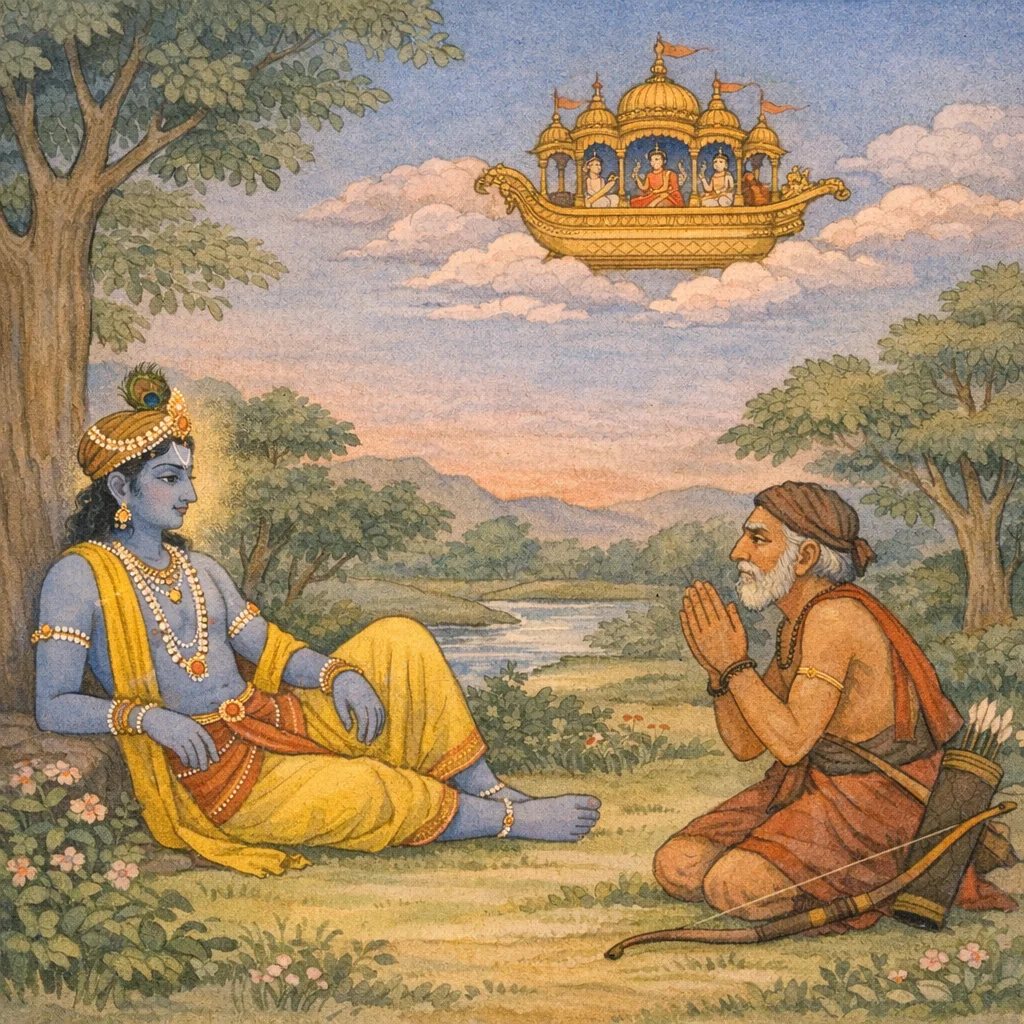
Chương 211 thuật lại đoạn kết của līlā trần thế của Kṛṣṇa và đặt trong viễn tượng thần học về sự tự nguyện thu hồi vào Brahman bất hoại. Dāruka vâng lệnh Kṛṣṇa đến Dvārakā và đưa Arjuna trở lại, cùng với Vajra được nêu như hình tượng người kế vị vương quyền. Văn bản chuyển sang hành vi nội quán của Govinda: gìn giữ nguyên lý Vāsudeva tối thượng trong mọi hữu tình. Tôn trọng lời của bà-la-môn Durvāsas, Kṛṣṇa an tọa trong tư thế yoga. Đúng lúc ấy, thợ săn Jarā đến, mang mũi tên có đầu kim loại còn sót từ muśala, lầm bàn chân của Chúa là nai và bắn trúng. Thấy tướng bốn tay, Jarā liên tiếp cầu xin tha thứ, thú nhận vì vô tri. Kṛṣṇa xá tội và ban cho ông lập tức thăng thiên bằng vimāna. Sau đó, Đức Chúa hợp nhất tự ngã với Brahman thanh tịnh, bất khả tư nghị, không hoại diệt—Vāsudeva thấm khắp muôn loài—rồi xả bỏ thân người, đạt đến đích siêu việt ba phần.
Chapter Arc
{"opening_hook":"The chapter opens in the wake of the Yādava collapse: Dāruka, obeying Kṛṣṇa’s final directive, hastens toward Dvārakā to summon Arjuna, while Vajra is positioned as a continuity-figure for royal succession—an immediate narrative bridge from catastrophe to dharmic aftermath.","rising_action":"Attention turns inward: Govinda is portrayed as the indwelling support of all beings, establishing the supreme Vāsudeva-principle within the self. In fidelity to the brāhmaṇa-word of Durvāsas, Kṛṣṇa assumes a yogic posture, and the ominous detail is introduced—an arrow tipped with the remaining iron of the muśala, now in the hands of the hunter Jarā.","climax_moment":"Jarā mistakes the Lord’s foot for a deer and releases the arrow; the revelation follows instantly when Jarā beholds the four-armed form. The theological peak is Kṛṣṇa’s untroubled absolution—transforming an apparent “accident” into a deliberate, sovereign closure of līlā and a demonstration of the Lord’s freedom from karma.","resolution":"Kṛṣṇa removes Jarā’s fear, grants him immediate heavenly ascent by vimāna, and then relinquishes the human body, uniting the self with the stainless, unthinkable, undecaying Brahman—described as Vāsudeva-pervading all—thus concluding the avatāra’s terminal movement as voluntary withdrawal into the imperishable.","key_verse":"“Seeing the Lord’s four-armed form, the hunter fell again and again, begging pardon; the Blessed One dispelled his fear and, having granted him heaven, Himself entered the stainless, undecaying Brahman—Vāsudeva, the Self of all.” (sense-translation; chapter’s central teaching)"}
Thematic Essence
{"primary_theme":"Kṛṣṇa’s voluntary withdrawal (līlā-saṃhāra) into Vāsudeva-Brahman","secondary_themes":["Succession and continuity after the Yādava end (Arjuna and Vajra)","Brāhmaṇa-vāk and dharma as cosmic constraint honored even by the Lord","Grace overriding apparent fault: Jarā’s fear removed and heaven granted","Muśala-iron as narrative causality: the remnant of internecine ruin becomes the final instrument"],"brahma_purana_doctrine":"The chapter crystallizes a Brahma Purāṇa-style metaphysical reading of avatāra: Kṛṣṇa is the indwelling Vāsudeva who sustains all beings and, at the end, does not ‘die’ but consciously re-identifies with the stainless, unthinkable, undecaying Brahman—making the event a yogic, sovereign consummation rather than karmic defeat.","adi_purana_significance":"As ‘Ādi Purāṇa,’ it models how primordial Purāṇic narration absorbs epic history into a cosmological-theological frame: the end of Kṛṣṇa’s earthly līlā is presented as a paradigmatic template for understanding divine descent and withdrawal within the larger Purāṇic vision of dharma and the Absolute."}
Emotional Journey
{"opening_rasa":"करुण (karuṇa)","climax_rasa":"अद्भुत (adbhuta)","closing_rasa":"शान्त (śānta)","rasa_transitions":["करुण → भयानक (Jarā’s fearful mistake) → अद्भुत (four-armed revelation and grace) → शान्त (Brahman-union)"],"devotional_peaks":["Govinda as inner support of all beings: contemplative bhakti grounded in metaphysics","Jarā’s repeated prostrations upon seeing the four-armed form","The Lord’s fear-dispelling absolution and gift of vimāna","Final union with the stainless Vāsudeva-Brahman as a śānta-bhakti summit"]}
Tirtha Focus
{"tirthas_covered":["द्वारका"],"jagannath_content":null,"surya_content":null,"cosmology_content":"Implicit dissolution motif at the microcosmic level: the avatāra’s embodied līlā is ‘withdrawn’ into the imperishable Brahman (Vāsudeva as all-pervading Self), echoing Purāṇic saṃhāra logic without a full sarga/pralaya excursus."}
Shlokas in Adhyaya 211
Verse 1
व्यास उवाच इत्य् उक्तो दारुकः कृष्णं प्रणिपत्य पुनः पुनः प्रदक्षिणं च बहुशः कृत्वा प्रायाद् यथोदितम् //
Câu kệ này: “1” — ký hiệu đánh số của lời thánh trong kinh Purāṇa.
Verse 2
स च गत्वा तथा चक्रे द्वारकायां तथार्जुनम् आनिनाय महाबुद्धिं वज्रं चक्रे तथा नृपम् //
Câu kệ này: “2” — số thứ tự của lời thiêng trong Purāṇa.
Verse 3
भगवान् अपि गोविन्दो वासुदेवात्मकं परम् ब्रह्मात्मनि समारोप्य सर्वभूतेष्व् अधारयत् //
Câu kệ này: “3” — dấu hiệu phân định lời thánh trong Purāṇa.
Verse 4
स मानयन् द्विजवचो दुर्वासा यद् उवाच ह योगयुक्तो ऽभवत् पादं कृत्वा जानुनि सत्तमाः //
Câu kệ này: “4” — số thứ tự để sắp xếp lời thiêng trong Purāṇa.
Verse 5
संप्राप्तो वै जरा नाम तदा तत्र स लुब्धकः मुशलशेषलोहस्य सायकं धारयन् परम् //
Câu kệ này: “5” — ký hiệu số để định danh và dẫn chiếu lời thánh trong Purāṇa.
Verse 6
स तत्पादं मृगाकारं समवेक्ष्य व्यवस्थितः ततो विव्याध तेनैव तोमरेण द्विजोत्तमाः //
Câu kệ này (số 6) được gìn giữ như lời thiêng trong truyền thống Purāṇa.
Verse 7
गतश् च ददृशे तत्र चतुर्बाहुधरं नरम् प्रणिपत्याह चैवैनं प्रसीदेति पुनः पुनः //
Câu kệ này (số 7) là lời đáng tôn kính, thích hợp cho tụng niệm và khảo cứu.
Verse 8
अजानता कृतम् इदं मया हरिणशङ्कया क्षम्यताम् आत्मपापेन दग्धं मा दग्धुम् अर्हसि //
Câu kệ này (số 8) nêu bày tri thức cổ xưa, vẫn giữ phẩm cách của tiếng Phạn.
Verse 9
व्यास उवाच ततस् तं भगवान् आह नास्ति ते भयम् अण्व् अपि गच्छ त्वं मत्प्रसादेन लुब्ध स्वर्गेश्वरास्पदम् //
Câu kệ này (số 9) nên được đọc với tâm an tĩnh và lòng kính trọng để thấu hiểu ý nghĩa sâu xa.
Verse 10
व्यास उवाच विमानम् आगतं सद्यस् तद्वाक्यसमनन्तरम् आरुह्य प्रययौ स्वर्गं लुब्धकस् तत्प्रसादतः //
Câu kệ này (số 10) là sự kết yếu theo lối cổ, tiếp nối truyền thống của Purāṇa.
Verse 11
गते तस्मिन् स भगवान् संयोज्यात्मानम् आत्मनि ब्रह्मभूते ऽव्यये ऽचिन्त्ये वासुदेवमये ऽमले //
Kệ 211.11: Chưa có nguyên văn Sanskrit. Xin gửi đầy đủ câu kệ để tôi dịch theo văn phong Purana trang nghiêm.
Verse 12
अजन्मन्य् अजरे ऽनाशिन्य् अप्रमेये ऽखिलात्मनि त्यक्त्वा स मानुषं देहम् अवाप त्रिविधां गतिम् //
Kệ 211.12: Không có bản Sanskrit kèm theo. Xin cung cấp nguyên văn để bản dịch được chuẩn xác và trang nghiêm.
Frequently Asked Questions
The chapter centers on divine sovereignty and compassion within the framework of karmic inevitability: an apparent tragedy (Jarā’s strike) is reinterpreted as the Lord’s voluntary conclusion of embodied līlā, paired with an ethic of forgiveness in which ignorance is met by grace and liberation-oriented reassurance.
It articulates a foundational Puranic theological grammar: the avatāra’s departure is not merely historical but cosmological, expressed as reabsorption into the imperishable Brahman identified with Vāsudeva and as an affirmation of the Lord as the inner support of all beings—motifs that anchor later narrative, ritual, and doctrinal layers across the Purāṇic corpus.
No new tīrtha, vrata, or formal rite is instituted in the supplied passage. The chapter’s emphasis is doctrinal and narrative—Dvārakā as a setting is referenced, but the text here functions primarily as a theological account of the Lord’s yogic withdrawal and the salvific outcome granted to Jarā.