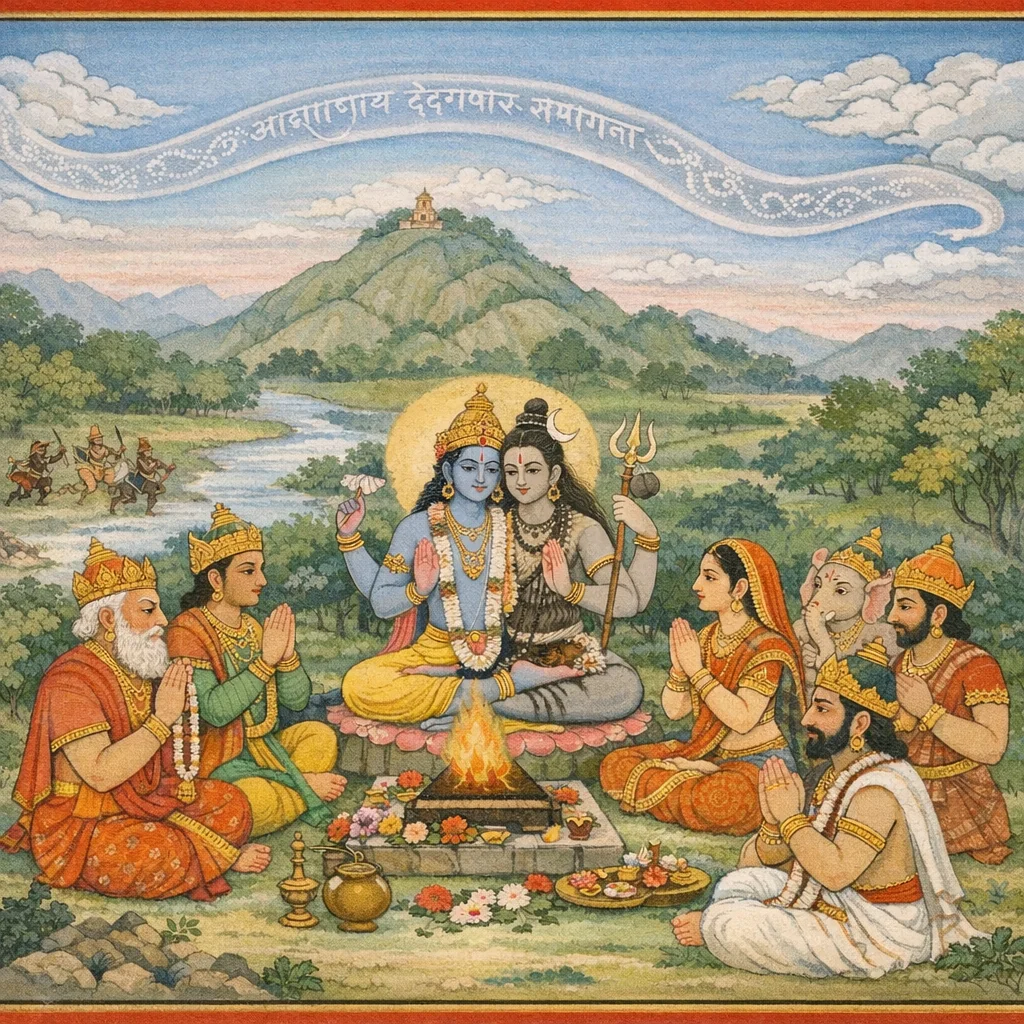
Adhyaya 160: Devagama Tirtha on the Godavari: Devas, Asuras, and the Victory through Hari-Hara
Chương 160 trình bày sự linh thiêng và nguồn gốc huyền thoại của Devāgama Tīrtha bên sông Godāvarī (Gautamī), một thánh địa Śaiva ban phúc cả hưởng thụ thế gian (bhukti) lẫn giải thoát (mukti), đồng thời làm thỏa lòng các Pitṛ (tổ tiên) qua nghi lễ cúng tế tại đây. Phạm Thiên kể với Nārada về cuộc xung đột do tranh giành của cải và quyền hưởng phần tế lễ: các Asura tràn chiếm karmabhūmi, phá hoại yajña bằng cách giết người bố thí, khiến chư Deva mất phần cúng tế. Đau khổ, chư Deva tìm lời khuyên và được thúc giục phục hồi bằng chiến trận, nhưng một tiếng nói vô hình từ trời lại chỉ họ đến Gautamī, nơi Śiva hiện diện. Nhờ lòng sùng kính Hari và Hara, chư Deva đạt thắng lợi, khôi phục quyền cai quản vũ trụ. Kết chương nêu danh và tán dương Devāgama Tīrtha, gắn với hội tụ thần lực, núi Devāgama và vô số Śiva-liṅga, xác lập uy danh nghi lễ bền lâu của thánh địa này.
Chapter Arc
{"opening_hook":"Brahmā, answering Nārada’s curiosity, foregrounds Devāgama as a Gautamī tīrtha that uniquely yields sarvakāma (all desired ends), bhukti–mukti, and Pitṛ-tarpaṇa—immediately binding myth to ritual payoff.","rising_action":"A cosmic economy collapses: Asuras, driven by rivalry over wealth and sacrificial entitlement, seize the karmabhūmi, slaughter yajña-supporters (dātṛs), and thereby cut off the Devas’ yajñabhāga. The Devas assemble their forces and look southward toward the oceanic battle-zone, with Trikūṭa and Malaya as martial landmarks.","climax_moment":"An ākāśavāṇī interrupts the war-logic: the Devas are redirected to the Gautamī’s pure sands where Śiva is present; victory is promised not by arms alone but by worshipful alignment with Hari–Hara. Their devotion becomes the decisive ‘weapon’ that turns the tide.","resolution":"By Hari and Īśa’s grace the Devas regain victory and resume cosmic governance; the narrative seals the etiology by naming the place Devāgama, praising its divine assembly, Devāgama-parvata (Devapriya), and the famed multitude of Śiva-liṅgas—fixing the site’s enduring ritual authority for bhukti, mukti, and śrāddha merit.","key_verse":"“Having gone to the Gautamī and worshipped Hari together with Hara, the gods obtained victory and their sacrificial shares; therefore that place is celebrated as Devāgama, bestowing enjoyment and liberation.” (memorable teaching, translated; wording varies by recension)"}
Thematic Essence
{"primary_theme":"Gautamī–Devāgama tīrtha-māhātmya (Śaiva pilgrimage efficacy grounded in mythic etiology)","secondary_themes":["Breakdown and restoration of yajña reciprocity (yajñabhāga, dātṛ-protection)","Hari–Hara unity as the practical theology of victory and liberation","Southern battle-geography as sacred cartography (Dakṣiṇārṇava, Trikūṭa, Malaya)","Pitṛ-satisfaction through tīrtha rites (śrāddha/tarpaṇa legitimacy)"],"brahma_purana_doctrine":"Tīrtha is not merely ‘holy place’ but a corrective mechanism for cosmic disorder: when yajña is obstructed, pilgrimage and Hari–Hara worship at Gautamī re-establish dharma, restore yajñabhāga, and simultaneously grant bhukti–mukti and Pitṛ-śānti.","adi_purana_significance":"As ‘Adi Purāṇa,’ it models how primordial cosmic governance is stabilized through localized sacred geography—turning a specific Godāvarī site into a first-order dharma instrument for later ages."}
Emotional Journey
{"opening_rasa":"śānta","climax_rasa":"adbhuta","closing_rasa":"śānta","rasa_transitions":["śānta → raudra","raudra → karuṇa","karuṇa → vīra","vīra → adbhuta","adbhuta → śānta"],"devotional_peaks":["The ākāśavāṇī’s injunction to seek Śiva on the Gautamī sands (pilgrimage as divine command).","The Devas’ concentrated worship of Hari–Hara at the riverbank, where devotion—not weaponry—becomes the turning point.","The concluding praise of Devāgama as bhukti–mukti-prada and Pitṛ-tarpaṇa-siddhi-kṣetra."]}
Tirtha Focus
{"tirthas_covered":["Devāgama Tīrtha","Gautamī / Godāvarī River (pulina/riverbank context)","Devāgama Mountain (Devāgama-parvata / Devapriya)"],"jagannath_content":null,"surya_content":null,"cosmology_content":null}
Shlokas in Adhyaya 160
Verse 1
ब्रह्मोवाच देवागमं नाम तीर्थं सर्वकामप्रदं शिवम् भुक्तिमुक्तिप्रदं नॄणां पितॄणां तृप्तिकारकम् //
Câu kinh này ghi: “1” — một ký hiệu số trong văn mạch thánh điển, dùng để chỉ mục.
Verse 2
तत्र वृत्तं समाख्यास्ये तव यत्नेन नारद देवानाम् असुराणां च स्पर्धाभूद् धनहेतवे //
Câu này ghi: “2” — dấu số dùng làm mốc tham chiếu trong bản văn thiêng.
Verse 3
स्वर्गः सुराणाम् अभवद् असुराणाम् इलाभवत् कर्मभूमिम् अवष्टभ्य असुराः सर्वतो ऽभवन् //
Câu này ghi: “3” — ký hiệu số nhằm sắp xếp các đoạn trong thánh điển.
Verse 4
देवानां यज्ञभागांश् च दातॄन् घ्नन्त्य् असुरास् ततः ततः सुरगणाः सर्वे यज्ञभागैर् विना कृताः //
Câu này ghi: “4” — số tham chiếu trong văn bản thiêng, thuận tiện cho việc khảo cứu.
Verse 5
व्यथिता माम् उपाजग्मुः किं कृत्यम् इति चाब्रुवन् मया चोक्ताः सुरगणा युद्धे जित्वासुरान् बलात् //
Câu này ghi: “5” — ký hiệu số trong lời kinh, nhằm xác định thứ tự đoạn mục.
Verse 6
भुवं प्राप्स्यथ कर्माणि हवींषि च यशांसि च तथेत्य् उक्त्वा गता देवा भूमिं ते समरार्थिनः //
Câu kệ này (số 6) được xem là lời thánh trong Purāṇa, đáng tụng niệm và khảo cứu.
Verse 7
दैत्याश् च दानवाश् चैव राक्षसा बलदर्पिताः एकीभूत्वा ययुस् ते ऽपि जयिनो युद्धकाङ्क्षिणः //
Câu kệ này (số 7) tiếp nối việc trình bày ý nghĩa thiêng liêng theo truyền thống Purāṇa.
Verse 8
अहिर् वृत्रो बलिस् त्वाष्ट्रिर् नमुचिः शम्बरो मयः एते चान्ये च बहवो योद्धारो बलदर्पिताः //
Câu kệ này (số 8) đáng kính như lời dạy sâu xa dành cho người học và người mộ đạo.
Verse 9
अग्निर् इन्द्रो ऽथ वरुणस् त्वष्टा पूषा तथाश्विनौ मरुतो लोकपालाश् च नानायुद्धविशारदाः //
Câu kệ này (số 9) nên được đọc với lòng kính trọng và sự chú tâm để hiểu đúng ý nghĩa.
Verse 10
ते दानवाः सर्व एव याम्यां वै दिशि संगरे अकुर्वन्त महायत्नं दक्षिणार्णवसंस्थिताः //
Câu kệ này (số 10) khép lại đoạn này, nhắc giữ gìn dharma và tôn trọng truyền thống cổ xưa.
Verse 11
त्रिकूटः पर्वतश्रेष्ठो राक्षसानां पुराभवत् तद्वनेन ययुः सर्वे तैः सार्धं दक्षिणार्णवम् //
Kệ này (11) thuộc Phạm Thiên Purāṇa, ghi chép theo truyền thống thiêng liêng và nêu bày ý nghĩa mang tính bách khoa của thánh điển.
Verse 12
सर्वेषां मेलनं यत्र पर्वतो मलयस् तु सः मलयस्यापि देशो ऽसौ देवारीणाम् अभूत् तदा //
Kệ (12) tiếp nối lời thuật thiêng, nhằm gìn giữ tri thức và Dharma theo khuôn phép của Purāṇa.
Verse 13
देवानां गौतमीतीरे तत्र संनिहितः शिवः इति तेषां समायोगो देवानाम् अभवत् किल //
Kệ (13) làm sáng tỏ ý nghĩa của Dharma và lối biên soạn thánh sử, hữu ích cho cả người học thuật lẫn người hành trì sùng kính.
Verse 14
देवाः स्वरथम् आरूढास् तत्र तत्र समागमन् गौतम्याः सरिदम्बायाः पुलिने विमलाशयाः //
Kệ (14) bày tỏ sự tôn kính đối với nguồn Sanskrit và sự tiếp nối của thánh ngôn theo truyền thống cổ xưa.
Verse 15
प्रसन्नाभीष्टदा या स्यात् पितॄणाम् अखिलस्य तु ततो देवगणाः सर्वे स्तुत्वा देवं महेश्वरम् अभयं चिन्तयाम् आसुस् ते सर्वे ऽथ परस्परम् //
Kệ (15) kết luận rằng việc lắng nghe, đọc tụng và quán niệm Purāṇa làm tăng trưởng phước đức và trí tuệ.
Verse 16
देवा ऊचुः अत्राप्य् उपायः को ऽस्माकं निर्जितानां परैर् हठात् एकम् एवात्र नः श्रेयो विजयो वाथवा मृतिः सपत्नैर् अभिभूतानां जीवितं धिङ् मनस्विनाम् //
Câu kệ này (16) thuộc về Purāṇa, nêu bày ý nghĩa thiêng liêng và tri thức cổ truyền.
Verse 17
ब्रह्मोवाच एतस्मिन्न् अन्तरे पुत्र वाग् उवाचाशरीरिणी //
Câu kệ này (17) tiếp tục trình bày về Dharma và truyền sử Purāṇa, làm kim chỉ nam cho người học.
Verse 18
आकाशवाग् उवाच क्लेशेनालं सुरगणा गौतमीम् आशु गच्छत भक्त्या हरिहरौ तत्र समाराधयतेश्वरौ //
Câu kệ này (18) nêu bật các đức hạnh và nghi lễ cúng tế cần thực hành để gìn giữ chính hạnh.
Verse 19
गोदावर्यास् तयोश् चैव प्रसादात् किं तु दुष्करम् //
Câu kệ này (19) giảng rõ quả báo của thiện nghiệp và ác nghiệp theo luật Karma.
Verse 20
ब्रह्मोवाच प्रसन्नाभ्यां हरीशाभ्यां देवा जयम् अभीप्सितम् अवाप्य सर्वतो जग्मुः पालयन्तो दिवौकसः //
Câu kệ này (20) kết lại bằng lời khuyến tấn hãy lắng nghe, học hỏi và ghi nhớ Purāṇa để thọ nhận ân phúc.
Verse 21
यत्र देवागमो जातस् तत् तीर्थं तेन विश्रुतम् देवागमं प्रशंसन्ति मुनयस् तत्त्वदर्शिनः //
Câu (160.21) không có văn bản Sanskrit được cung cấp; vì vậy không thể dịch một cách chuẩn xác và tôn nghiêm.
Verse 22
तत्राशीतिसहस्राणि शिवलिङ्गानि नारद देवागमः पर्वतो ऽसौ प्रिय इत्य् अपि कथ्यते ततः प्रभृति तत् तीर्थं देवप्रियम् अतो विदुः //
Câu (160.22) không có văn bản Sanskrit được cung cấp; vì vậy không thể dịch một cách chuẩn xác và tôn nghiêm.
Frequently Asked Questions
The chapter foregrounds the restoration of cosmic order through tīrtha-oriented devotion: when yajña and its social supports are violently disrupted, the Devas regain stability not merely by force but through pilgrimage to the Gautamī and worship of Hari-Hara, linking dharma’s recovery to sacred geography and divine grace.
Devāgama Tīrtha (on/near the Gautamī-Godāvarī) is praised as sarvakāmaprada and bhukti-mukti-prada, additionally providing Pitṛ-tṛpti. Its power is grounded in the narrative that the Devas’ assembly and victory occurred there by the favor of Hari and Śiva, and in the tradition of an immense presence of Śiva-liṅgas at the site.
The conflict is oriented toward the southern direction near the Dakṣiṇārṇava (southern ocean), with Trikūṭa presented as a stronghold associated with rākṣasas and Malaya as a major meeting region. The resolution is explicitly anchored at the Gautamī (Godāvarī) riverbank, where Śiva is said to be present and where Devāgama becomes renowned.