
Bhagavad Gita — Vishwarupa Darshana Yoga, Shloka 25
Vishwarupa Darshana Yoga
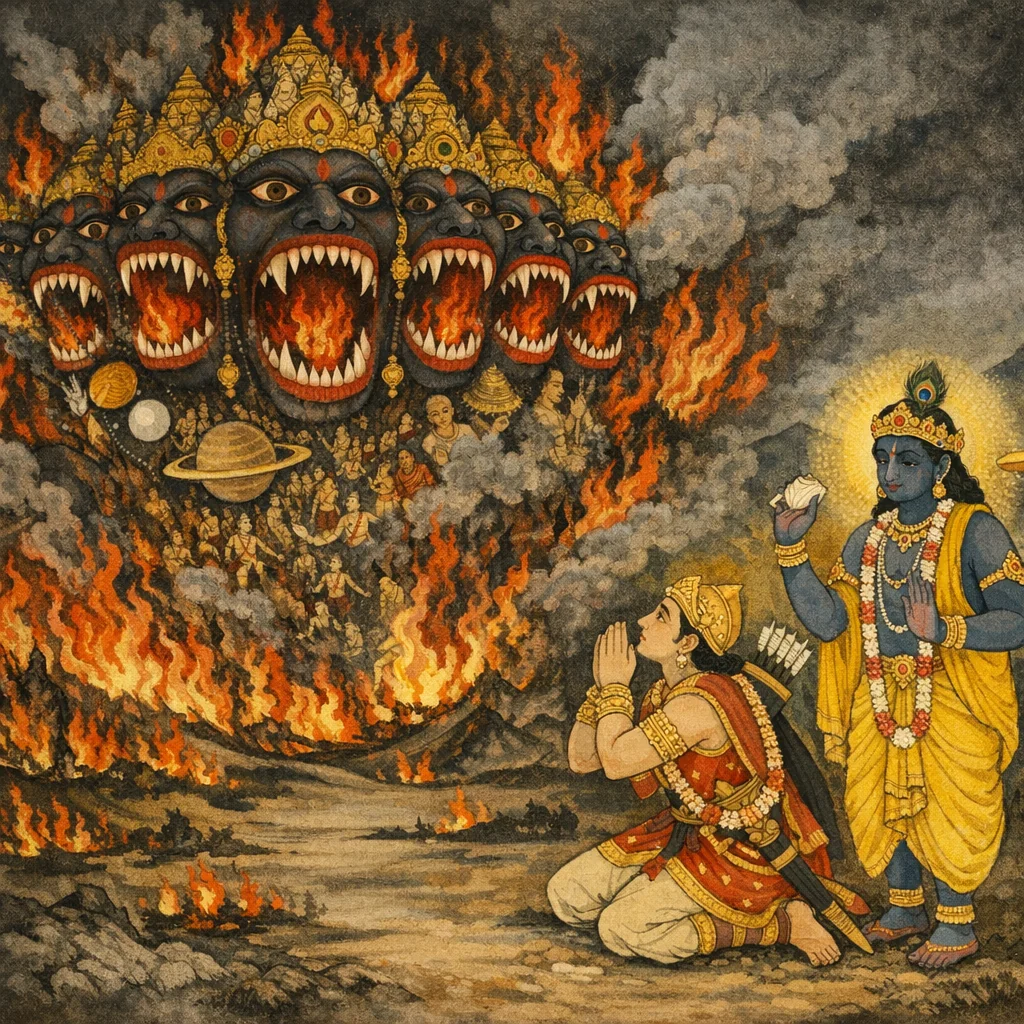
दंष्ट्राकरालानि च ते मुखानि दृष्ट्वैव कालानलसन्निभानि । दिशो न जाने न लभे च शर्म प्रसीद देवेश जगन्निवास ॥
daṃṣṭrā-karālāni ca te mukhāni dṛṣṭvaiva kālānala-sannibhāni | diśo na jāne na labhe ca śarma prasīda deveśa jagan-nivāsa ||

Thấy những miệng của Ngài với răng ghê rợn, tựa như ngọn lửa của Thời gian—con mất phương hướng, chẳng tìm được chỗ nương an. Xin thương xót, hỡi Đấng Chúa của chư thiên, nơi cư ngụ của vũ trụ.
Seeing Your mouths with formidable teeth, like the fire of time, I lose my sense of direction and find no comfort. Be gracious, O Lord of the gods, abode of the world.
Having seen your mouths, terrifying with teeth, resembling the conflagration of time, I do not know the directions and I do not find ease. Show favor, O lord of gods, dwelling-place of the world.
kālānala (‘time-fire’) is often read as an image of impermanence and cosmic dissolution. The verse can be interpreted as an existential confrontation with mortality and change rather than a literal threat.
FAQs
Losing ‘sense of direction’ is a metaphor for disorientation under stress; the plea ‘prasīda’ shows a turn toward relational coping—seeking reassurance from a trusted source of meaning.
The imagery of ‘time-fire’ suggests that the divine encompasses transformative processes (arising and passing), integrating creation and dissolution within one reality.
This is a pivot from witnessing to supplication, foreshadowing Arjuna’s desire to return from the cosmic vision to a more personal, approachable form.
It can be read as a response to impermanence: acknowledging anxiety about change while seeking steadiness through ethical practice, reflection, or faith.