
Shloka 24
Vishwarupa Darshana Yoga — Vishwarupa Darshana Yoga
नभःस्पृशं दीप्तमनेकवर्णं व्यात्ताननं दीप्तविशालनेत्रम् । दृष्ट्वा हि त्वां प्रव्यथितान्तरात्मा धृतिं न विन्दामि शमं च विष्णो ॥
nabhaḥspṛśaṃ dīptam aneka-varṇaṃ vyāttānanaṃ dīpta-viśāla-netram | dṛṣṭvā hi tvāṃ pravyathitāntarātmā dhṛtiṃ na vindāmi śamaṃ ca viṣṇo ||

Thấy Ngài chạm tới trời, rực sáng muôn màu, miệng há rộng, đôi mắt lớn bừng lửa—tâm can con chấn động—con không tìm được sự vững lòng cũng chẳng được an tịnh, hỡi Viṣṇu.
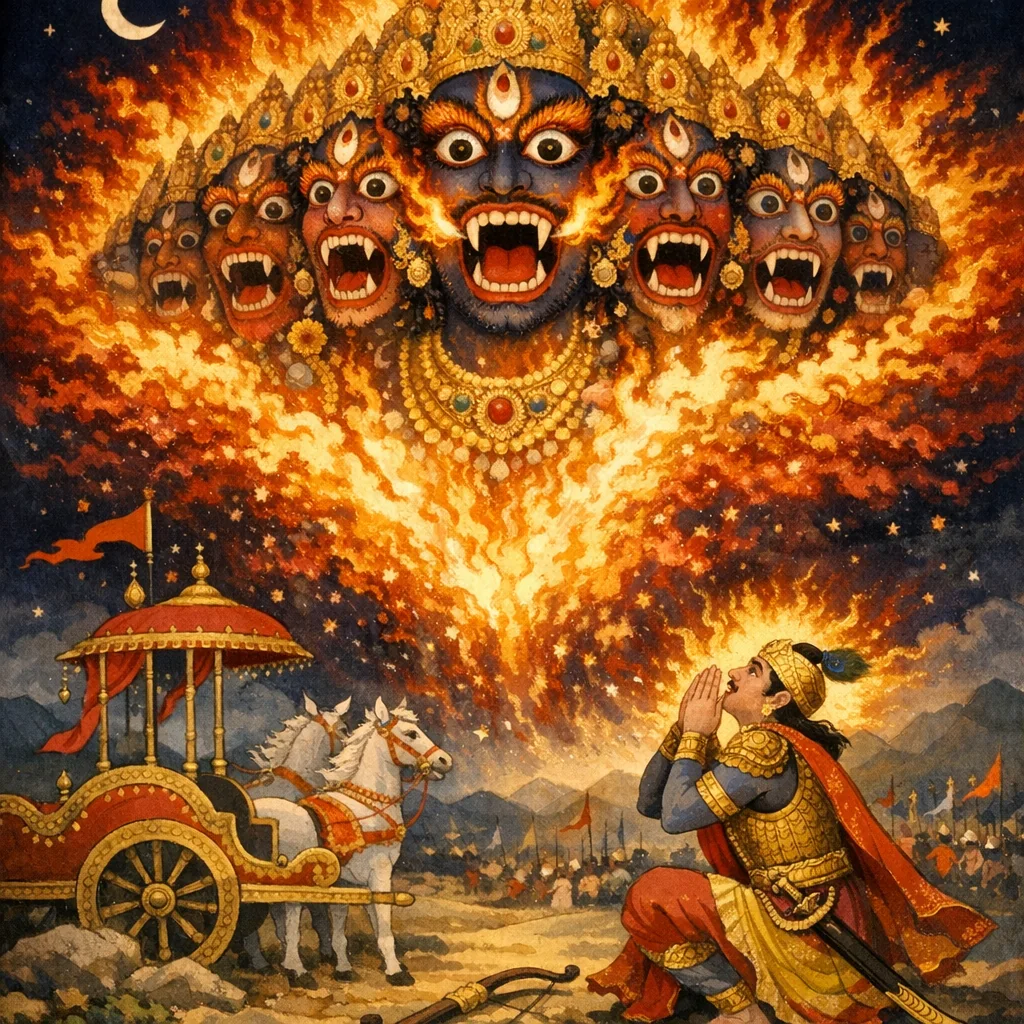
Seeing You touching the sky, radiant and multicolored, with open mouth and blazing wide eyes—my inner self shaken—I find neither steadiness nor peace, O Viṣṇu.
Having seen you—sky-reaching, luminous, many-hued, with gaping mouth and shining, vast eyes—my inward self disturbed, I do not find composure or calm, O Viṣṇu.
The address ‘Viṣṇu’ is significant for identifying the vision with a pan-Indian divine idiom. dhṛti (steadfastness) and śama (calm) are technical-ethical terms in Indian philosophy, here presented as temporarily disrupted by the sublime.
FAQs
The verse is a candid report of dysregulation under awe: even a disciplined person may temporarily lose calm when confronted with overwhelming meaning.
The cosmic form is not merely an object of sight but a transformative disclosure that reorders the subject’s inner world, indicating that knowledge can be existential, not only conceptual.
It transitions from description to confession, setting up Arjuna’s request for grace and a more approachable manifestation.
It supports a balanced spirituality: profound experiences may require integration practices (reflection, ethical grounding) to restore steadiness and calm.