
Bhagavad Gita — Gunatraya Vibhaga Yoga, Shloka 11
Gunatraya Vibhaga Yoga
सर्वद्वारेषु देहेऽस्मिन्प्रकाश उपजायते । ज्ञानं यदा तदा विद्याद्विवृद्धं सत्त्वमित्युत ॥ १४.११ ॥
sarvadvāreṣu dehe 'smin prakāśa upajāyate | jñānaṁ yadā tadā vidyād vivṛddhaṁ sattvam ity uta || 14.11 ||

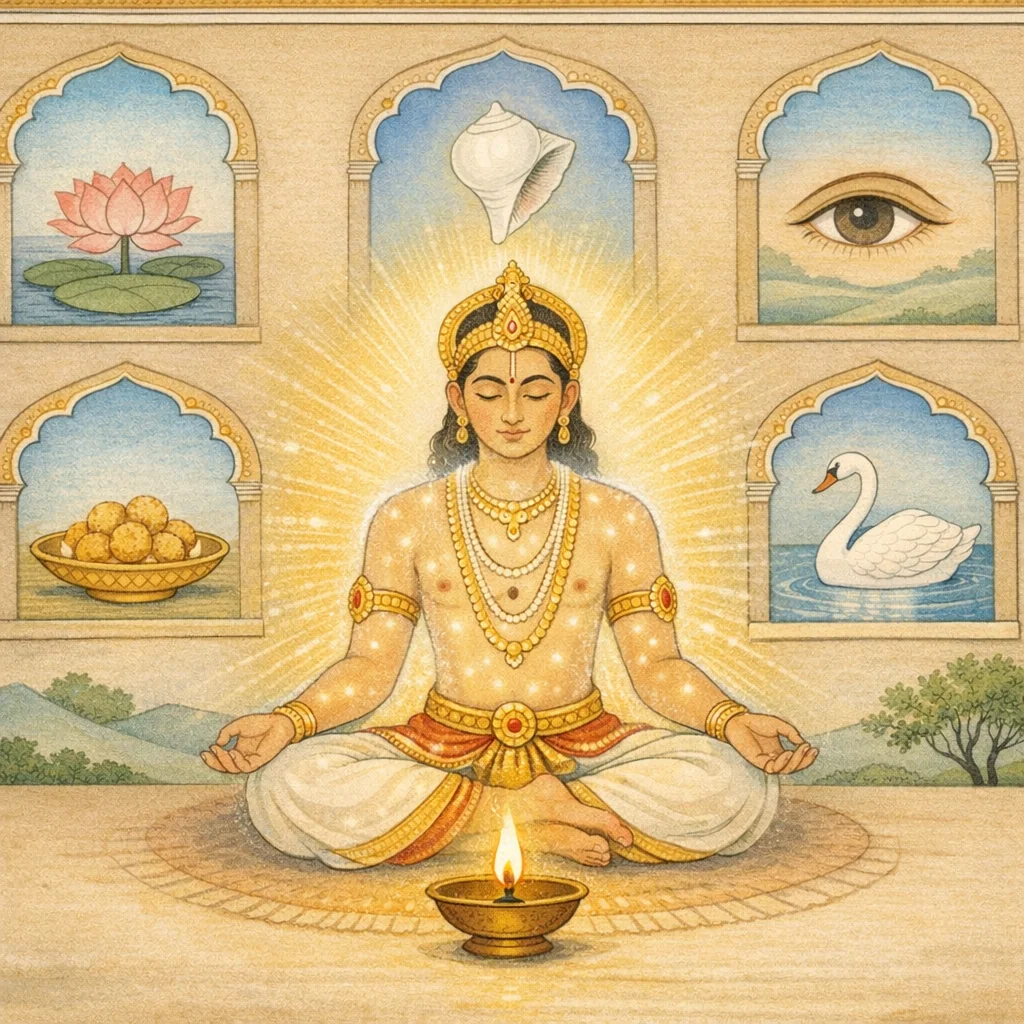
When, in this body, light arises through all the gates, then one should know that sattva has increased—so it is said.
When, in this body, light arises through all the gates, then one should know that sattva has increased, it is said.
When illumination arises in this body through all its ‘gates’ (i.e., the senses and faculties), then one should understand that sattva has become intensified.
‘Gates’ (dvāra) is commonly interpreted as sense-organs and cognitive channels; some devotional translations read it more broadly as moral and perceptual openings. ‘Prakāśa’ ranges from ‘light’ to ‘clarity/illumination’.
FAQs
Sattva is associated with heightened clarity: perception, attention, and understanding feel ‘bright,’ coherent, and integrated across one’s faculties.
The text treats knowledge as a manifestation that becomes more available when sattva predominates, aligning with classical views where sattva is the most transparent guṇa for consciousness.
After describing guṇa alternation, the chapter begins offering observable indicators—starting with the experiential signature of sattva.
It can function as a self-assessment cue: increased calm clarity, better judgment, and consistent awareness across contexts may indicate a more sattvic state.