
Bhagavad Gita — Gunatraya Vibhaga Yoga, Shloka 10
Gunatraya Vibhaga Yoga
रजस्तमश्चाभिभूय सत्त्वं भवति भारत । रजः सत्त्वं तमश्चैव तमः सत्त्वं रजस्तथा ॥ १४.१० ॥
rajas tamaś cābhibhūya sattvaṁ bhavati bhārata | rajaḥ sattvaṁ tamaś caiva tamaḥ sattvaṁ rajas tathā || 14.10 ||

Overcoming rajas and tamas, sattva prevails, O Bhārata; rajas prevails over sattva and tamas; and tamas likewise prevails over sattva and rajas.
Overcoming rajas and tamas, sattva prevails, O Bhārata; rajas (prevails) over sattva and tamas; and tamas over sattva and rajas likewise.
Sattva arises as dominant after surpassing rajas and tamas; rajas (becomes dominant) after surpassing sattva and tamas; and tamas (becomes dominant) after surpassing sattva and rajas.
The verse is syntactically elliptical in Sanskrit; translators supply ‘prevails/becomes dominant’ in the latter clauses. No major doctrinal divergence, but some emphasize alternation over time, others emphasize situational dominance.
FAQs
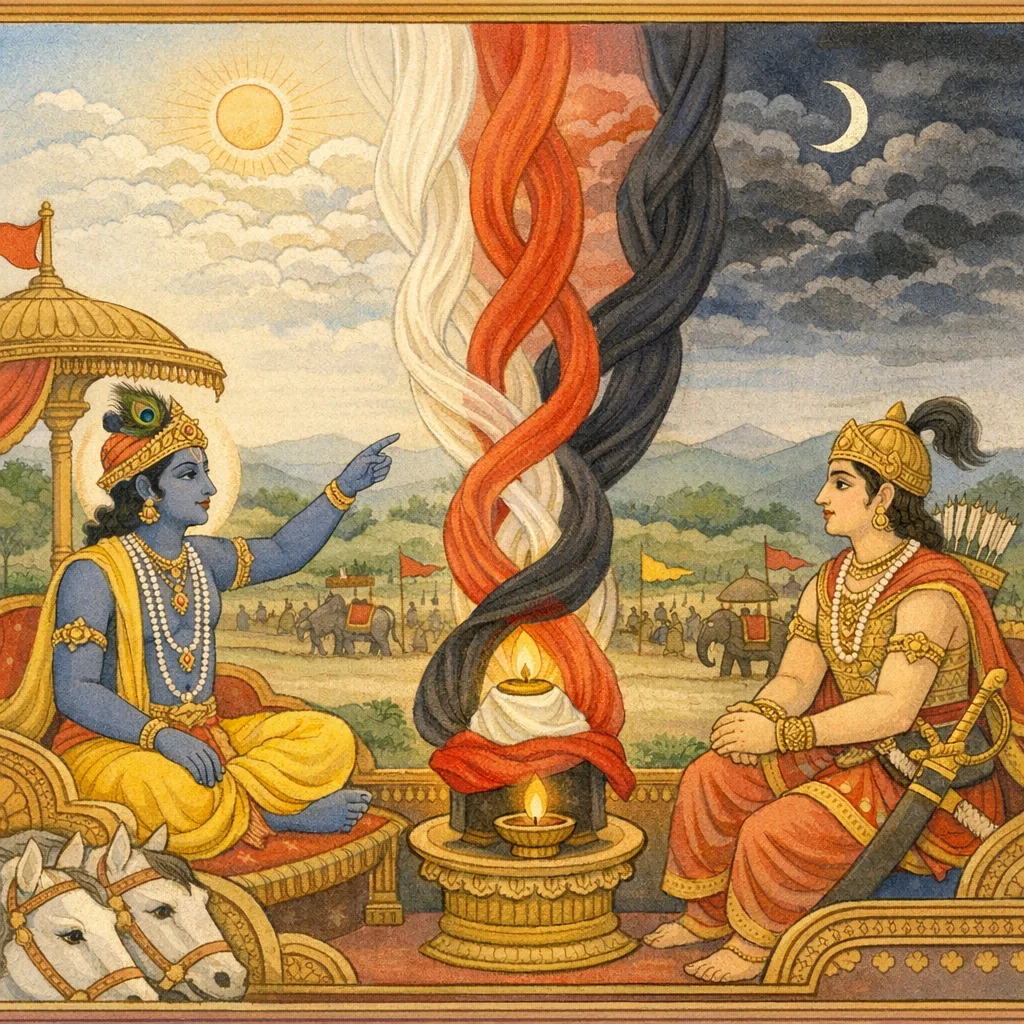
The verse depicts mental life as dynamically shifting: clarity, restlessness, and inertia can each become dominant depending on conditions, habits, and attention.
In guṇa theory, prakṛti is not uniform; its constituents compete for predominance, shaping cognition and behavior without implying an unchanging essence at the empirical level.
It transitions from defining each guṇa to explaining how they operate in alternation, setting up diagnostic signs of dominance in the next verses.
It supports a non-essentialist view of character: one can cultivate conditions that increase clarity (sattva) and reduce inertia (tamas) or compulsive agitation (rajas).