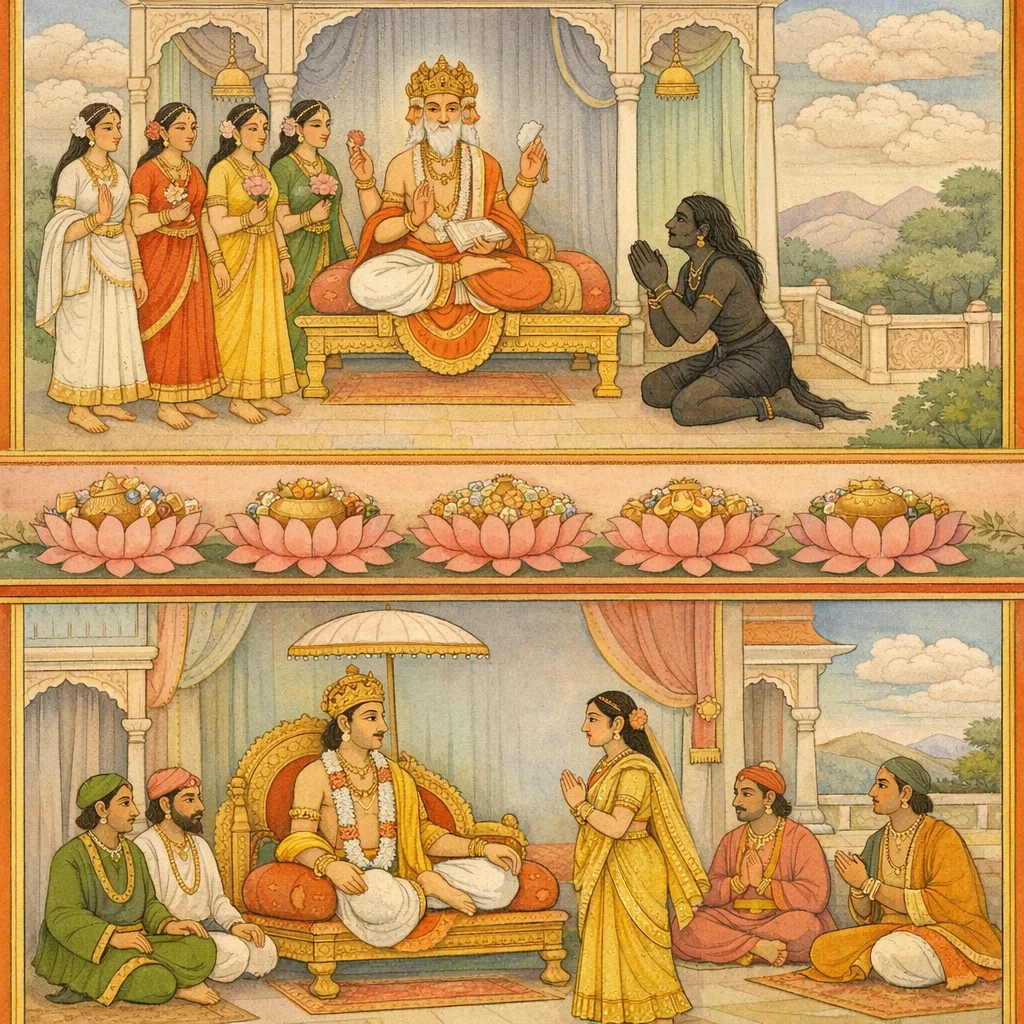
Adhyaya 49: Kali’s Complaint to Brahma and the Arrival of Śrī (Jayaśrī) in Bali’s Reign
कलि-ब्रह्म-शरणागति तथा श्री-विभाजन-वर्णन (Kali-Brahma-Śaraṇāgati tathā Śrī-Vibhājana-Varṇana)
Sri in Bali's Reign
Within the Pulastya–Nārada dialogue-frame, this adhyāya depicts Bali’s dhārmic sovereignty over the three worlds and the consequent displacement of Kali’s disruptive “svabhāva.” Kali approaches Brahmā in Brahmaloka, where Brahmā diagnoses that Bali’s strength has not only checked Kali but has also humbled the devas—none can counter Bali except Hari in his cosmic, thousand-headed form. The chapter then pivots to an iconographic and theological exposition of Śrī’s differentiated manifestations: four feminine forms marked by white/red/yellow/blue garments, vehicles, and guṇic affiliations (sattva–rajas–tamas), distributed among Brahmā and allied deities, Indra and rulers, Prajāpatis/Śukra/communities, and extending to dānavas and other classes. These forms are correlated with enduring “nidhis” (Mahāpadma, Padma, Mahānīla, Śaṅkha) and with ethical typologies of human conduct. Finally, Jayaśrī (a form of Śrī) enters Bali, and a cluster of virtues (hrī, dhī, dhṛti, kīrti, etc.) are said to repose in him, presenting an asura-dharma idealization that anticipates later divine intervention without explicit sectarian conflict, while retaining Purāṇic syncretic theology through Brahmā’s mediation and Hari’s supremacy.
Divine Beings
Sacred Geography
Mortal & Asura Figures
Key Content Points
- Pulastya narrates to Nārada how Bali’s asura-dharma rule stabilizes the cosmos, forcing Kali to seek refuge with Brahmā in Brahmaloka; Brahmā notes only Hari can ultimately restrain Bali.
- Śrī is presented through iconographic descriptions of four guṇa-linked feminine forms (white/red/yellow/blue), their vehicles and ritual associations, and their allocation across deities and social orders.
- The chapter maps Śrī’s forms onto the four nidhis (Mahāpadma, Padma, Mahānīla, Śaṅkha) and offers moral typologies of people aligned with each treasury, culminating in Jayaśrī’s entry into Bali and the aggregation of virtues around him.
Shlokas in Adhyaya 49
Verse 1
इति श्रीवामनपुराणे अष्टचत्वारिंशो ऽध्यायः पुलस्त्य उवाच ततो गतेषु देवेषु ब्रह्मलोकं प्रति द्विज त्रैलोक्यं पालयामास बलिर्धर्मान्वितः सदा
“Thus, in the Śrī Vāmana Purāṇa, the forty-eighth chapter (ends).” Pulastya said: “Then, when the gods had departed toward Brahmaloka, O twice-born one, Bali—ever endowed with dharma—ruled the three worlds.”
Verse 2
कलिस्तदा धर्मयुतं जगद् दृष्ट्वा कृते यथा ब्रह्माणं शरणं भेजे स्वभावस्य निषेणात्
Then Kali, seeing the world endowed with dharma—as it is in the Kṛta age—took refuge in Brahmā, compelled by his own nature.
Verse 3
गत्वा स ददृशे देवं सेन्द्रैर्देवैः समन्वितम् स्वदीप्त्या द्योतयन्तं च स्वदेशं ससुरासुरम्
Having gone there, he beheld the Lord, attended by the gods together with Indra, illuminating by his own radiance his own realm—(a realm) comprising both the suras and the asuras.
Verse 4
प्रणिपत्य तमाहाथ तिष्यो ब्रह्माणमीश्वरम् मम स्वभावो बलिना नाशितो देवसत्तम
Having bowed down, Tiṣya then spoke to Brahmā, the Lord: “O best of gods, my inherent nature/condition has been destroyed by Bali.”
Verse 5
तं प्राह भगवान् योगी स्वभावं जगतो ऽपि हि न केवलं हि भवतो हृतं तेन बलीयसा
To him spoke the Blessed Lord, the yogin: “Indeed, the natural order of the world itself (has been seized/overpowered); it is not only yours that has been taken away by that stronger one.”
Verse 6
पश्यस्व तिष्य देवेन्द्रं वरुणं च समारुतम् भास्करो ऽपि हि दीनत्वं प्रयातो हि बलाद् बलेः
“Behold, O Tiṣya: even Devendra (Indra), Varuṇa together with Marut, and even Bhāskara (the Sun) have been reduced to a state of wretchedness—driven thereto by the might of Bali.”
Verse 7
न तस्य कश्चित् त्रैलोक्ये प्रतिषेद्धास्ति कर्मणः ऋते सहस्रं शिरसं हरिं दशशताङ्घ्रिकम्
“For his deeds there is no one in the three worlds who can offer resistance—except Hari, the thousand-headed one, the one of ten-hundred (i.e., a thousand) feet.”
Verse 8
म भूमिं च तथा नाकं राज्यं लक्ष्मीं यसो ऽव्ययः समाहरिष्यति बलेः कर्तुः सद्धर्मगोचरम्
“He, the imperishable one, will gather back (reclaim) the earth and likewise heaven, the kingship, fortune (Lakṣmī), and fame—(all) that had become the domain of Bali, the doer (of mighty deeds), within the sphere of ‘true dharma’.”
Verse 9
इत्येवमुक्तो देवेन ब्रह्मणा कलिरव्ययः दीनान् दृष्ट्वा स शक्रादीन् विभीतकवनं गतः
Thus addressed by the god Brahmā, the imperishable Kali—seeing Indra and the other gods cast down—went to the Vibhitaka forest.
Verse 10
कृतः प्रावर्त्तत तदा कलेर्नासात् जगत्त्रये धर्मो ऽभवच्चतुष्पादश्चातुर्वर्ण्ये ऽपि नारद
Then the Kṛta (age) commenced again, owing to the destruction (or suppression) of Kali, throughout the three worlds; and Dharma became four-footed again, even within the system of the four varṇas, O Nārada.
Verse 11
तपो ऽहिंसा च सत्यं च शौचमिन्द्रियनिग्रहः दया दानं त्वानृशंस्यं शुश्रुषा यज्ञकर्म च
Austerity, non-violence, truth, purity, restraint of the senses; compassion, charity, gentleness (non-cruelty), service (to elders/teachers), and the performance of sacrificial rites—these (prevailed as the constituents of Dharma).
Verse 12
एतानि सर्वजगतः परिव्याप्य स्थितानि हि बलिना बलवान् ब्रह्मन् तिष्यो ऽपि हि कृतः कृतः
“Indeed, these (conditions) have pervaded and come to prevail throughout the whole world. By Bali’s (rule), O Brahmin, even Tiṣya has been made powerful—yes, it has truly been brought about.”
Verse 13
स्वधर्मस्थायिनो वर्णा ह्याश्रमांश्चाविश्न् द्विजाः प्रजापालनधर्मस्थाः सदैव मनुजर्षभाः
“The varṇas remained established in their own duties, and the twice-born entered (and abided in) their āśramas. Ever devoted to the dharma of protecting subjects, the best of men (thus prevailed).”
Verse 14
धर्मोत्तरे वर्तमाने ब्रह्मन्नस्मिञ्जगत्त्रये त्रैलोक्यलक्ष्मीर्वरदा त्वायाता दानवेश्वरम्
“When dharma was thus prevailing in this triple world, O Brahmin, Trailokya-Lakṣmī—the bestower of boons—came to you, O lord of the Dānavas.”
Verse 15
तामागतां निरीक्ष्यैव सहस्राक्षश्रियं बलिः पप्रच्छ कासि मां ब्रूहि केनास्यर्थेन चागता
Seeing her arrive—she who was the very Śrī (Fortune) of Sahasrākṣa (Indra)—Bali questioned her: “Who are you? Tell me. For what purpose have you come here?”
Verse 16
सा तद्वचनमाकर्ण्य प्राह श्रीः पद्ममालिनी बले शृणुष्व यास्मि त्वामायाता महिषि बलात्
Hearing his words, Śrī—garlanded with lotuses—spoke: “Bali, listen. I have come to you, O queen, compelled by (your) power.”
Verse 17
अप्रमेयबलो देवो यो ऽसौ चक्रगदाधरः तेन त्यक्तस्तु मघवा ततो ऽहं त्वामिहागता
That god of immeasurable power—he who bears the discus and the mace—abandoned Maghavā (Indra). Therefore I have come here to you.
Verse 18
स निर्ममे युवतयश्चास्रो रूपसंयुताः श्वेताम्बरधरा चैव श्वेतस्रगनुलेपना
He then created four youthful maidens, endowed with beauty; they wore white garments and were adorned with white garlands and unguents.
Verse 19
श्वेतवृन्दारकारूढा सत्त्वाढ्या श्वेतविग्रहा रक्ताम्बरधरा चान्या रक्तस्रगनुलेपना
One (maiden) mounted upon a white celestial elephant, rich in sattva and of a white-bodied form; another wore red garments and was adorned with red garlands and unguents.
Verse 20
रक्तवाजिसामारूढा रक्ताङ्गी राजसी हि सा पीताम्बरा पीरवर्णा पीतमाल्यानुलेपना
Mounted upon a red horse, red-limbed, she is indeed rājasic; (another) wore yellow garments, was yellow-hued, and had yellow garlands and unguents.
Verse 21
सौवर्णस्यन्दनचरा तामसं गुणमाश्रिता नीलाम्बरा नीमाल्या नीलगन्धामनुलेपना
She moves in a golden chariot; she is established in the guṇa of tamas. Clad in blue garments, wearing blue garlands, and anointed with blue-fragrant unguents, she is so described.
Verse 22
नीलवृषसमारूढा त्रिगुणा सा प्रकीर्तिता या सा श्वेताम्भरा श्वेता सत्त्वाढ्या कुञ्जरस्थिता
Mounted upon a blue bull, she is proclaimed as the one characterized by the three guṇas. That one who is clad in white, white in hue, rich in sattva, is stationed upon an elephant.
Verse 23
सा ब्रह्माणं समायाता चन्द्रं चन्द्रानुगानपि या रक्ता रक्तवसना वाजिस्था रजसान्विता
She approached Brahmā, and (also) the Moon together with those who follow the Moon. That one who is red, wearing red garments, seated upon a horse, is endowed with rajas.
Verse 24
तां प्रादाद् देवराजाय मनेव तत्समेषु च पीताम्बरा या सुभगा रथस्था कनकप्रभा
He bestowed her upon the king of the gods (Indra), and likewise among those of his own rank. She—auspicious, clad in yellow garments, standing upon a chariot, radiant like gold—(was so described/manifest).
Verse 25
प्रजापतिभ्यस्तां प्रादात् शुक्राय च विशःसु च नीलवस्त्रालिसदृशी या चुर्थी वृषस्थिता
He bestowed her upon the Prajāpatis, and also upon Śukra, and among the Vaiśyas. She is described as resembling a garland/array of blue garments, and as being established upon the bull.
Verse 26
सा दानवान् नैऋतांश् च शूद्रान् विद्याधरानपि विप्राद्याः श्वेतरूपां तां कथयन्ति सरस्वतीम्
She (is connected with/benefits) the Dānavas and the Naiṛtas, the Śūdras, and also the Vidyādharas. The Brāhmaṇas and others describe that white-formed one as ‘Sarasvatī’.
Verse 27
स्तुवन्ति ब्रह्मणा सार्धं मखे मन्त्रादिभिः सदा क्षत्रिया रक्तवर्णां तां जयश्रीमिति शंसिरे
In the sacrifice (makha), together with the Brāhmaṇas, they continually praise her with mantras and the like. The Kṣatriyas, (seeing her) of red complexion, proclaim her as “Jayaśrī” (the Splendour of Victory).
Verse 28
सा चेन्द्रेणासुरश्रेष्ठ मनुना च यशस्विनी वैश्यास्तां पीतवसनां कनकाङ्गीं सदैव हि
And she—glorious—(is praised) by Indra, by the foremost of Asuras, and by Manu. The Vaiśyas ever (praise) her as clad in yellow garments, with a golden body.
Verse 31
एतासां च स्वरूपस्तास्तिष्ठन्ति निधयो ऽव्ययाः इतिहासपुराणानि वेदाः साङ्गास्तथोक्तयः
And their essential forms remain as imperishable treasures: the Itihāsas and Purāṇas, the Vedas together with their auxiliaries, and likewise the authoritative teachings so declared.
Verse 32
चतुःषष्टिकलाः श्वेता महापद्मो निधिः स्थितः मुक्तासुवर्णरजतं रथाश्वगजभूषणम्
(Contextual) Sage narrator to the inquirer (likely Pulastya to Nārada in the broader tirtha-mahātmya frame)
Verse 40
इत्येवं कथितस्तुभ्यं तेषां दानव निर्णयः
“Thus, in this manner, their determination/assessment—O Dānava—has been explained to you.”
Verse 41
अहं सा रागिणी नाम जायश्रीस्त्वामुपागता ममास्ति दावनपते प्रतिज्ञा साधुसंमता
“I am she named Rāgiṇī; (I am) Jāyaśrī, who has come to you. O lord of the Dānavas, I have a vow/pledge—approved by the virtuous.”
Verse 42
समाश्रयामि शौर्यढ्यं न च क्लीबं कथञ्चन न चास्ति भवतस्तुल्यो त्रैलोक्ये ऽपि बलाधिकः
“I take refuge in (i.e., I align myself with) your valor, rich in heroism; there is no cowardice in you in any way. Nor is there anyone equal to you—indeed, even in the three worlds there is none superior to you in strength.”
Verse 43
त्वया बलविभूत्या हि प्रीतिर्मे जनिता ध्रुवा यत्त्वया युधि विक्रम्य देवराजो विनिर्जितः
“Indeed, through your manifestation of strength, a firm joy has arisen in me—because you, displaying prowess in battle, have thoroughly defeated the king of the gods.”
Verse 44
अतो मम परा प्रीतिर्जाता दानव शाश्वती दृष्ट्वा ते परमं सत्त्वं सर्वेभ्यो ऽपि बलाधिकम्
“Therefore, O Dānava, an exalted and enduring joy has arisen in me, having seen your supreme ‘sattva’—a strength surpassing that of all others.”
Verse 45
शौण्डीर्यमानिनं वीरं ततो ऽहं स्वयमागता नाश्चर्य दानवश्रेष्ठ हिरण्यकशिपोः कुले
“Seeing you, a hero who prides himself on bold prowess, I have therefore come here in person. It is no wonder, O best of Dānavas, since you are born in the lineage of Hiraṇyakaśipu.”
Verse 46
प्रसूतस्यासुरेन्द्रस्य तव कर्म यदीदृशम् विशेषितस्त्वया राजन् दैतेयः प्रपितामहः
“Since you are born of an Asura-lord, your conduct being of such a kind is understandable. O king, your Daitya great-grandfather has been distinguished (made eminent) by you.”
Verse 47
विजितं विक्रमाद् येन त्रैलोक्यं वै परैर्हृतम् इत्येवमुक्त्वा वचनं दानवैन्द्रं तदा बलिम्
“‘By whose valor the three worlds—though seized by others—were conquered’: having spoken these words, (he addressed) then Bali, the lord of the Dānavas.”
Verse 48
जयश्रीश्चन्द्रवदना प्रविष्टाद्योतयच्छुभा तस्यां चाथ प्रविष्टायां विधवा इव योषितः
Victory and Fortune—moon-faced—entered (that royal assembly/court) and, auspicious, illumined it. And when she had entered, the women there appeared like widows (as though bereft of their own splendor).
Verse 49
समाश्रयन्ति बलिनं ह्रीश्रीधीधृतिकीर्त्तयः प्रभा मतिः श्रमा भूतिर्विद्या नीतिर्दया तथा
Modesty, Fortune, Intelligence, Steadfastness, and Fame took refuge in Bali; likewise Radiance, Understanding, Effort, Prosperity, Knowledge, Right Conduct (policy/ethics), and Compassion.
Verse 50
श्रुतिः स्मृतिर्धृतिः कीर्तिर्मूर्तिः शान्ति क्रियान्विताः पुष्टिस्तुष्टी रुचिस्त्वन्या तथा सत्त्वाश्रिता गुणाः ताः सर्वा बलिमाश्रित्य व्यश्राम्यन्त यथासुखम्
a sustainer
Verse 52
त्रिविष्टपं शासति दानवेन्द्रे नासीन् क्षुधार्तो मलिनो न दीनः सदोज्ज्वलो धर्मरतो ऽथ दान्तः कामोपभोक्ता मनुजो ऽपि जातः
तस्मिन् दानवसैन्यपाले हते त्रिदशैः संपीड्यमानाः दैत्याः विमुक्तशस्त्राः केशालङ्कारचर्मफलकवस्त्राणि परित्यज्य बाणहतप्रायाः असुरेन्द्राः संप्राद्रवन्।
Frequently Asked Questions
This chapter is primarily Vaishnava in its hierarchy—Brahmā states that only Hari can ultimately counter Bali—yet it operates through a syncretic Purāṇic theology in which cosmic order is administered via Brahmā and distributed divine powers (Śrī’s forms) rather than sectarian polemic. Śiva is not foregrounded here; the reconciliation is implicit in the Purāṇic model of shared cosmic governance where different deities and their śaktis function cooperatively under dharma.
Direct tīrtha-mahātmya is minimal in this adhyāya. The explicit locations are Brahmaloka (as the cosmological court where Kali petitions Brahmā) and Vibhītaka-vana (a forest to which Kali withdraws after seeing the devas’ humiliation). No Kurukṣetra/Sarasvatī-basin pilgrimage sites, rivers, or sarovaras are described in this passage.
Bali is portrayed as an asura king whose rule enforces dharma so effectively that Kali’s influence is checked and even the devas are rendered powerless. The arrival of Śrī as Jayaśrī into Bali, followed by the clustering of virtues around him, elevates Bali’s legitimacy and sets a narrative tension: only Hari is said to be capable of reversing Bali’s dominance, foreshadowing later developments in the Bali cycle.