
Bhagavad Gita — Raja Vidya Raja Guhya Yoga, Shloka 7
Raja Vidya Raja Guhya Yoga
सर्वभूतानि कौन्तेय प्रकृतिं यान्ति मामिकाम् । कल्पक्षये पुनस्तानि कल्पादौ विसृजाम्यहम् ॥ ९.७ ॥
sarva-bhūtāni kaunteya prakṛtiṁ yānti māmikām | kalpa-kṣaye punas tāni kalpādau visṛjāmy aham || 9.7 ||

Ó filho de Kuntī, ao fim de um kalpa todos os seres entram na Minha Prakriti; no início de um kalpa, Eu os manifesto novamente.
हे कौन्तेय! कल्प के अन्त में सब भूत मेरी प्रकृति में प्रवेश करते हैं और कल्प के आदि में मैं उनको फिर उत्पन्न करता हूँ।
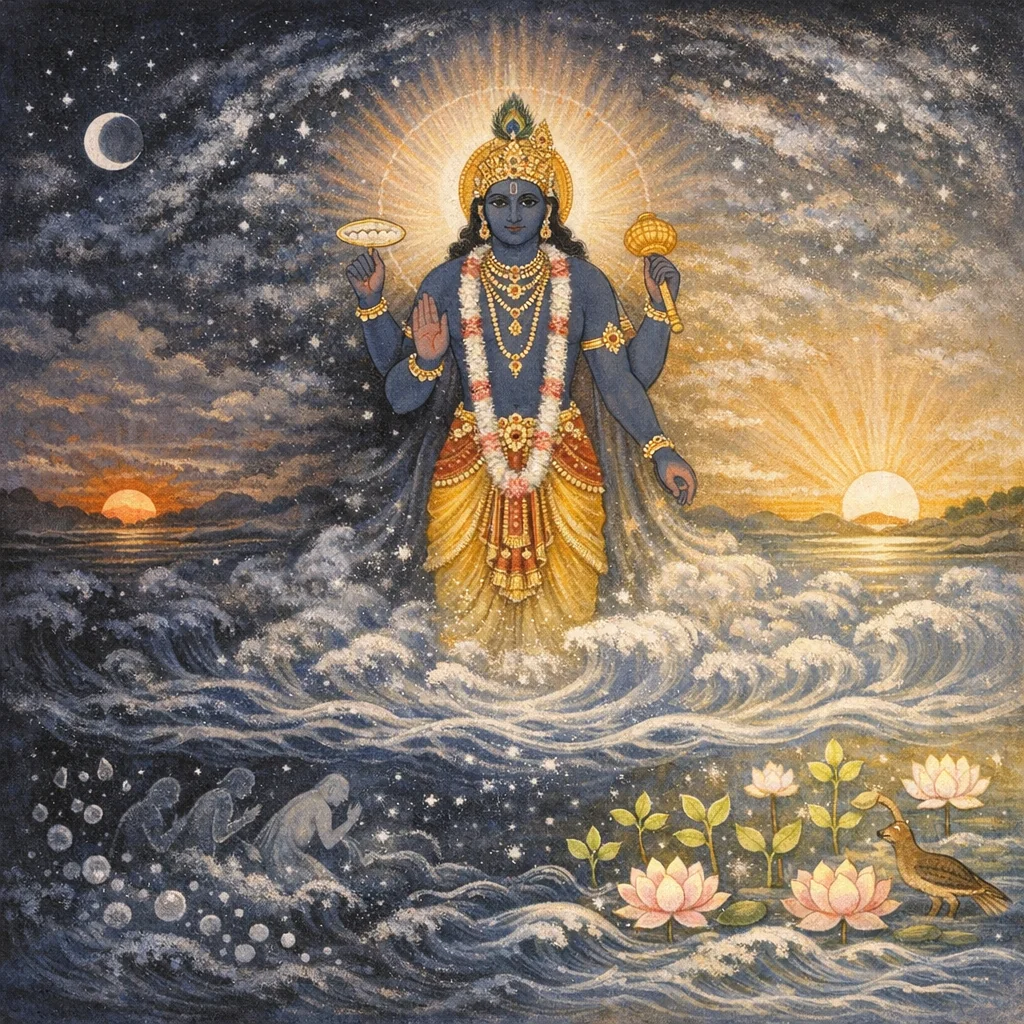
O son of Kuntī, at the end of an aeon all beings enter My nature; at the beginning of an aeon I send them forth again.
‘प्रकृति’ is read in Sāṅkhya-inflected terms as primordial materiality, while devotional readings treat it as ‘My power.’ The verse aligns with cyclical cosmology (kalpa) rather than a single creation event.
FAQs
On a metaphorical level, it can suggest periodic ‘return’ to a baseline (rest, silence, or unformed potential) followed by renewed activity—cycles that structure growth and learning.
The verse presents a cyclic universe: beings manifest from prakṛti under divine agency and are reabsorbed into it at cosmic dissolution, then re-emerge.
After describing divine pervasion, Krishna explains cosmic process: how the manifest world arises and subsides without compromising divine transcendence.
It can be approached as a worldview emphasizing recurrence and regeneration rather than linear finality—useful for interpreting change, loss, and renewal in non-finalistic terms.
Read Bhagavad Gita in the Vedapath app
Scan the QR code to open this directly in the app, with audio, word-by-word meanings, and more.