
Bhagavad Gita — Raja Vidya Raja Guhya Yoga, Shloka 32
Raja Vidya Raja Guhya Yoga
मां हि पार्थ व्यपाश्रित्य येऽपि स्युः पापयोनयः । स्त्रियो वैश्यास्तथा शूद्रास्तेऽपि यान्ति परां गतिम् ॥ ९.३२ ॥
māṁ hi pārtha vyapāśritya ye 'pi syuḥ pāpa-yonayaḥ | striyo vaiśyās tathā śūdrās te 'pi yānti parāṁ gatim || 9.32 ||

Pois, ao tomarem refúgio em Mim, ó Pārtha, mesmo aqueles que fossem de «nascimento pecaminoso» —mulheres, vaiśyas e śūdras— também alcançam o destino supremo.
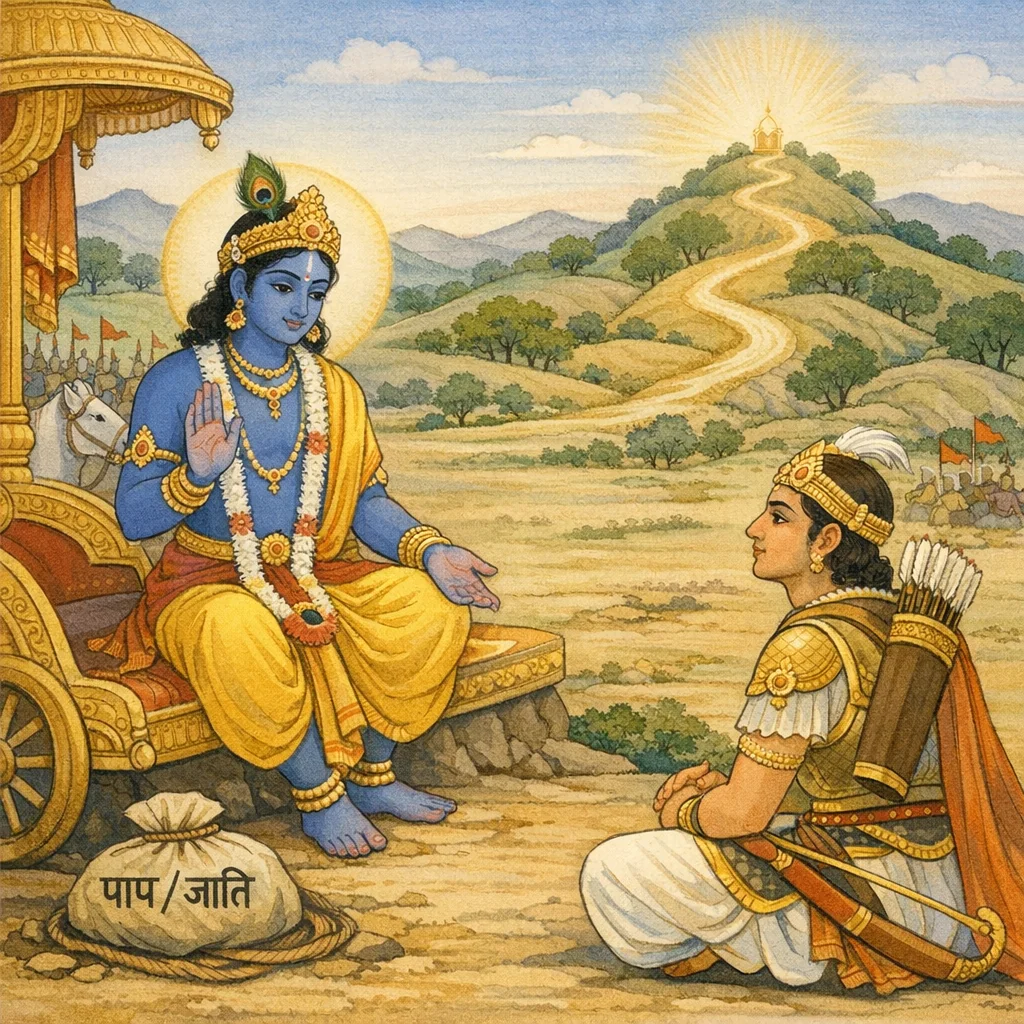
For taking refuge in Me, O Pārtha, even those who are of ‘sinful birth’—women, Vaiśyas, and Śūdras—also attain the supreme goal.
For, O Pārtha, relying upon Me, even those who would be considered of disadvantaged/blemished social origin—women, vaiśyas, and śūdras—those too go to the highest attainment.
The phrase ‘pāpa-yonayaḥ’ is historically tied to social hierarchies of the period and is ethically sensitive today. Many academic notes treat it as reflecting inherited social valuations in the text’s milieu, while the verse’s central doctrinal move is inclusive: access to the ‘highest goal’ is opened through refuge/devotion regardless of social category.
FAQs
It can function as an anti-despair teaching: perceived stigma or marginalization need not determine one’s capacity for meaning, dignity, or spiritual growth.
The verse emphasizes that the decisive factor for the highest attainment is reliance on the supreme (vyapāśritya), not birth-based qualification.
It extends the chapter’s message of accessibility (9.26–9.31) by explicitly naming groups historically treated as having limited ritual privilege, asserting their eligibility for the highest goal through devotion.
Read today, it can support inclusive spiritual communities and the principle that ethical and contemplative capacities are not restricted by social identity.
Read Bhagavad Gita in the Vedapath app
Scan the QR code to open this directly in the app, with audio, word-by-word meanings, and more.