
Bhagavad Gita — Karma Sannyasa Yoga, Shloka 12
Karma Sannyasa Yoga
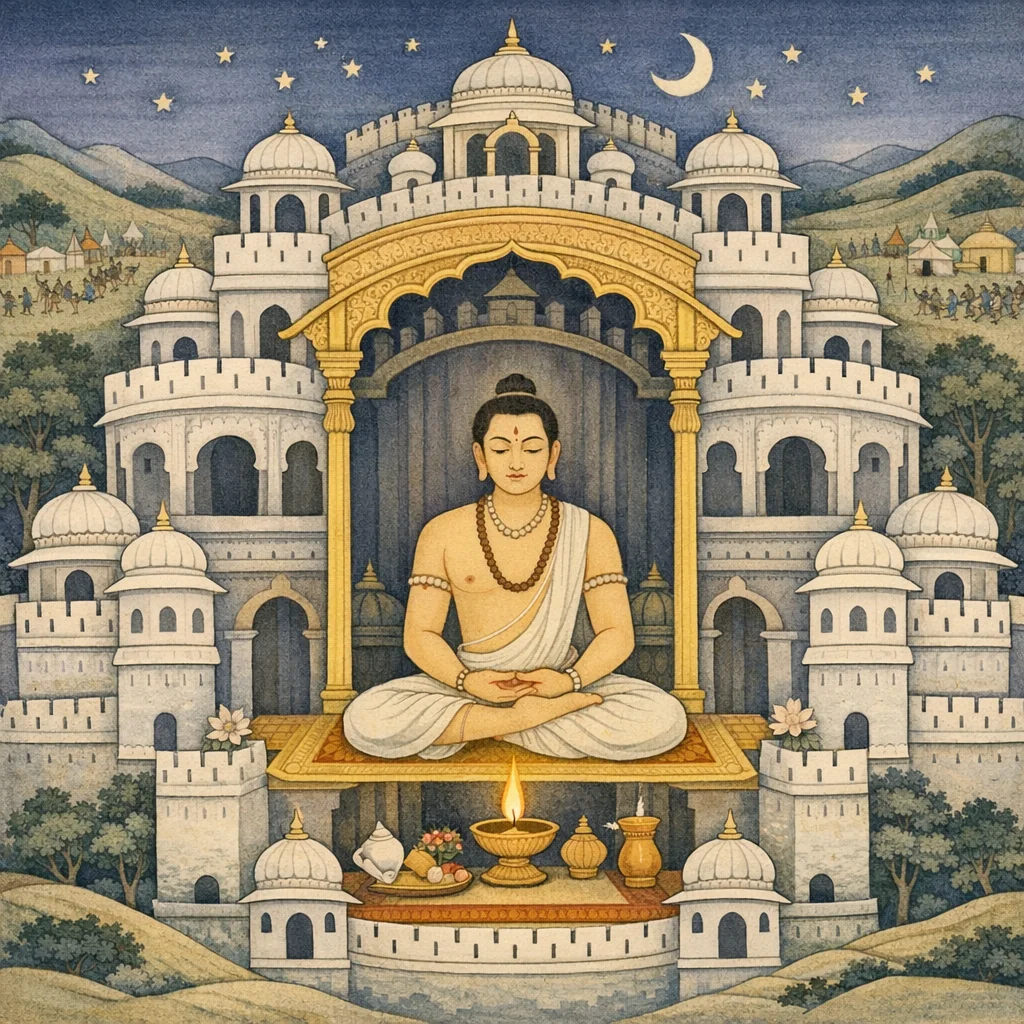
सर्वकर्माणि मनसा संन्यस्यास्ते सुखं वशी । नवद्वारे पुरे देही नैव कुर्वन्न कारयन् ॥ ५.१३ ॥
sarvakarmāṇi manasā saṃnyasyāste sukhaṃ vaśī | navadvāre pure dehī naiva kurvan na kārayan || 5.13 ||

Tendo renunciado com a mente a todas as ações, o senhor de si permanece feliz na cidade de nove portas; não age nem faz agir.
समस्त कर्मों का मन से त्याग करके वशीभूत देही नवद्वार वाली पुरी (शरीर) में सुखपूर्वक रहता है—न करता हुआ, न करवाता हुआ।
Having mentally renounced all actions, the self-controlled embodied one dwells at ease in the city of nine gates, neither acting nor causing action.
“City of nine gates” is a well-known body-metaphor (two eyes, two ears, two nostrils, mouth, and two lower openings). “Neither doing nor causing to do” is interpreted as non-identification with agency, not necessarily denial of empirical causation in embodied life.
FAQs
The metaphor encourages a shift from “I am my impulses” to “I inhabit a system of faculties.” This can reduce reactivity and support calm self-governance.
The verse articulates a layered self-model: the embodied person (dehī) is distinct from bodily gates and actions, enabling the claim of non-agency at the level of the true Self.
It continues the chapter’s teaching that renunciation can be internal (a cognitive and affective stance), compatible with life in the body and society.
Use brief contemplative pauses (“I am aware of seeing/hearing/breathing”) to re-center identity in awareness rather than in momentary impulses.