
Shloka 39
Vishwarupa Darshana Yoga — Vishwarupa Darshana Yoga
वायुर्यमोऽग्निर्वरुणः शशाङ्कः प्रजापतिस्त्वं प्रपितामहश्च ।
नमो नमस्तेऽस्तु सहस्रकृत्वः पुनश्च भूयोऽपि नमो नमस्ते ॥
vāyur yamo ’gnir varuṇaḥ śaśāṅkaḥ prajāpatis tvaṃ prapitāmahaś ca |
namo namas te ’stu sahasrakṛtvaḥ punaś ca bhūyo ’pi namo namas te ||

ତୁମେ ବାୟୁ, ଯମ, ଅଗ୍ନି, ବରୁଣ, ଶଶାଙ୍କ (ଚନ୍ଦ୍ର), ପ୍ରଜାପତି ଏବଂ ପ୍ରପିତାମହ (ବ୍ରହ୍ମା) ହେଉଛ। ତୁମକୁ ସହସ୍ରବାର ନମସ୍କାର, ନମସ୍କାର; ଏବଂ ପୁନଃ ପୁନଃ, ଭୂୟୋ ଭୂୟଃ ନମସ୍କାର, ନମସ୍କାର।
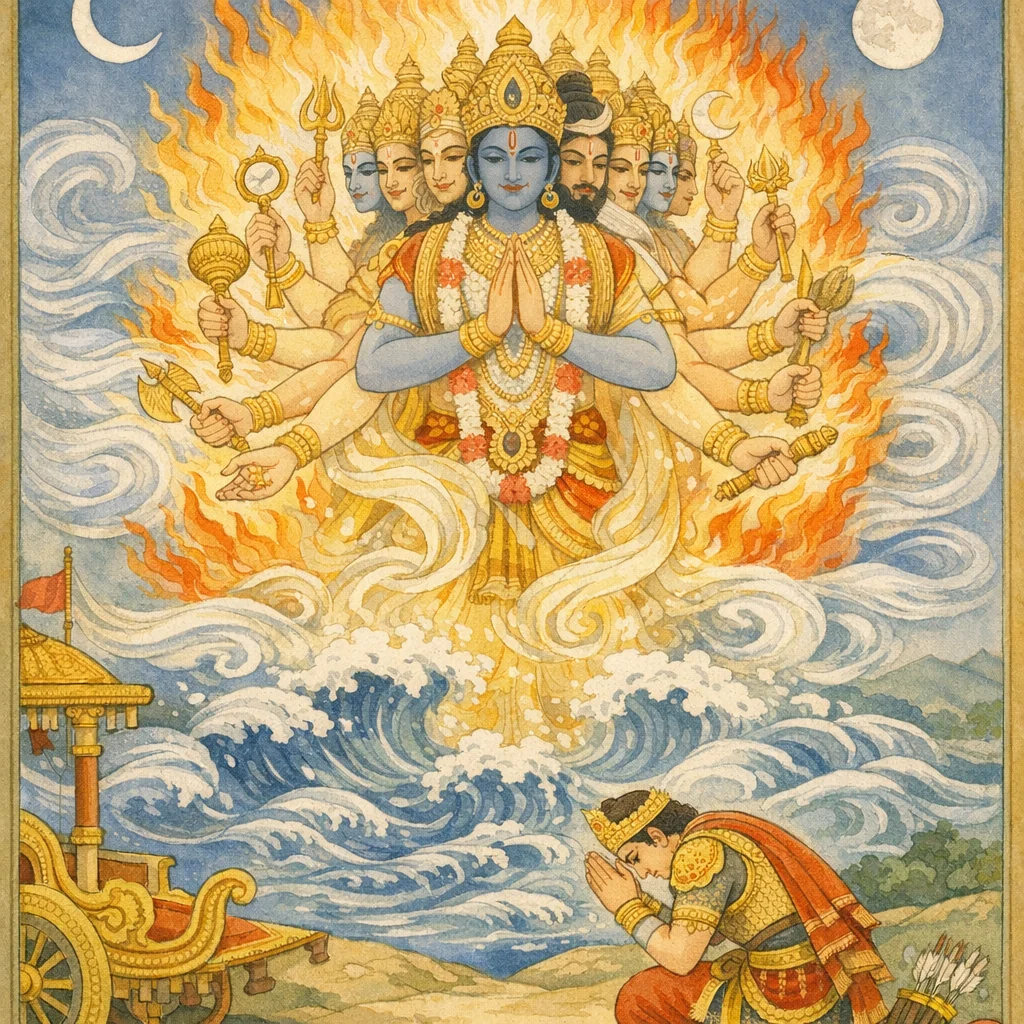
You are Vāyu (the wind-god), Yama (the god of justice/death), Agni (fire), Varuṇa (the lord of waters), the Moon, Prajāpati (the lord of creatures), and the great-grandfather (Brahmā). Salutations, salutations to You a thousand times; and again and again, salutations, salutations to You!
You are (identical with) Vāyu, Yama, Agni, Varuṇa, the Moon, Prajāpati, and the great-grandfather. Homage to you—homage be to you—thousands of times; and again, once more, homage—homage to you.
Most editions read essentially the same. Interpretive differences mainly concern identifying “prapitāmaha” as Brahmā (the cosmic progenitor) and understanding the list as either literal deities or as names for cosmic functions subsumed in the singular divine reality revealed in the viśvarūpa.
FAQs
The verse reflects an intense shift from analytical questioning to reverential surrender: Arjuna responds to an overwhelming experience by organizing it through familiar categories (major deities and cosmic functions) and stabilizing himself through repeated acts of homage.
Philosophically, it articulates a monistic or integrative claim: diverse powers—natural (wind, fire, moon), moral-regulative (Yama), and generative (Prajāpati, the primordial ancestor)—are presented as expressions of one ultimate reality encountered in the viśvarūpa.
In Chapter 11, Arjuna beholds the universal form. Verse 39 belongs to his hymn of praise, where he identifies the vision with the principal Vedic-cosmic deities and affirms Krishna as the encompassing ground of the cosmos.
The verse can be read as a practice of seeing interconnectedness: recognizing that forces shaping life—nature, time, ethics, and creativity—can be approached with humility and responsibility, encouraging reverence toward the larger systems that sustain human existence.