Dashati 9
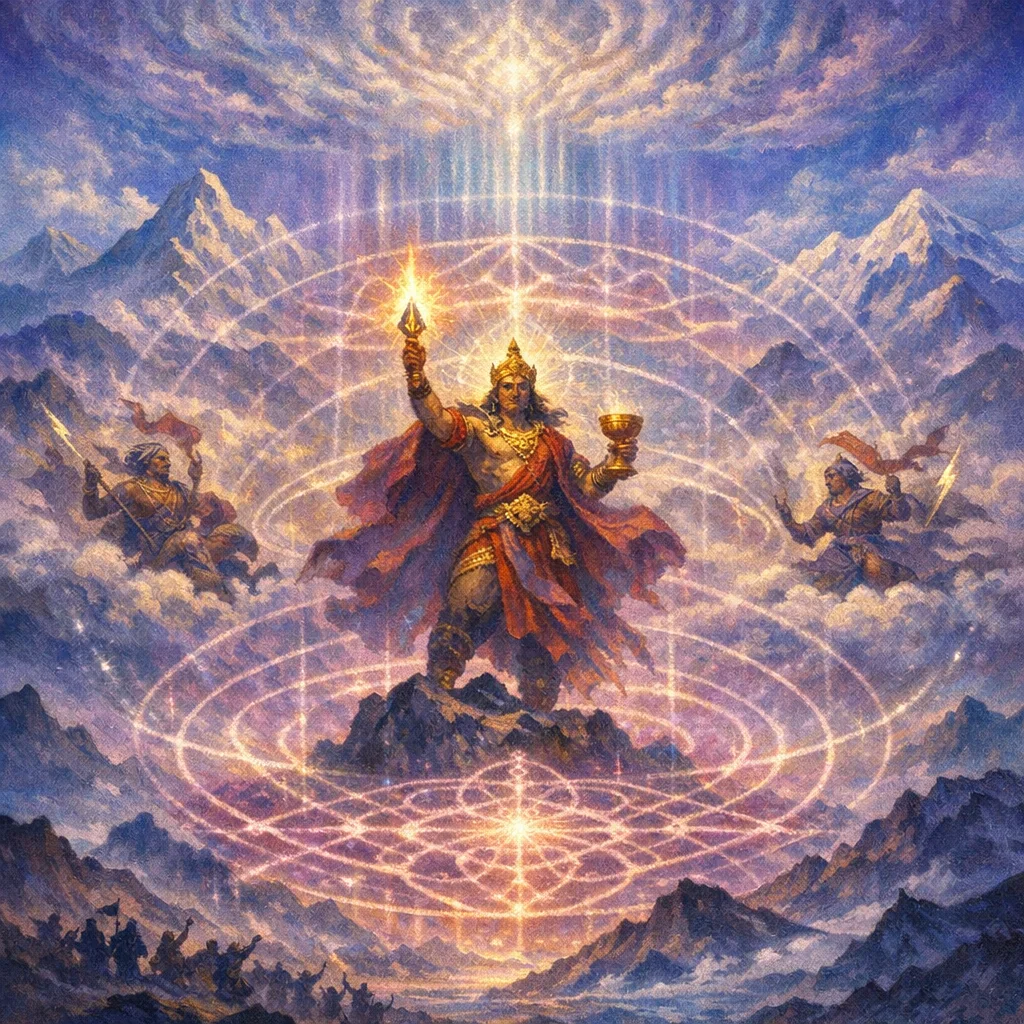
Aindra stuti: Indra as the collectively ‘fashioned’ and manifest power who conquers battles and grants sovereignty through soma-inspired praise
Indra
Vīra (heroic) and utsāha (invigorating) with a devotional warmth in the embracing imagery
Rṣi not specified in the provided data; in Sāmavedic practice these verses are treated chiefly by their gāna assignment rather than rṣi-lineage emphasis unless identified from the Ṛgvedic source.
Primarily Soma-yajña usage: Indra praised as soma-drinker (pitumat/mandin) whose empowerment yields victory and rain.
Mantras
Mantra 1
विश्वाः पृतना अभिभूतरं नरः सजूस्ततक्षुरिन्द्रं जजनुश्च राजसे क्रत्वे वरे स्थेमन्यामुरीमुतोग्रमोजिष्ठं तरसं तरस्विनम्
All conflicts the worshippers, of one accord, have fashioned and generated Indra, the more-than-conquering, for sovereignty and for excellent might; they have attained firm station—yea, him the most victorious in the host, the strong, the impetuous.
Mantra 2
श्रत्ते दधामि प्रथमाय मन्यवे ऽहन्यद्दस्युं नर्यं विवेरपः उभे यत्वा रोदसी धावतामनु भ्यसात्ते शुष्मात्पृथिवी चिदद्रिवः
In thee I place my faith for thy foremost ardour: thou smotest the Dasyu, the foe of men; thou didst rend him. Both worlds followed in their course; through thy might even the earth, O bolt-armed, was made to tremble.
Mantra 3
समेत विश्वा ओजसा पतिं दिवो य एक इद्भूरतिथिर्जनानाम् स पूर्व्यो नूतनमाजिगीषं तं वर्त्तनीरनु वावृत एक इत्
All (powers) have assembled with vigour unto the lord of heaven, who alone hath become the guest of men; ancient, yet seeking ever to win anew, he alone moves onward along the paths.
Mantra 4
इमे त इन्द्र ते वयं पुरुष्टुत ये त्वारभ्य चरामसि प्रभूवसो न हि त्वदन्यो गिर्वणो गिरः सघत्क्षोणीरिव प्रति तद्धर्य नो वचः
These are thine, Indra; we, O much-praised, relying upon thee, proceed (in our acts), O abounding in wealth: for none other than thou, accepter of praise, receiveth hymns; therefore accept our utterance in return, as the earth (receiveth the seed).
Mantra 5
चर्षणीधृतं मघवानमुक्थ्या3मिन्द्रं गिरो बृहतीरभ्यनूषत वावृधानं पुरुहूतं सुवृक्तिभिरमर्त्यं जरमाणं दिवेदिवे
Lofty hymns have been chanted unto Indra, the bountiful, upheld by men, worthy of the uktha; him, ever increasing, much-invoked, with well-uttered praises—immortal, enduring—day by day.
Mantra 6
अच्छा व इन्द्रं मतयः स्वर्युवः सध्रीचीर्विश्वा उशतीरनूषत परि ष्वजन्त जनयो यथा पतिं मर्यं न शुन्ध्युं मघवानमूतये .
Towards Indra, verily, the devout thoughts, seeking heaven, all harmonious and eager, have sounded forth; they embrace him round about, as wives a husband, as women a youthful and splendid lord—the bountiful—for succour.
Mantra 7
अभि त्यं मेषं पुरुहूतमृग्मियमिन्द्रं गीर्भिर्मदता वस्वो अर्णवम् यस्य द्यावो न विचरन्ति मानुषं भुजे मंहिष्ठमभि विप्रमर्चत .
Praise, O opulent priests, with hymns that Indra, the impetuous, the much-invoked, the theme of sacred verses, rejoicing in the abundant Soma-flood; he, whose heavens move not among men, is the most liberal for our enjoyment: worship that wise and mighty one.
Mantra 8
त्यं सु मेषं महया स्वर्विदं शतं यस्य सुभुवः साकमीरते अत्यं न वाजं हवनस्यदं रथमेन्द्रं ववृत्यामवसे सुवृक्तिभिः .
Him, verily, the impetuous Indra, the finder of heaven, the hundred-powered, whose auspicious powers are stirred together, him, like a swift steed, the giver of the reward of invocation, we would bring in his chariot for our protection, with well-ordered praises.
Mantra 9
घृतवती भुवनानामभिश्रियोर्वी पृथ्वी मधुदुघे सुपेशसा द्यावापृथिवी वरुणस्य धर्मणा विष्कभिते अजरे भूरिरेतसा
Rich in clarified butter, and in the splendour of all beings, the vast Earth yields sweetness, of comely aspect; Heaven and Earth, by the ordinance of Varuṇa, are upheld apart, unaging, of abundant generative power.
Mantra 10
उभे यदिन्द्र रोदसी आपप्राथोषा इव महान्तं त्वा महीनां सम्राजं चर्षणीनाम् देवी जनित्र्यजीजनद्भद्रा जनित्र्यजीजनत्
When, O Indra, thou hast filled both worlds, like the Dawn spreading, the divine mother bore thee great, the universal sovereign of the mighty, the king of men; the auspicious mother bore thee.
Mantra 11
प्र मन्दिने पितुमदर्चता वचो यः कृष्णगर्भा निरहन्नृजिश्वना अवस्यवो वृषणं वज्रदक्षिणं मरुत्वन्तं सख्याय हुवेमहि
Utter forth the hymn to Indra, exhilarated, abounding in the draught; who, with straight-going might, smote down the dark-wombed (clouds): we, seeking protection, invoke for friendship the vigorous, thunderbolt-armed, Marut-attended (deity).
Frequently Asked Questions
In Vedic idiom, Indra is ‘made present’ through stotra and offerings. The hymn and soma do not create the god, but manifest his power in the ritual moment.
It commonly refers to rain-bearing clouds described as dark within. Indra’s strike symbolizes releasing waters and removing obstruction, bringing fertility and relief.
The Maruts are Indra’s storm-companions. Mentioning them highlights Indra’s battle-and-rain force as a coordinated power and frames the invocation as a request for protective friendship (sakhyā).