
Bhagavad Gita — Gunatraya Vibhaga Yoga, Shloka 21
Gunatraya Vibhaga Yoga
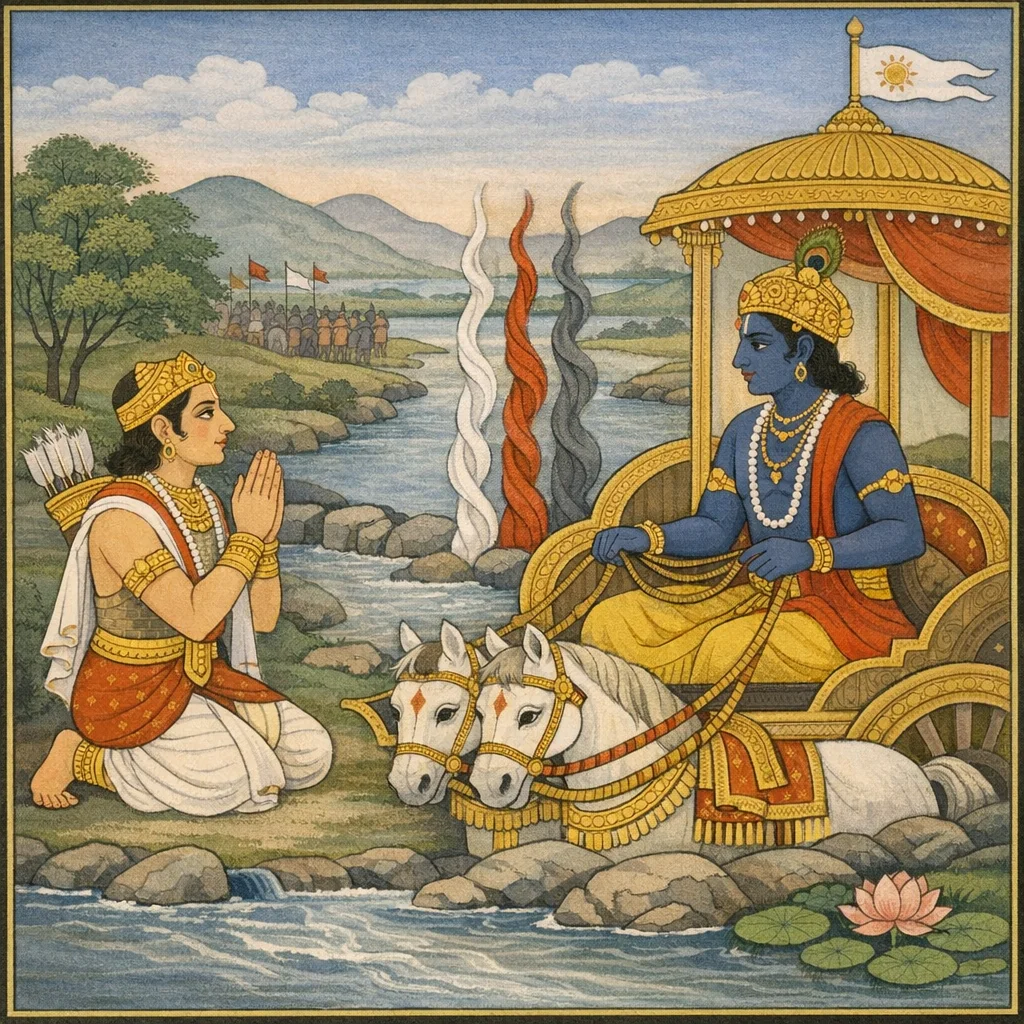
अर्जुन उवाच । कैर्लिङ्गैस्त्रीन्गुणानेतानतीतो भवति प्रभो किमाचारः कथं चैतांस्त्रीन्गुणानतिवर्तते ॥ १४.२१ ॥
arjuna uvāca | kair liṅgais trīn guṇān etān atīto bhavati prabho | kim ācāraḥ kathaṃ caitāṃs trīn guṇān ativartate || 14.21 ||

Arjuna berkata: Wahai Tuhan, dengan tanda-tanda apakah seseorang diketahui telah melampaui tiga guṇa ini? Bagaimanakah tingkah lakunya, dan bagaimana dia melampaui tiga guṇa ini?
Arjuna said: By what marks is one known to have transcended these three guṇas, O Lord? What is his conduct, and how does he go beyond these three guṇas?
Arjuna said: By what signs does one become (or is known as) beyond these three guṇas, O Master? What is his comportment, and how does he transcend these three guṇas?
The verse is a straightforward inquiry. Some translations nuance whether the signs are epistemic (how to recognize) or developmental (how one becomes). Both senses are grammatically plausible in context.
FAQs
Arjuna’s question shifts from theory to observable traits: how a transformed person thinks, reacts, and behaves in daily life.
It asks how transcendence of prakṛti’s qualities is manifested in an embodied person, implying a distinction between ultimate realization and its empirical expression.
This question prompts Krishna’s ensuing description (14.22–25) of the guṇātīta’s equanimity and non-reactivity toward the guṇas.
It encourages readers to seek concrete behavioral indicators—reduced reactivity, steadiness, ethical consistency—rather than relying only on abstract claims of insight.
Read Bhagavad Gita in the Vedapath app
Scan the QR code to open this directly in the app, with audio, word-by-word meanings, and more.