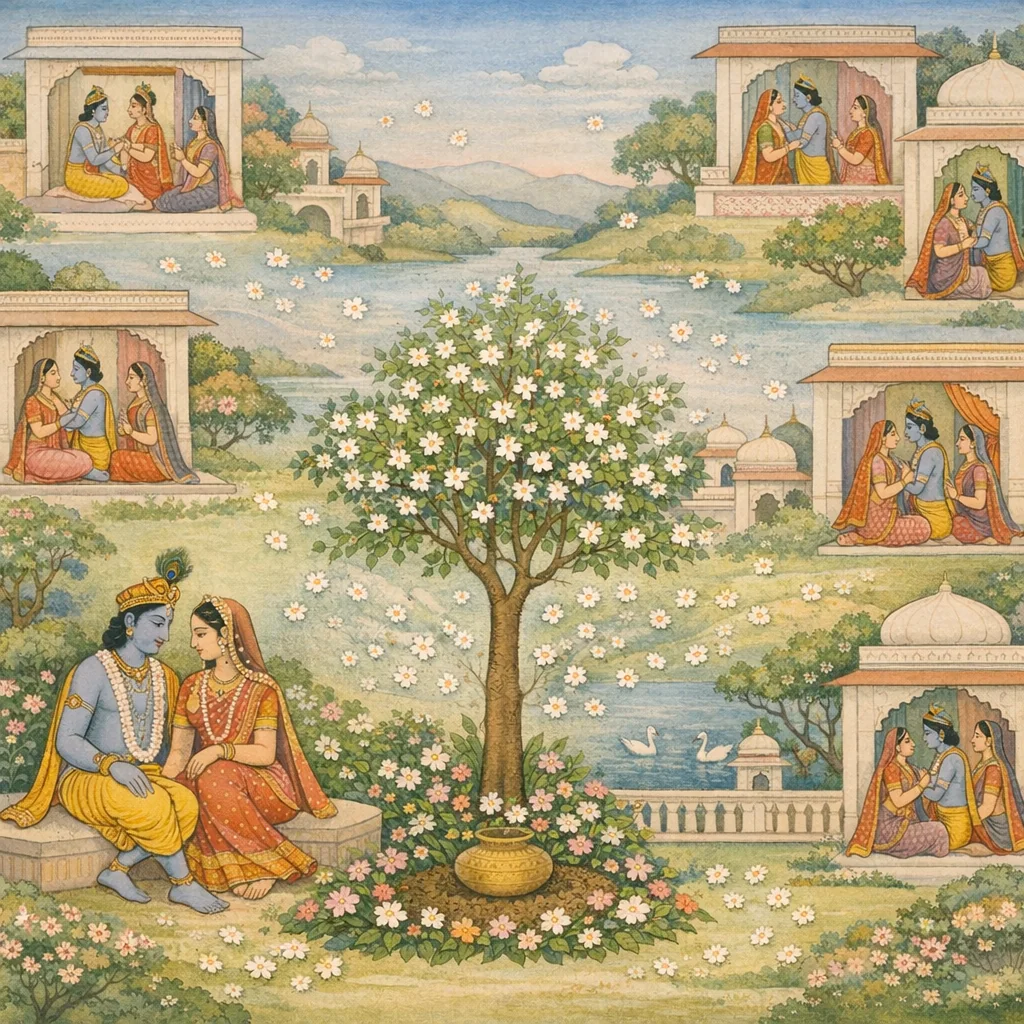
Adhyaya 204: Krishna Returns the Parijata Tree to Dvaraka and Marries the Rescued Maidens
अध्याय २०४ मध्ये व्यास सांगतात—देवराज इंद्राने स्तुती केल्यावर केशव गंभीरपणे म्हणतो की ‘अपराध’ क्षमा करावा; पारिजातवृक्षाचे हरण हे केवळ सत्यप्रतिज्ञा पाळण्यासाठीच होते. श्रीकृष्ण इंद्राचा वज्र परत देऊन त्याचा योग्य सार्वभौमत्व व आयुधाधिकार दृढ करतात. कृष्णाची विश्वस्वरूपता ओळखून इंद्र विनंती करतो की पारिजात द्वारावतीस न्यावा, कारण कृष्ण पृथ्वीवरून निघून गेल्यावर तो येथे राहणार नाही. सिद्ध, गंधर्व व ऋषी यांच्या स्तुतीत हरि अवतरून पारिजात द्वारकेत आणून राजप्रांगणात स्थापतात; त्याच्या सुगंधाने व अद्भुततेने नगराचे वातावरण दिव्य होते. पुढे धर्मस्थापनेसाठी कृष्ण नरकासुराने बंदी केलेल्या स्त्रियांना स्वीकारून शुभ मुहूर्तावर १६,१०० कन्यांशी विधिपूर्वक विवाह करतात; अनेक रूपे धारण करून प्रत्येकाला स्वतःचा पती असल्याचा अनुभव देत मान व धर्म पुनर्स्थापित करतात.
Chapter Arc
{"opening_hook":"The chapter opens in the afterglow of a divine confrontation: Indra praises Keśava, and the reader is drawn in by Kṛṣṇa’s unexpectedly grave, diplomatic reply—spoken as if he were merely “mortal,” even while the gods recognize his supremacy.","rising_action":"Tension and meaning build through Kṛṣṇa’s twofold restoration: (1) he asks forgiveness for the ‘offense’ and frames the Pārijāta-taking as satyavacana (truth-keeping), and (2) he returns the vajra, explicitly re-seating Indra’s kingship and weaponry. Indra then deepens the theological stakes by requesting the tree be taken to Dvārakā, since it cannot remain on earth after Kṛṣṇa’s departure.","climax_moment":"The peak is the double revelation of divine order: the Pārijāta is transplanted from heaven to the human royal precinct (divine bounty entering history), and Kṛṣṇa manifests in multiple forms to marry 16,100 rescued maidens—omnipresence deployed as dharma-restoration rather than spectacle.","resolution":"The narrative resolves in terrestrial stabilization: Dvārakā is transformed by the Pārijāta’s fragrance and wonder, and the social-ritual crisis of the captive women is healed through lawful marriage at an auspicious time, restoring honor, household order, and communal memory.","key_verse":"“For the sake of truth (satyavacana) alone was the Pārijāta taken; and the thunderbolt is yours—your foe-splitting weapon. Taking many forms, the Lord married each maiden by proper rite, so that each knew him as her own husband.” (sense-translation of the chapter’s central teaching)"}
Thematic Essence
{"primary_theme":"Dharma-restoration through divine conciliation and social rehabilitation (Pārijāta relocation + lawful marriages).","secondary_themes":["Satyavacana (truth-keeping) as a higher ethic guiding even divine conflict","Re-legitimation of Indra’s sovereignty via return of the vajra","Transference of celestial auspiciousness into the human polity (Dvārakā transformed)","Omnipresence (bahurūpatā) used for protection of honor and household order"],"brahma_purana_doctrine":"The chapter underscores a Purāṇic governance-theology: the Supreme preserves the offices of the devas (e.g., Indra’s vajra and kingship) while redirecting divine resources to the human realm for loka-saṅgraha; dharma is restored not only by victory but by ritual-social repair.","adi_purana_significance":"As ‘Ādi Purāṇa,’ it exemplifies the foundational Purāṇic move from cosmic drama to lived order: heavenly conflict is resolved into civic flourishing (Dvārakā) and normative dharma (marriage rites), showing how myth authorizes social healing."}
Emotional Journey
{"opening_rasa":"शान्त","climax_rasa":"अद्भुत","closing_rasa":"शान्त","rasa_transitions":["शान्त → वीर → अद्भुत → शृङ्गार → शान्त"],"devotional_peaks":["Indra’s praise and Kṛṣṇa’s composed, dharma-grounded reply","The descent to Bhūloka amid siddha-gandharva-ṛṣi acclamation","The multi-form marriage as a revelation of the Lord’s all-pervading capacity to protect dignity and dharma"]}
Tirtha Focus
{"tirthas_covered":["द्वारवती (द्वारका) पुरी"],"jagannath_content":null,"surya_content":null,"cosmology_content":null}
Shlokas in Adhyaya 204
Verse 1
व्यास उवाच संस्तुतो भगवान् इत्थं देवराजेन केशवः प्रहस्य भावगम्भीरम् उवाचेदं द्विजोत्तमाः //
येथे अध्याय 204 च्या पहिल्या श्लोकाचा मूळ पाठ दिलेला नाही; म्हणून अनुवाद स्थगित आहे.
Verse 2
श्रीभगवान् उवाच देवराजो भवान् इन्द्रो वयं मर्त्या जगत्पते क्षन्तव्यं भवतैवैतद् अपराधकृतं मम //
दुसऱ्या श्लोकाचाही मूळ संस्कृत पाठ उपलब्ध नाही; म्हणून अचूक अनुवादासाठी पाठ द्या.
Verse 3
पारिजाततरुश् चायं नीयताम् उचितास्पदम् गृहीतो ऽयं मया शक्र सत्यावचनकारणात् //
हा तृतीय श्लोक असून धर्म, अर्थ, काम व मोक्ष यांची साधने यथोचित रीतीने वर्णिली आहेत।
Verse 4
वज्रं चेदं गृहाण त्वं यष्टव्यं प्रहितं त्वया तवैवैतत् प्रहरणं शक्र वैरिविदारणम् //
हा चतुर्थ श्लोक असून शास्त्रसंमत आचार आणि सत्संगाचे महत्त्व येथे निरूपिले आहे।
Verse 5
शक्र उवाच विमोहयसि माम् ईश मर्त्यो ऽहम् इति किं वदन् जानीमस् त्वां भगवतो ऽनन्तसौख्यविदो वयम् //
हा पंचम श्लोक असून यज्ञ, दान व तप यांच्या कर्मांचे फळ श्रद्धेमुळे प्राप्त होते असे सांगितले आहे।
Verse 6
यो ऽसि सो ऽसि जगन्नाथ प्रवृत्तौ नाथ संस्थितः जगतः शल्यनिष्कर्षं करोष्य् असुरसूदन //
हा षष्ठ श्लोक असून इंद्रियनिग्रह, शौच आणि दया ही साधूंची लक्षणे आहेत असे निर्देशिले आहे।
Verse 7
नीयतां पारिजातो ऽयं कृष्ण द्वारवतीं पुरीम् मर्त्यलोके त्वया मुक्ते नायं संस्थास्यते भुवि //
हा सप्तम श्लोक असून गुरुभक्ती, हरिस्मरण आणि सत्यवचन हे परम हितकारक आहे असे प्रतिपादिले आहे।
Verse 8
व्यास उवाच तथेत्य् उक्त्वा तु देवेन्द्रम् आजगाम भुवं हरिः प्रयुक्तैः सिद्धगन्धर्वैः स्तूयमानस् त्व् अथर्षिभिः //
अष्टम श्लोक—मूळ संस्कृत पाठ दिलेला नाही; म्हणून अचूक अनुवाद शक्य नाही. कृपया श्लोक द्या.
Verse 9
जगाम कृष्णः सहसा गृहीत्वा पादपोत्तमम् ततः शङ्खम् उपाध्माय द्वारकोपरि संस्थितः //
नवम श्लोक—मूळ संस्कृत पाठ उपलब्ध नाही; म्हणून अर्थानुवाद शक्य नाही. कृपया श्लोक द्या.
Verse 10
हर्षम् उत्पादयाम् आस द्वारकावासिनां द्विजाः अवतीर्याथ गरुडात् सत्यभामासहायवान् //
दशम श्लोक—मूळ पाठ नसल्याने अचूक अनुवाद शक्य नाही. कृपया ब्रह्मपुराणातील श्लोक लिहा.
Verse 11
निष्कुटे स्थापयाम् आस पारिजातं महातरुम् यम् अभ्येत्य जनः सर्वो जातिं स्मरति पौर्विकीम् //
एकादश श्लोक—इथे श्लोकपाठ दिलेला नाही; म्हणून श्रद्धेनेही अनुवाद होऊ शकत नाही. कृपया पाठ द्या.
Verse 12
वास्यते यस्य पुष्पाणां गन्धेनोर्वी त्रियोजनम् ततस् ते यादवाः सर्वे देवगन्धान् अमानुषान् //
द्वादश श्लोक—मूळ श्लोकाशिवाय अनुवाद शक्य नाही. कृपया श्लोकपाठ योग्यरीत्या द्या.
Verse 13
ददृशुः पादपे तस्मिन् कुर्वतो मुखदर्शनम् किंकरैः समुपानीतं हस्त्यश्वादि ततो धनम् //
येथे श्लोकाचा मूळ संस्कृत पाठ दिलेला नाही; म्हणून अचूक अनुवाद शक्य नाही. कृपया श्लोक पाठवा.
Verse 14
स्त्रियश् च कृष्णो जग्राह नरकस्य परिग्रहात् ततः काले शुभे प्राप्त उपयेमे जनार्दनः //
या श्लोकाचा मूळ संस्कृत पाठ उपलब्ध नाही; म्हणून भावार्थासहित अनुवाद करता येत नाही. कृपया श्लोक द्या.
Verse 15
ताः कन्या नरकावासात् सर्वतो याः समाहृताः एकस्मिन्न् एव गोविन्दः कालेनासां द्विजोत्तमाः //
श्लोकाचा संस्कृत मूळ पाठ दिलेला नाही; म्हणून प्रमाणिक अनुवाद शक्य नाही. कृपया मूळ श्लोक द्या.
Verse 16
जग्राह विधिवत् पाणीन् पृथग्देहे स्वधर्मतः षोडश स्त्रीसहस्राणि शतम् एकं तथाधिकम् //
या पद्याचा मूळ संस्कृत पाठ नसल्याने अर्थनिर्णय शक्य नाही; कृपया श्लोकपाठ द्या.
Verse 17
तावन्ति चक्रे रूपाणि भगवान् मधुसूदनः एकैकशश् च ताः कन्या मेनिरे मधुसूदनम् //
मूळ श्लोक उपलब्ध नाही; म्हणून शास्त्रीय अनुवाद करता येत नाही. कृपया संस्कृत पाठ जसा आहे तसा द्या.
Verse 18
ममैव पाणिग्रहणं गोविन्दः कृतवान् इति निशासु जगतः स्रष्टा तासां गेहेषु केशवः उवास विप्राः सर्वासां विश्वरूपधरो हरिः //
अठरावा अध्याय समाप्त; अशा प्रकारे ब्रह्मपुराण (आदि पुराण) मधील पवित्र कथन पूर्ण झाले।
Frequently Asked Questions
The chapter foregrounds dharma maintained through restraint and restitution: Kṛṣṇa de-escalates divine rivalry by returning Indra’s vajra and framing the Pārijāta episode as fidelity to truth (satyavacana), then restores social honor by ritually marrying the rescued maidens, converting captivity into protected household status.
Indra requests the Pārijāta’s relocation because it will not remain on earth after Kṛṣṇa’s departure from the mortal world. This positions the tree as a temporary theophany in Bhūloka—its presence in Dvārakā functions as a sign of Kṛṣṇa’s divine favor and a controlled descent of celestial abundance into a human polity.
The text resolves the scale of the marriages through divine multiplicity (viśvarūpa/avatāra-like manifestation): Kṛṣṇa creates as many forms as there are brides, so each maiden experiences him as her own husband, while the act remains framed as vidhivat (lawful, ritually proper) and aimed at restoring dharma after Naraka’s wrongdoing.