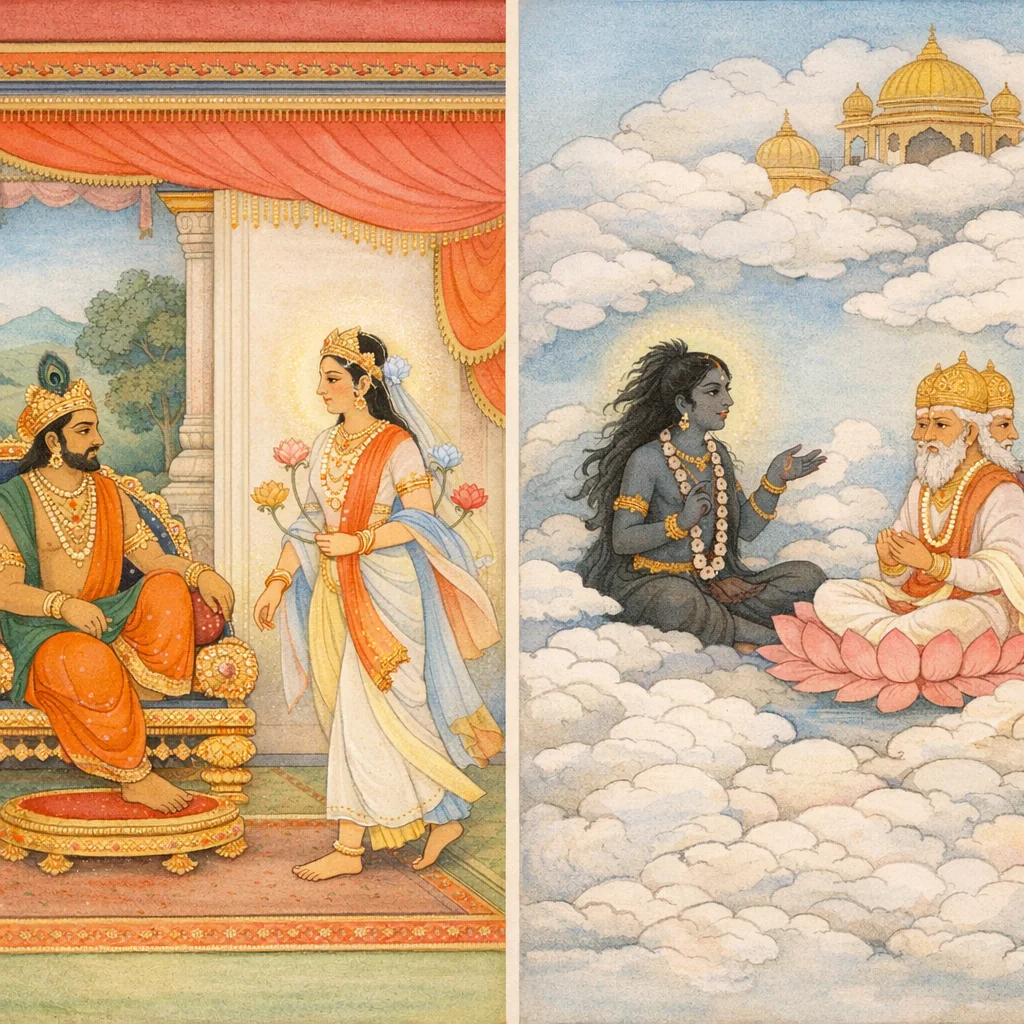
Adhyaya 48: Kali’s Complaint to Brahma and the Arrival of Śrī (Jayaśrī) in Bali’s Court
कलिब्रह्मसंवादः—बलौ श्रीजयश्रीप्रवेशः (Kali-Brahma-saṃvādaḥ—Balau Śrī-Jayaśrī-praveśaḥ)
Arrival of Jayashri
Within the Pulastya–Nārada dialogue-frame, this adhyāya depicts a paradoxical ‘Kṛta-like’ restoration of dharma under the asura-king Bali after the devas withdraw toward Brahmaloka. Kali, seeing the world stabilized by asura-dharma and the fourfold supports of righteousness, approaches Brahmā to protest the loss of his own adharmic ‘svabhāva’; Brahmā replies that Bali’s power subdues not only Kali but even the devas, and that only Hari (Vişṇu/Trivikrama-to-be) can ultimately check Bali. The narrative then shifts to an iconographic and sociological mapping of Śrī’s differentiated manifestations—white/red/yellow/blue forms aligned with the three guṇas, varṇas, and ritual spheres—together with the associated ‘nidhis’ (Mahāpadma, Padma, Mahānīla, Śaṅkha) and the ethical typologies of persons who ‘take refuge’ in them. Finally, Jayaśrī explicitly chooses Bali for his valor, and a cluster of virtues (hrī, dhī, dhṛti, kīrti, etc.) are said to abide in him, portraying Bali’s reign as a temporary dharmic order that sets the stage for Viṣṇu’s later intervention.
Divine Beings
Sacred Geography
Mortal & Asura Figures
Key Content Points
- Pulastya narrates to Nārada how Bali rules the three worlds in a dharma-aligned manner, prompting Kali to seek refuge with Brahmā and complain that his nature has been suppressed.
- Brahmā’s theological assessment: Bali’s dominance humbles even Indra and other devas; only Hari (Viṣṇu) is presented as the ultimate counterforce—an implicit bridge toward the Vāmana/Trivikrama arc.
- Iconographic and ethical taxonomy of Śrī/Jayaśrī: four color-forms linked to guṇas and varṇa-ritual domains, the four nidhis (Mahāpadma, Padma, Mahānīla, Śaṅkha), and the corresponding moral profiles of humans; Jayaśrī enters Bali and virtues congregate around him.
Shlokas in Adhyaya 48
Verse 7
मयो ऽपि मायामास्थाय तैस्तै रूपान्तरैर्मुने योधयामास बलावान् सुराणां च वरूछिनीम्
And Maya too, resorting to his māyā, O sage, fought by means of various transformations of form, powerfully assailing the radiant host of the gods.
Verse 8
विद्युज्जिह्वः प्ररिभद्रो वृषपर्वा शतेक्षणः विपाको विक्षरः सैन्यं ते ऽपि देवानुपाद्रवन्
Vidyujjihva, Praribhadra, Vṛṣaparvā, Śatekṣaṇa, Vipāka, and Vikṣara—along with their forces—also attacked the gods.
Verse 9
ते हन्यमाना दितिजैर्देवाः शक्रपुरोगमाः गते जनार्दने देवे प्रायशो विमुख्याभवन्
When Janārdana (Viṣṇu) had departed, the gods—led by Śakra (Indra)—being struck down by the sons of Diti (the Daityas), for the most part turned away in defeat (lost heart and retreated).
Verse 10
तान् प्रभग्नान् सुरगाणान् बलिबाणापुरोगमाः पृष्ठतश्चाद्रवन् सर्वे त्रैलोक्यविजिगीषवः
Viṣṇu as Mādhava (iconic four-armed form with śaṅkha-cakra-gadā)
Verse 19
विविधानपि भोगांश्च भुञ्जन् दैत्येश्वरो बलि सस्मार मनसा ब्रह्मन् प्रह्लादं स्वपितामहम्
While enjoying various pleasures, Bali—the lord of the Daityas—remembered in his mind, O Brāhmaṇa, his own grandfather Prahlāda.
Verse Śakra (Indra) came to the wondrous bank of the Mahānadī; and
संस्मृतो नप्तृणा चासौ महाभागवतो ऽसुरः समभ्यागात् त्वरायुक्तः पातालात् स्वर्गमव्ययम्
అక్కడ శక్రుడు (ఇంద్రుడు) మహానది యొక్క అద్భుత తీరానికి వచ్చి, దేవుని ఆరాధనార్థం ఆశ్రమం నిర్మించి అక్కడే నివసించాడు।
Verse pulindāḥ ||"
न सा पालयतो राज्यं धृतिर्भवति सत्तम या धृतिर्गुरुशुश्रुषां कुर्वतो जायते विभो
அப்போது அவர் கொடிய செயல்கள் புரியும், ‘புலிந்தர்’ என அழைக்கப்படும்—என் பாவத்திலிருந்து தோன்றிய—அவர்களை நோக்கி: “ஓ புலிந்தர்களே! ஹிமாத்ரி மற்றும் காலிஞ்ஜர மலைகளுக்கிடையிலுள்ள இடைநிலப் பகுதியில் நீங்கள் குடியிருங்கள்” என்று கூறினார்.
Verse 31
सोपविष्टो महेन्द्रस्य सर्वरत्नमये शुभे सिंहहासने दैत्यपतिः शुशुभे मघवानिव
Seated there upon the auspicious lion-throne of Mahendra, fashioned of every kind of jewel, the lord of the Daityas shone forth—like Maghavan (Indra) himself.
Verse 32
तत्रोपविष्टश्चैवासौ कृताञ्जलिपुटो नतः प्रह्लादं प्राह वचनं मेघगम्भीरया गिरा
And seated there, he—bowed and with hands joined in reverence—addressed Prahlāda in words spoken with a voice deep as thunderclouds.
Verse 33
यन्मया तात कर्तव्यं त्रैलोक्यं परिरक्षता धर्मार्थकाममोक्षेभ्यस्तदादिशतु मे भवान्
‘O dear father/elder, what should be done by me, as one who protects the three worlds? Let you instruct me concerning dharma, artha, kāma, and mokṣa.’
Verse 34
तद्वाक्यसम कालं च शुक्रः प्रह्लादमब्रवीत् यद्युक्तं तन्महाबाहो वदस्वाद्योत्तरं वचः
At that very moment, after those words were spoken, Śukra addressed Prahlāda: “O mighty-armed one, if it is proper, speak now in reply—utter your answering statement.”
Verse 35
वचनं बलिशुक्राभ्यां श्रुत्वा भागवतो ऽसुरः प्राह धर्मार्थसंयुक्तं प्रह्लादो वाक्यमुत्तमम्
Having heard the words of Bali and Śukra, the devoted Asura—Prahlāda—spoke an excellent statement, joined with dharma and artha (righteousness and practical good).
Verse 36
यदायत्यां क्षमं राजन् यद्धितं भुवनस्य च अविरोधेन धर्मस्य अर्थस्योपार्जनं च यत्
“O King, that which is sustainable for the future, and that which is beneficial for the world; and that acquisition of artha (resources/power) which occurs without conflicting with dharma—[that is what should be chosen].”
Verse 37
सर्वसत्त्वानुगमनं कामवर्गफलं च यत् परत्रेह च यच्छ्रेयः पुत्र तत्कर्म आरच
“That action, my son, should be undertaken—(the action) which follows (i.e., benefits and is in harmony with) all living beings, which yields the fruits of the aims of desire (kāma) in due measure, and which brings what is truly auspicious (śreyas) both here (in this world) and hereafter.”
Verse 38
यता श्लाघ्यं प्रयास्यद्य यथा कीर्तिर्भवेत्तव यता नायशसो योगस्तथा कुरु महामते
“Act, O great-minded one, in such a way that you may attain what is praiseworthy, that fame may arise for you, and that there be no association with dishonor; do so accordingly.”
Verse 39
एतदर्थ श्रियं दीप्तां काङ्क्षन्ते पुरुषोत्तमाः येनैतानि गृहे ऽस्माकं निवसन्ति सुनिर्वृताः
“For this very purpose, the best of men desire radiant prosperity—so that these (good qualities/benefits) may dwell in our house, abiding there in complete contentment.”
Verse 40
कुलजो व्यसने मग्नः सखा चार्थबहिः कृतः वृद्धो ज्ञातिर्गुणी विप्रः कीर्तीश्च यशसा सह
A kinsman of noble birth has sunk into misfortune; a friend has been cast out from prosperity; an aged relative, and a virtuous brāhmaṇa—along with one’s good repute and fame—(all these are at stake/are to be upheld).
Verse 41
तस्माद् यथैते निवसन्ति पुत्र राज्यस्थितस्येह कुलोद्गताद्याः तथा यत्स्वामलसत्त्वचेष्ट यथा यशस्वी भवितासि लोके
Therefore, O son, while you are established in sovereignty here, act so that these—beginning with those sprung from your lineage—may dwell (securely and properly); and conduct yourself with your own stainless disposition and actions, so that you may become renowned in the world.
Verse 42
भूभ्यां सदा ब्राह्मणभूषितायां क्षत्रान्वितायां दृढवापितायाम् शुश्रुषणासक्तसमुद्भवाया मृद्धिं प्रयान्तीह नराधिपेन्द्राः
In a land ever adorned by brāhmaṇas, furnished with kṣatriyas, firmly settled and well-established, and arising from devoted service (to dharma and to the worthy), the foremost of kings attain prosperity here.
Verse 43
तस्माद् द्विजाग्र्याः श्रुतिशास्त्रयुक्ता नराधिपांस्ते क्रतुभिर्द्विजेन्द्रा यज्ञाग्निधूमेन नृपस्य शान्तिः
“Therefore, O foremost of twice-born, those Brahmin leaders who are grounded in the Veda and the śāstras should perform sacrifices for the kings; by the smoke of the sacrificial fire arises the pacification (śānti) of the ruler.”
Verse 45
तपो ऽध्ययनसंपन्ना याजनाध्यापने रताः सन्तु विप्रा बले पूज्यास्त्वत्तो ऽनुज्ञामवाप्य हि / 48.44 स्वाध्याययज्ञनिरता दातारः शस्त्रजीविनः क्षत्रियाः सन्तु दैत्येन्द्र प्रजापालनधर्मिणः
“Let the Brahmins be endowed with austerity and study, devoted to officiating sacrifices and teaching; having obtained your permission, O Bali, let them be worthy of honor. And let the Kṣatriyas, O lord of the Daityas, be devoted to Vedic study and sacrifice, be givers (generous), live by the weapon (i.e., the profession of arms), and have as their dharma the protection of the subjects.”
Verse 46
यज्ञाध्ययनसंपन्ना दातारः कृषिकारिणः पाशुपाल्यं प्रकुर्वन्तु वेश्या विपणिजीविनः
“Let the Vaiśyas be accomplished in sacrifice and study, be generous, engage in agriculture, and carry out the tending of cattle; let them live by trade and commerce.”
Verse 47
ब्राह्मणक्षत्रियविशां सदा शुश्रुषणे रताः शूद्राः सन्त्वसुरश्रेष्ठ तवाज्ञाकारिणः सदा
“Let the Śūdras, O best of Asuras, always be devoted to service (śuśrūṣā) of the Brāhmaṇas, Kṣatriyas, and Vaiśyas, and let them ever act in accordance with your commands.”
Verse 48
यदा वर्णाः स्वधर्मस्था भवन्ति दितिजेश्वर धर्मवृद्धिस्तदा स्याद्वै धर्मवृद्धौ नृपोदयः
“When the social orders abide in their own duties, O lord of the sons of Diti, then there indeed arises an increase of dharma; and when dharma increases, the rise (prosperity and ascendancy) of the king follows.”
Verse 49
तस्माद् वर्णाः स्वधर्मस्थास्त्वया कार्याः सदा बले तद्वृद्धौ भवतो वृद्धिस्तद्वानौ हानिरुच्यते
“Therefore, O Bali, you must always ensure that the social orders remain established in their own duties. With the increase of that (dharma), your own increase (prosperity) occurs; but when that declines, your decline is said to follow.”
Verse 50
इत्थं वचः श्राण्य महासुरेन्द्रो बलिं महात्मा स बभूव तूष्णीम् ततो यदाज्ञापयसे करिष्ये इत्थं बलिः प्राह वचो महर्षे
Having heard these words, the great lord of the Asuras—Bali, the high-souled—became silent. Then he said: “Whatever you command, I shall do.” Thus spoke Bali to the great sage.
Frequently Asked Questions
Brahmā acknowledges Bali’s extraordinary asura-dharma and his effective subjugation of devas and Kali, yet explicitly states that no one in the three worlds can restrain Bali except Hari (Viṣṇu). This preserves a syncretic political-theology: Bali’s reign is ethically ordered, but ultimate cosmic sovereignty remains with Viṣṇu, foreshadowing the Vāmana/Trivikrama resolution.
This adhyāya is primarily doctrinal and iconographic rather than a Kurukṣetra–Sarasvatī tirtha-catalogue. The explicit locations are Brahmaloka (as the devas’ destination) and Vibhītaka-vana (as Kali’s place of withdrawal). No rivers, sarovaras, or pilgrimage rites are detailed here.
The chapter establishes Bali’s legitimacy through virtues, social order, and Śrī/Jayaśrī’s voluntary ‘residence’ in him, portraying a peak of prosperity and dharma under an asura king. Simultaneously, Brahmā’s statement that only Hari can counter Bali functions as narrative scaffolding for Viṣṇu’s forthcoming intervention, aligning moral admiration for Bali with the inevitability of divine rebalancing.