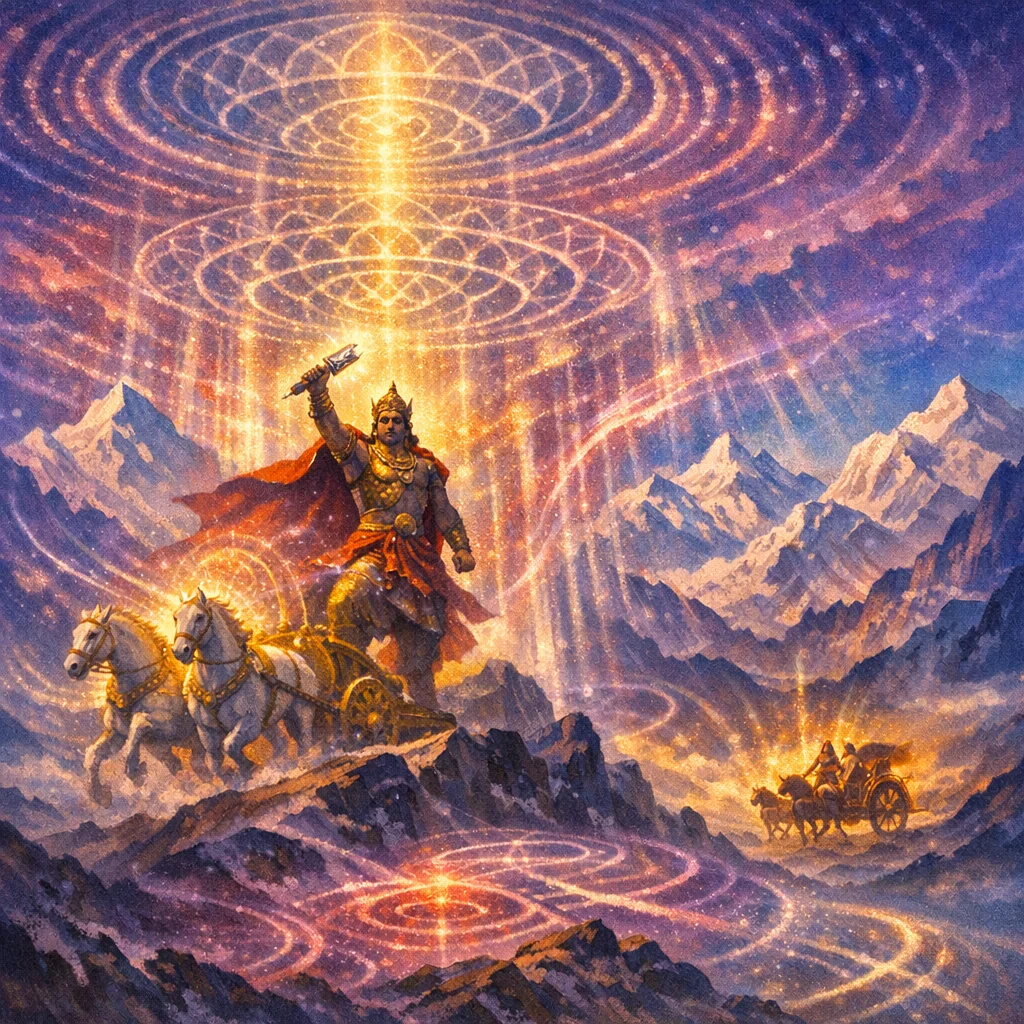
Dashati 3
Indra’s soma-joy at the Viṣūvant and his power to grant victory and wealth
Indra
Exultant and martial—bright soma-ecstasy moving into confident petition for victory and wealth
Vāmadeva Gautama
Viṣūvant / Madhyandina-savana (midday pressing) where Indra’s soma-drinking is central and petitions for vāja (strength/prize) are prominent.
Mantras
Mantra 1
स्वादोरित्था विषूवतो मधोः पिबन्ति गौर्यः या इन्द्रेण सयावरीर्वृष्णा मदन्ति शोभथा वस्वीरनु स्वराज्यम्
Thus, at the Viṣūvant, they drink of the sweet Soma; the bright (draughts) that accompany Indra, that rejoice with the vigorous (god), shine forth, bestowing riches, according to (his) heavenly sovereignty.
Mantra 2
इत्था हि सोम इन्मदो ब्रह्म चकार वर्धनम् शविष्ठ वज्रिन्नोजसा पृथिव्या निः शशा अहिमर्चन्ननु स्वराज्यम्
Thus, verily, Soma, exhilarating, hath made the sacred hymn an augmenter (of thy power); O most powerful Vajrin, by thy might thou didst cast forth from the earth the serpent (Vṛtra); praising (thee), (we follow) after heavenly sovereignty.
Mantra 3
इन्द्रो मदाय वावृधे शवसे वृत्रहा नृभिः तमिन्महत्स्वाजिषूतिमर्भे हवामहे स वाजेषु प्र नो ऽविषत्
Indra hath waxed strong for exhilaration, for strength, the slayer of Vṛtra, with (the aid of) men; him, the great, of excellent succour, we invoke in our need: may he, in the contests for prize, protect us.
Mantra 4
इन्द्र तुभ्यमिदद्रिवो ऽनुत्तं वज्रिन्वीर्यम् यद्ध त्यं मायिनं मृगं तव त्यन्माययावधीरर्चन्ननु स्वराज्यम् .
O Indra, for thee indeed, O Adriva, is that unsurpassed prowess, O Vajrin, in that thou didst slay, by thy stratagem, that delusive beast (the foe): praising (thee), (we follow) after heavenly sovereignty.
Mantra 5
प्रेह्यभीहि धृष्णुहि न ते वज्रो नि यंसते इन्द्र नृम्णं हि ते शवो हनो वृत्रं जया अपो ऽर्चन्ननु स्वराज्यम्
Go forth, advance, O daring (Indra); thy thunderbolt is not restrained: for thine is manly might and strength; slay Vṛtra, win the waters; praising (thee), (we follow) after heavenly sovereignty.
Mantra 6
यदुदीरत आजयो धृष्णवे धीयते धनम् युङ्क्ष्वा मदच्युता हरी कं हनः कं वसौ दधो ऽस्मां इन्द्र वसौ दधः
When battles are stirred up, and wealth is assigned to the bold (Indra), yoke thy two bay steeds, that shed exhilaration: whom wilt thou smite, whom wilt thou set in affluence? Set us, O Indra, in affluence.
Mantra 7
अक्षन्नमीमदन्त ह्यव प्रिया अधूषत अस्तोषत स्वभानवो विप्रा नविष्ठया मती योजा न्विन्द्र ते हरी
They have eaten, they have rejoiced; for thy dear (worshippers) have been exhilarated; the self-radiant sages have praised (thee) with their newest thought: yoke now, O Indra, thy two bay steeds.
Mantra 8
उपो षु शृणुही गिरो मघवन्मातथा इव कदा नः सूनृतावतः कर इदर्थयास इद्योजा न्विन्द्र ते हरी
Hear, indeed, our hymns, O Maghavan; be not (to us) as though indifferent: when will thy hand, rich in gracious benediction, be for our desire? Yoke, O Indra, thy two tawny steeds.
Mantra 9
चन्द्रमा अप्स्वा3न्तरा सुपर्णो धावते दिवि न वो हिरण्यनेमयः पदं विन्दन्ति विद्युतो वित्तं मे अस्य रोदसी
The Moon moves amid the waters; the fair-winged (radiant one) hastens in the sky: your gold-rimmed (wheels) find not his track; the lightnings (declare) the wealth of him—(even) of these two worlds, heaven and earth.
Mantra 10
प्रति प्रियतमं रथं वृषणं वसुवाहनम् स्तोता वामश्विनावृशि स्तोमेभिर्भूषति प्रति माध्वी मम श्रुतं हवम् .
Towards your most प्रिय chariot, vigorous and wealth-bearing, the worshipper, O Aśvins, adorns (it) with praises; accept in return my honeyed, heard invocation.
Frequently Asked Questions
It links midday Soma praise with results: Indra’s exhilaration becomes protective power, victory in conflict, and the placing of the sacrificer in wealth and ‘svarājya’ (heavenly sovereignty).
Viṣūvant points to a key midday Soma context (madhyandina-savana), when Indra is especially addressed as the foremost Soma-drinker and the chants emphasize vāja (winning strength) and prosperity.
Samaveda sequences can join related stotra materials; a concluding Aśvinau verse can function as a neighboring invocation—welcoming swift aid and auspicious reception—without displacing the decad’s dominant Indra focus.