Adhyaya 211: The Hunter Jarā, Krishna’s Final Līlā, and the Lord’s Ascension
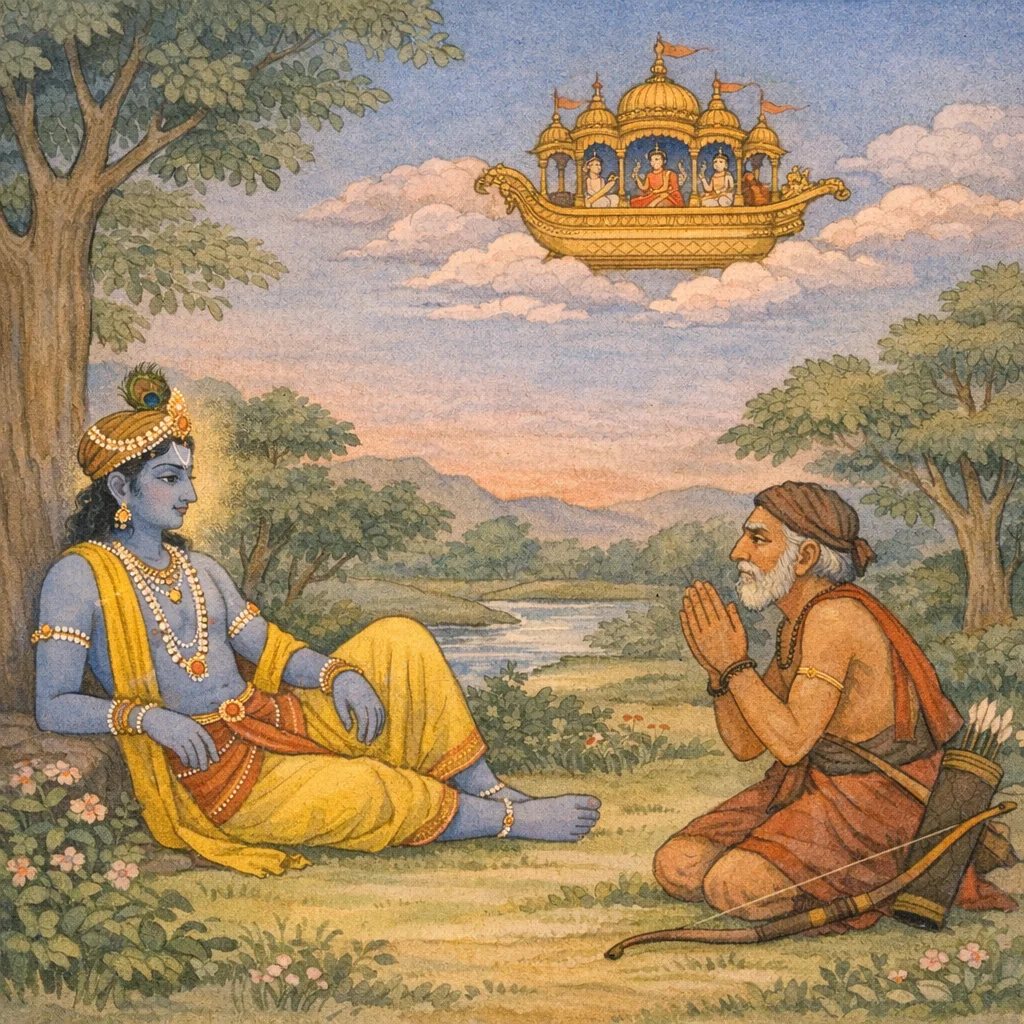
第211章は、クリシュナの地上のリーラーが終末へ向かうさまを語り、それを不滅のブラフマンへ自ら退入する神学的地平の中で描く。ダールカはクリシュナの命に従いドヴァーラカーへ赴き、アルジュナを、王統の後継者として示されるヴァジュラとともに連れて来る。続いて本文は、ゴーヴィンダが万有のうちに至高のヴァースデーヴァ原理を内的に保持する行へと移る。バラモンのドゥルヴァーサスの言葉を尊び、クリシュナはヨーガの坐法を取る。その時、猟師ジャラーが、ムシャラの残余から成る金属の鏃を付けた矢を携えて現れ、主の足を鹿と誤って射抜く。四臂の御姿を見たジャラーは無知を告白し、幾度も赦しを乞う。クリシュナはこれを赦し、ヴィマーナによって直ちに天界へ昇る恩寵を与える。その後、主は垢なく不可思議で朽ちぬブラフマン—万物に遍満するヴァースデーヴァ—と自己を合一させ、人身を捨て、三重の超越的帰趣を成就する。
Chapter Arc
{"opening_hook":"The chapter opens in the wake of the Yādava collapse: Dāruka, obeying Kṛṣṇa’s final directive, hastens toward Dvārakā to summon Arjuna, while Vajra is positioned as a continuity-figure for royal succession—an immediate narrative bridge from catastrophe to dharmic aftermath.","rising_action":"Attention turns inward: Govinda is portrayed as the indwelling support of all beings, establishing the supreme Vāsudeva-principle within the self. In fidelity to the brāhmaṇa-word of Durvāsas, Kṛṣṇa assumes a yogic posture, and the ominous detail is introduced—an arrow tipped with the remaining iron of the muśala, now in the hands of the hunter Jarā.","climax_moment":"Jarā mistakes the Lord’s foot for a deer and releases the arrow; the revelation follows instantly when Jarā beholds the four-armed form. The theological peak is Kṛṣṇa’s untroubled absolution—transforming an apparent “accident” into a deliberate, sovereign closure of līlā and a demonstration of the Lord’s freedom from karma.","resolution":"Kṛṣṇa removes Jarā’s fear, grants him immediate heavenly ascent by vimāna, and then relinquishes the human body, uniting the self with the stainless, unthinkable, undecaying Brahman—described as Vāsudeva-pervading all—thus concluding the avatāra’s terminal movement as voluntary withdrawal into the imperishable.","key_verse":"“Seeing the Lord’s four-armed form, the hunter fell again and again, begging pardon; the Blessed One dispelled his fear and, having granted him heaven, Himself entered the stainless, undecaying Brahman—Vāsudeva, the Self of all.” (sense-translation; chapter’s central teaching)"}
Thematic Essence
{"primary_theme":"Kṛṣṇa’s voluntary withdrawal (līlā-saṃhāra) into Vāsudeva-Brahman","secondary_themes":["Succession and continuity after the Yādava end (Arjuna and Vajra)","Brāhmaṇa-vāk and dharma as cosmic constraint honored even by the Lord","Grace overriding apparent fault: Jarā’s fear removed and heaven granted","Muśala-iron as narrative causality: the remnant of internecine ruin becomes the final instrument"],"brahma_purana_doctrine":"The chapter crystallizes a Brahma Purāṇa-style metaphysical reading of avatāra: Kṛṣṇa is the indwelling Vāsudeva who sustains all beings and, at the end, does not ‘die’ but consciously re-identifies with the stainless, unthinkable, undecaying Brahman—making the event a yogic, sovereign consummation rather than karmic defeat.","adi_purana_significance":"As ‘Ādi Purāṇa,’ it models how primordial Purāṇic narration absorbs epic history into a cosmological-theological frame: the end of Kṛṣṇa’s earthly līlā is presented as a paradigmatic template for understanding divine descent and withdrawal within the larger Purāṇic vision of dharma and the Absolute."}
Emotional Journey
{"opening_rasa":"करुण (karuṇa)","climax_rasa":"अद्भुत (adbhuta)","closing_rasa":"शान्त (śānta)","rasa_transitions":["करुण → भयानक (Jarā’s fearful mistake) → अद्भुत (four-armed revelation and grace) → शान्त (Brahman-union)"],"devotional_peaks":["Govinda as inner support of all beings: contemplative bhakti grounded in metaphysics","Jarā’s repeated prostrations upon seeing the four-armed form","The Lord’s fear-dispelling absolution and gift of vimāna","Final union with the stainless Vāsudeva-Brahman as a śānta-bhakti summit"]}
Tirtha Focus
{"tirthas_covered":["द्वारका"],"jagannath_content":null,"surya_content":null,"cosmology_content":"Implicit dissolution motif at the microcosmic level: the avatāra’s embodied līlā is ‘withdrawn’ into the imperishable Brahman (Vāsudeva as all-pervading Self), echoing Purāṇic saṃhāra logic without a full sarga/pralaya excursus."}
Shlokas in Adhyaya 211
Verse 1
व्यास उवाच इत्य् उक्तो दारुकः कृष्णं प्रणिपत्य पुनः पुनः प्रदक्षिणं च बहुशः कृत्वा प्रायाद् यथोदितम् //
この偈:「1」—プラーナにおける聖なる句の番号標識。
Verse 2
स च गत्वा तथा चक्रे द्वारकायां तथार्जुनम् आनिनाय महाबुद्धिं वज्रं चक्रे तथा नृपम् //
この偈:「2」—プラーナの聖句に付された参照番号。
Verse 3
भगवान् अपि गोविन्दो वासुदेवात्मकं परम् ब्रह्मात्मनि समारोप्य सर्वभूतेष्व् अधारयत् //
この偈:「3」—プラーナにおける聖なる言葉を識別する番号。
Verse 4
स मानयन् द्विजवचो दुर्वासा यद् उवाच ह योगयुक्तो ऽभवत् पादं कृत्वा जानुनि सत्तमाः //
この偈:「4」—プラーナの聖句を配列するための順序番号。
Verse 5
संप्राप्तो वै जरा नाम तदा तत्र स लुब्धकः मुशलशेषलोहस्य सायकं धारयन् परम् //
この偈:「5」—プラーナの聖なる言葉を特定し引用するための番号。
Verse 6
स तत्पादं मृगाकारं समवेक्ष्य व्यवस्थितः ततो विव्याध तेनैव तोमरेण द्विजोत्तमाः //
この偈(第6)は、プラーナ文献の伝統における聖なる言葉として保持される。
Verse 7
गतश् च ददृशे तत्र चतुर्बाहुधरं नरम् प्रणिपत्याह चैवैनं प्रसीदेति पुनः पुनः //
この偈(第7)は敬うべき聖句であり、信仰の誦読と学術的研究の双方に適する。
Verse 8
अजानता कृतम् इदं मया हरिणशङ्कया क्षम्यताम् आत्मपापेन दग्धं मा दग्धुम् अर्हसि //
この偈(第8)は古の知を示し、サンスクリット原典の荘厳さを保つ。
Verse 9
व्यास उवाच ततस् तं भगवान् आह नास्ति ते भयम् अण्व् अपि गच्छ त्वं मत्प्रसादेन लुब्ध स्वर्गेश्वरास्पदम् //
この偈(第9)は静かな心と敬虔さをもって読誦し、その深意を会得すべきである。
Verse 10
व्यास उवाच विमानम् आगतं सद्यस् तद्वाक्यसमनन्तरम् आरुह्य प्रययौ स्वर्गं लुब्धकस् तत्प्रसादतः //
この偈(第10)は古式の要約であり、プラーナの伝統的遺産を継承する。
Verse 11
गते तस्मिन् स भगवान् संयोज्यात्मानम् आत्मनि ब्रह्मभूते ऽव्यये ऽचिन्त्ये वासुदेवमये ऽमले //
第211.11偈:サンスクリット原文が提示されていません。全文をお送りいただければ、プラーナにふさわしく訳します。
Verse 12
अजन्मन्य् अजरे ऽनाशिन्य् अप्रमेये ऽखिलात्मनि त्यक्त्वा स मानुषं देहम् अवाप त्रिविधां गतिम् //
第211.12偈:サンスクリット原文がありません。正確で荘厳な訳のため、全文をご提示ください。
Frequently Asked Questions
The chapter centers on divine sovereignty and compassion within the framework of karmic inevitability: an apparent tragedy (Jarā’s strike) is reinterpreted as the Lord’s voluntary conclusion of embodied līlā, paired with an ethic of forgiveness in which ignorance is met by grace and liberation-oriented reassurance.
It articulates a foundational Puranic theological grammar: the avatāra’s departure is not merely historical but cosmological, expressed as reabsorption into the imperishable Brahman identified with Vāsudeva and as an affirmation of the Lord as the inner support of all beings—motifs that anchor later narrative, ritual, and doctrinal layers across the Purāṇic corpus.
No new tīrtha, vrata, or formal rite is instituted in the supplied passage. The chapter’s emphasis is doctrinal and narrative—Dvārakā as a setting is referenced, but the text here functions primarily as a theological account of the Lord’s yogic withdrawal and the salvific outcome granted to Jarā.