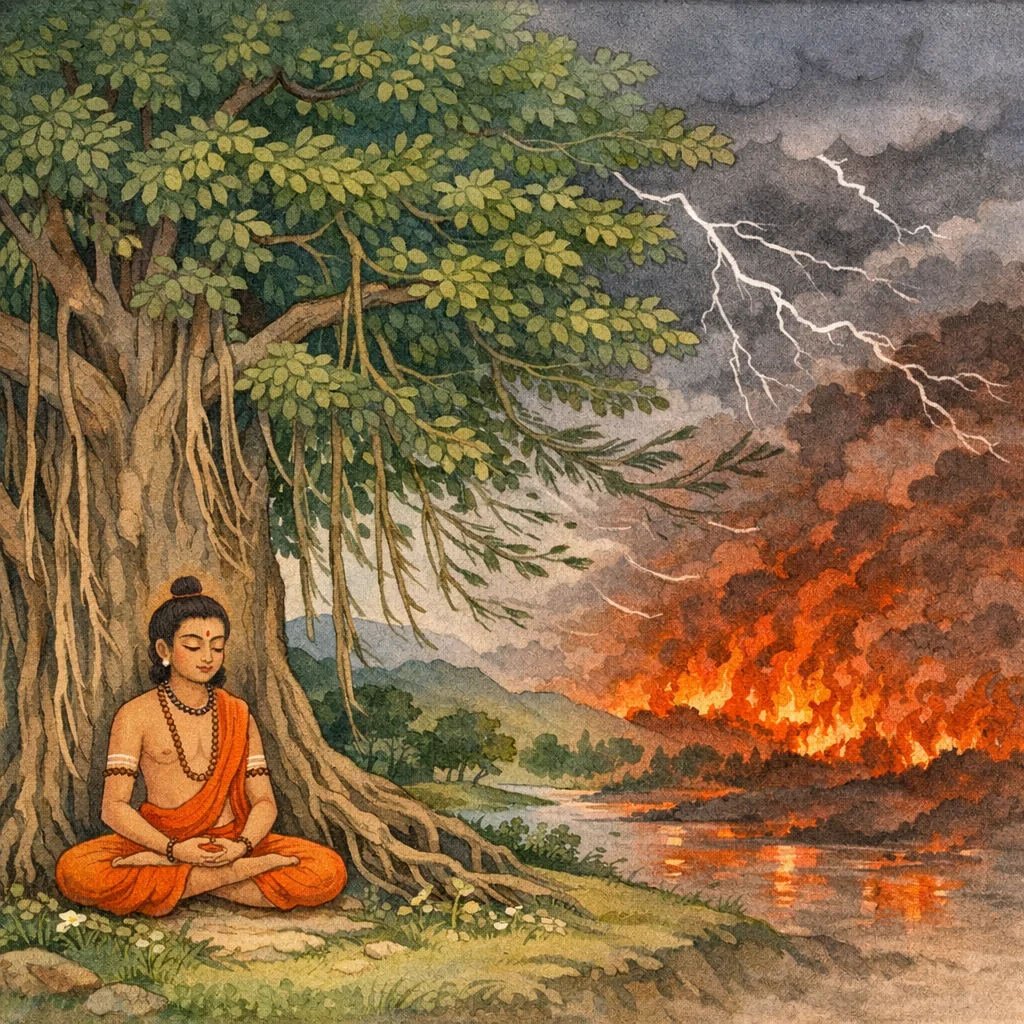
Adhyaya 52: The Conflagration of the Great Dissolution and Markandeya’s Refuge at the Eternal Banyan
第52章は、世界秩序の支えが崩れ去る大壊滅マハープララヤを宇宙的規模で描く。太陽と月は姿を消し、有情・無情の諸存在はことごとく滅し、雷鳴・稲妻・破壊的な震動といった凶兆が総溶解の到来を告げる。猛風を伴うサンヴァルタカの火、すなわち無数の太陽のごとく輝く名高いカルパーグニは諸世界に浸透し、地中を下ってラサータラに至り、ナーガローカを含む地下界を焼き尽くして、デーヴァや半神的存在を恐怖に陥れる。三界とその住民は瞬く間に焼かれる。かかる荒廃の中にただ一人、聖仙マールカンデーヤが立つ。霊性は高いが、渇きと迷妄に苦しみ、究竟の帰依処を求めて永遠のプルシェーシャを念じつつ、プララヤの因に結びつく神聖の座—時を超える「ヴァタラージャ」(常住のバニヤン)—へ至る。その根元には宇宙の火と雷霆の及ばぬ領域が示され、万有崩壊のただ中における護りの中心として立てられる。
Chapter Arc
{"opening_hook":"The chapter opens in a cosmic register: the familiar supports of order fail—sun and moon vanish, directions lose their bearings, and the world’s rhythms collapse, immediately pulling the listener into mahāpralaya’s dread.","rising_action":"Portents intensify: thunder and lightning tear the sky; hurricane-like winds drive the saṃvartaka fire through the worlds. The conflagration penetrates the earth, descends into rasātala, and consumes nāgaloka, spreading panic among devas, asuras, gandharvas, dānavas, yakṣas, uragas, and rākṣasas.","climax_moment":"At the height of universal burning—kalpāgni blazing like countless suns—the narrative pivots to the lone surviving sage Mārkaṇḍeya. Overcome by thirst and disorientation yet anchored in dhyāna, he fixes his mind on the eternal Puruṣeśa and reaches the timeless refuge: Vaṭarāja (the eternal banyan), where pralaya’s terrors do not operate.","resolution":"The chapter concludes by establishing a theological ‘safe zone’ amid dissolution: at the root of Vaṭarāja, the saṃvartaka fire and thunderbolts cannot harm the sage, implying that devotion and contemplative refuge in the Eternal Lord transcends cosmic cycles.","key_verse":null}
Thematic Essence
{"primary_theme":"Pralaya-varṇana (the description of cosmic dissolution) culminating in yogic refuge at Vaṭarāja.","secondary_themes":["Saṃvartaka fire and winds as instruments of kāla (time)","The collapse of cosmic order (lights, directions, atmospherics)","The netherworlds (rasātala/nāgaloka) are not exempt from dissolution","Bhakti-dhyāna as a metaphysical shelter beyond cosmic cycles"],"brahma_purana_doctrine":"Even when trailokya is consumed by kalpāgni, a locus of protection exists through remembrance of the Eternal Lord—symbolized by Vaṭarāja—indicating that sacred refuge is not merely geographic but ontological (beyond pralaya’s jurisdiction).","adi_purana_significance":"As an ‘Adi Purāṇa’ movement, it frames the universe’s end not as nihilism but as a doctrinal demonstration: cosmology serves theology, and the earliest Purāṇic voice links pralaya to the discovery of an eternal refuge-principle."}
Emotional Journey
{"opening_rasa":"bhayānaka","climax_rasa":"adbhuta","closing_rasa":"śānta","rasa_transitions":["bhayānaka → raudra → bhayānaka → adbhuta → śānta"],"devotional_peaks":["Mārkaṇḍeya’s inward turn to dhyāna on Puruṣeśa amid total collapse","Arrival at Vaṭarāja where pralaya’s weapons (fire/thunderbolts) lose efficacy"]}
Tirtha Focus
{"tirthas_covered":["वट / न्यग्रोध (Vaṭa / Nyagrodha; Vaṭarāja as a divine refuge-locus)"],"jagannath_content":null,"surya_content":null,"cosmology_content":"A full mahāpralaya tableau: disappearance of sun and moon; atmospheric portents; saṃvartaka winds; kalpāgni burning trailokya; fire penetrating earth into rasātala and consuming nāgaloka; universal terror across divine and semi-divine classes; a protected zone at Vaṭarāja accessed through contemplation of the Eternal Lord."}
Shlokas in Adhyaya 52
Verse 1
ब्रह्मोवाच आसीत् कल्पे मुनिश्रेष्ठाः संप्रवृत्ते महाक्षये नष्टे ऽर्कचन्द्रे पवने नष्टे स्थावरजङ्गमे //
新たな章の冒頭において、ブラフマーとヴィシュヌの威力による世界の創造と維持の秩序が宣言される。
Verse 2
उदिते प्रलयादित्ये प्रचण्डे घनगर्जिते विद्युदुत्पातसंघातैः संभग्ने तरुपर्वते //
この偈はダルマの精髄を要約し、賢者が観想し研究するために説かれる。
Verse 3
लोके च संहृते सर्वे महदुल्कानिबर्हणे शुष्केषु सर्वतोयेषु सरःसु च सरित्सु च //
静かな心で、古の師たちが伝えた清浄なる聖なる教えを聴きなさい。
Verse 4
ततः संवर्तको वह्निर् वायुना सह भो द्विजाः लोकं तु प्राविशत् सर्वम् आदित्यैर् उपशोभितम् //
ダルマを敬い誠実に実践する者は、安楽と名声とを得る。
Verse 5
पश्चात् स पृथिवीं भित्त्वा प्रविश्य च रसातलम् देवदानवयक्षाणां भयं जनयते महत् //
学びと真心の供養によって智慧は増し、無明は滅せられる。
Verse 6
निर्दहन् नागलोकं च यच् च किंचित् क्षिताव् इह अधस्तान् मुनिशार्दूलाः सर्वं नाशयते क्षणात् //
ゆえに、清らかな心でダルマの道を堅く守り、善の円満へと至りなさい。
Verse 7
ततो योजनविंशानां सहस्राणि शतानि च निर्दहत्य् आशुगो वायुः स च संवर्तको ऽनलः //
この偈(第52章第7偈)はサンスクリット原文が提示されていません。原文をご提示いただければ、聖典調で正確に訳します。
Verse 8
सदेवासुरगन्धर्वं सयक्षोरगराक्षसम् ततो दहति संदीप्तः सर्वम् एव जगत् प्रभुः //
この偈(第52章第8偈)はサンスクリット原文が提示されていません。原文をご提示いただければ、聖典調で正確に訳します。
Verse 9
प्रदीप्तो ऽसौ महारौद्रः कल्पाग्निर् इति संश्रुतः महाज्वालो महार्चिष्मान् संप्रदीप्तमहास्वनः //
この偈(第52章第9偈)はサンスクリット原文が提示されていません。原文をご提示いただければ、聖典調で正確に訳します。
Verse 10
सूर्यकोटिप्रतीकाशो ज्वलन्न् इव स तेजसा त्रैलोक्यं चादहत् तूर्णं ससुरासुरमानुषम् //
この偈(第52章第10偈)はサンスクリット原文が提示されていません。原文をご提示いただければ、聖典調で正確に訳します。
Verse 11
एवंविधे महाघोरे महाप्रलयदारुणे ऋषिः परमधर्मात्मा ध्यानयोगपरो ऽभवत् //
この偈(第52章第11偈)はサンスクリット原文が提示されていません。原文をご提示いただければ、聖典調で正確に訳します。
Verse 12
एकः संतिष्ठते विप्रा मार्कण्डेयेति विश्रुतः मोहपाशैर् निबद्धो ऽसौ क्षुत्तृष्णाकुलितेन्द्रियाः //
この偈は「12」という番号のみで、サンスクリット本文が示されていないため、確定的な訳はできない。
Verse 13
स दृष्ट्वा तं महावह्निं शुष्ककण्ठौष्ठतालुकः तृष्णार्तः प्रस्खलन् विप्रास् तदासौ भयविह्वलः //
この偈は「13」という番号のみで、サンスクリット本文が示されていないため、確定的な訳はできない。
Verse 14
बभ्राम पृथिवीं सर्वां कांदिशीको विचेतनः त्रातारं नाधिगच्छन् वै इतश् चेतश् च धावति //
この偈は「14」という番号のみで、サンスクリット本文が示されていないため、確定的な訳はできない。
Verse 15
न लेभे च तदा शर्म यत्र विश्राम्यता द्विजाः करोमि किं न जानामि यस्याहं शरणं व्रजे //
この偈は「15」という番号のみで、サンスクリット本文が示されていないため、確定的な訳はできない。
Verse 16
कथं पश्यामि तं देवं पुरुषेशं सनातनम् इति संचिन्तयन् देवम् एकाग्रेण सनातनम् //
この偈は「16」という番号のみで、サンスクリット本文が示されていないため、確定的な訳はできない。
Verse 17
प्राप्तवांस् तत् पदं दिव्यं महाप्रलयकारणम् पुरुषेशम् इति ख्यातं वटराजं सनातनम् //
これは『ブラフマ・プラーナ』第52章第17偈の聖なる句であり、敬虔に誦し学ぶべきである。
Verse 18
त्वरायुक्तो मुनिश् चासौ न्यग्रोधस्यान्तिकं ययौ आसाद्य तं मुनिश्रेष्ठास् तस्य मूले समाविशत् //
これは『ブラフマ・プラーナ』第52章第18偈であり、ダルマの荘厳な趣旨を示す。
Verse 19
न कालाग्निभयं तत्र न चाङ्गारप्रवर्षणम् न संवर्तागमस् तत्र न च वज्राशनिस् तथा //
これは『ブラフマ・プラーナ』第52章第19偈であり、信仰の誦読にも学術の考究にも適する。
Frequently Asked Questions
The chapter centers on the contrast between cosmic impermanence (mahāpralaya) and an enduring theological refuge: the eternal Puruṣeśa symbolized by the Vaṭarāja. It frames dissolution as total at the level of worlds, yet not absolute with respect to the divine ground that remains untouched.
By foregrounding a cosmogonic-cycle endpoint (pralaya) and naming the kalpāgni/saṃvartaka mechanism, the chapter anchors Purāṇic chronology in recurring creation–dissolution rhythms. This reinforces the Brahma Purana’s archival posture as a foundational text mapping cosmic time and its governing principles.
No explicit tīrtha, vrata, or procedural rite is instituted in the supplied passage. Instead, the chapter establishes a sacral motif—Vaṭarāja/nyagrodha as a protected divine locus during pralaya—functioning more as a theological landmark than as a described pilgrimage protocol.