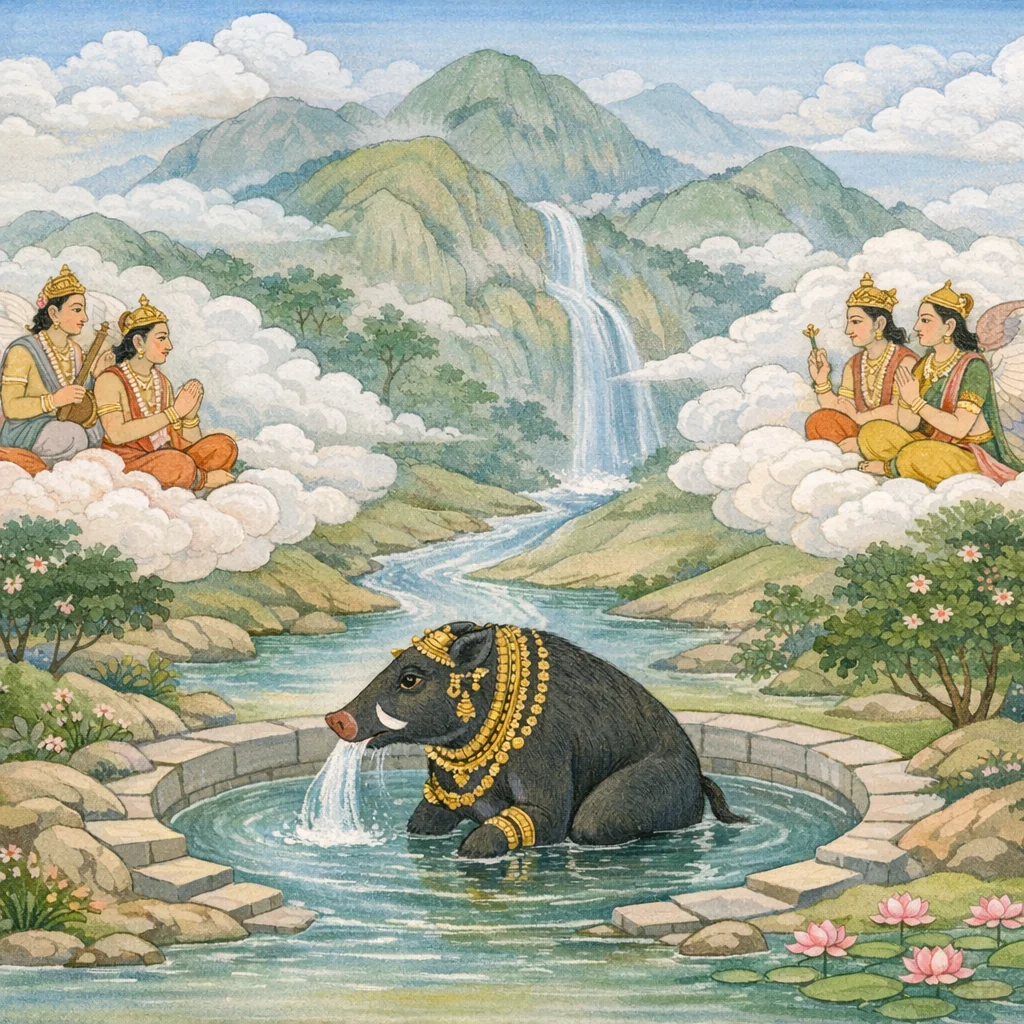
Adhyaya 79: Nārada Requests the Sequential Fruits of Tīrthas; The Origins of Tryambaka and Vārāha Tīrthas
第79章は、ナーラダが諸ティールタ(聖なる渡り場)の個別の功徳(ティールタパラ)を順序立てて聞きたいと切に願い、とりわけガンガー(Gaṅgā)の浄化の行路と、それに結びつく起源譚に注意を向けるところから始まる。ブラフマーは、ティールタの区別とその全マーハートミヤ(聖地讃徳)は尽くして語り得ず、また常人の聴聞では全てを担い切れないと方法上の注意を述べるが、それでもシュルティに似た権威ある言明と確立した聖地地理に基づき、簡潔な要約を授ける。続いて二つの名高いティールタが示される。トリヤンバカは世俗の享楽と解脱(モークシャ)をともに与えると讃えられ、ヴァーラーハは三界に名を轟かせる。ヴァーラーハ・ティールタは神話的事件に根差す。羅刹シンドゥセーナが祭祀(ヤジュニャ)を奪い、ラサータラへ降って宇宙の儀礼秩序を乱すと、デーヴァたちは勝てずヴィシュヌに救いを求める。ヴィシュヌは猪神ヴァーラーハの姿となって降下し、敵対する者を滅ぼしてヤジュニャを回復し、かつてガンガーが降った同じ道を通って地上へ現れる。その出現地点でガンガーの水が血に染まった御身を洗い清め、ヴァーラーハ・クンダが生じたと説かれる。このティールタでは沐浴と布施があらゆる供犠の果をもたらし、祖霊を想起するだけでも彼らの浄化と天界への上昇が成就すると示される。
Chapter Arc
{"opening_hook":"Nārada, marked by sustained curiosity (jijñāsā), presses Brahmā to enumerate—“in proper sequence” (krameṇa)—the distinct fruits of tīrthas, beginning with Gaṅgā and the itihāsa that makes her course intelligible as sacred geography.","rising_action":"Brahmā first places an epistemic boundary: tīrtha-māhātmya is effectively immeasurable, and ordinary hearing cannot bear the whole; yet he agrees to give a condensed, śruti-like précis, then narrows the focus to two named loci whose merits are both practical (snāna/dāna) and soteriological (bhukti/mukti).","climax_moment":"The etiological myth of Vārāha tīrtha: Sindhusena drags the yajña down to Rasātala, the devas fail to recover it, and Viṣṇu—becoming Vārāha—descends, slays the hostile beings, restores the sacrifice, and re-emerges along Gaṅgā’s own descent-path; Gaṅgā washes the blood from his body, and that purificatory contact crystallizes as Vārāha-kuṇḍa.","resolution":"Brahmā codifies the ritual consequences: bathing and gifting at Vārāha tīrtha yield the fruit of all kratus; even pitṛ-smaraṇa there purifies ancestors and leads them heavenward—closing the chapter by converting myth into repeatable pilgrimage practice.","key_verse":"Teaching (translation): “At Vārāha-tīrtha, by bathing and by gifting, one attains the fruit of all sacrifices; and by remembering one’s ancestors there, the pitṛs are purified of sin and ascend to heaven.”"}
Thematic Essence
{"primary_theme":"Tīrtha-māhātmya as ordered sacred geography: how specific sites (Tryambaka, Vārāha) yield defined fruits through myth-grounded practice.","secondary_themes":["Epistemic restraint in purāṇic discourse (the immeasurable totality of tīrthas vs. a usable précis)","Bhukti–mukti synthesis: pilgrimage as both worldly welfare and liberation","Yajña as cosmic infrastructure; avatāra as ritual-restoration","Gaṅgā as purifying medium that sacralizes landscape through contact with the divine"],"brahma_purana_doctrine":"Tīrtha is not merely a place but a repeatable interface between mythic event and present practice: snāna/dāna/pitṛ-smaraṇa at a site created by avatāric action is declared equivalent to comprehensive sacrificial merit (sarva-kratu-phala).","adi_purana_significance":"As an ‘Ādi’ purāṇa-style chapter, it demonstrates the template by which primordial narrative (avatāra restoring yajña) is converted into dharma for later ages—mapping cosmic history onto a pilgrim’s itinerary and daily ritual acts."}
Emotional Journey
{"opening_rasa":"adbhuta","climax_rasa":"vīra","closing_rasa":"śānta","rasa_transitions":["adbhuta → śānta","śānta → raudra","raudra → vīra","vīra → adbhuta","adbhuta → śānta"],"devotional_peaks":["Brahmā’s ‘immeasurable yet mercifully condensed’ authorization of tīrtha-knowledge","Viṣṇu’s descent as Vārāha to restore the yajña (dharma re-established)","Gaṅgā cleansing the blood-stained Vārāha body—tīrtha born from purification","Promise that pitṛ-smaraṇa at Vārāha tīrtha uplifts ancestors to heaven"]}
Tirtha Focus
{"tirthas_covered":["Gaṅgā","Brahmagiri","Gaṅgāsravaṇa","Tryambaka tīrtha","Vārāha tīrtha","Vārāha-kuṇḍa"],"jagannath_content":null,"surya_content":null,"cosmology_content":"Rasātala is invoked as the netherworld arena where ritual order is disrupted and restored; the chapter links cosmic stability to the continuity of yajña and to avatāric intervention."}
Shlokas in Adhyaya 79
Verse 1
नारद उवाच न मनस् तृप्तिम् आधत्ते कथाः शृण्वत् त्वयेरिताः पृथक् तीर्थफलं श्रोतुं प्रवृत्तं मम मानसम् //
この冒頭(79.1)において、プラーナは聖なる荘重な言葉で次の主題を説き起こす。
Verse 2
क्रमशो ब्राह्मणानीतां गङ्गां मे प्रथमं वद पृथक् तीर्थफलं पुण्यं सेतिहासं यथाक्रमम् //
この偈(79.2)は教えをさらに詳述し、心をダルマと内なる安寧へと導く。
Verse 3
ब्रह्मोवाच तीर्थानां च पृथग् भावं फलं माहात्म्यम् एव च सर्वं वक्तुं न शक्नोमि न च त्वं श्रवणे क्षमः //
この偈(第3)は『ブラフマ・プラーナ』において、聖なるダルマと古の知を荘重に説き明かす。
Verse 4
तथापि किंचिद् वक्ष्यामि शृणु नारद यत्नतः यान्य् उक्तानि च तीर्थानि श्रुतिवाक्यानि यानि च //
この偈(第4)は、ダルマの意義と古来の伝承を敬虔に解き明かし続ける。
Verse 5
तानि वक्ष्यामि संक्षेपान् नमस्कृत्वा त्रिलोचनम् यत्रासौ भगवान् आसीत् प्रत्यक्षस् त्र्यम्बको मुने //
この偈(第5)はダルマを讃え、崇敬に値する宗教的知見を示す。
Verse 6
त्र्यम्बकं नाम तत् तीर्थं भुक्तिमुक्तिप्रदायकम् वाराहम् अपरं तीर्थं त्रिषु लोकेषु विश्रुतम् //
この偈(第6)は、ダルマと、古の規範に基づき人生を導く作法を荘厳に語る。
Verse 7
तस्य रूपं प्रवक्ष्यामि नाम विष्णोर् यथाभवत् पुरा देवान् पराभूय यज्ञम् आदाय राक्षसः //
この偈(第7)は、真理と実践すべき徳を確言して結ぶ。
Verse 8
रसातलम् अनुप्राप्तः सिन्धुसेन इति श्रुतः यज्ञे तलम् अनुप्राप्ते निर्यज्ञा ह्य् अभवन् मही //
第8偈:このプラーナは、ヴェーダにかなう聖なる真理とダルマの秩序を説き明かす。
Verse 9
नायं लोको ऽस्ति न परो यज्ञे नष्ट इतीत्वराः सुरास् तम् एव विविशू रसातलम् अनुद्विषम् //
第9偈:賢者は敬虔に聴聞し、智慧を明らかにして心を静めるべきである。
Verse 10
नाशक्नुवंस् तु तं जेतुं देवा इन्द्रपुरोगमाः विष्णुं पुराणपुरुषं गत्वा तस्मै न्यवेदयन् //
第10偈:神聖なる御名を憶念しダルマを修することは功徳を増し、悪趣への堕落を防ぐ。
Verse 11
राक्षसस्य तु तत् कर्म यज्ञभ्रंशम् अशेषतः ततः प्रोवाच भगवान् वाराहं वपुर् आस्थितः //
第11偈:誠をもってプラーナを学ぶ者は、現世と来世において知識と安楽を得る。
Verse 12
शङ्खचक्रगदापाणिर् गत्वा चैव रसातलम् आनयिष्ये मखं पुण्यं हत्वा राक्षसपुंगवान् //
第12偈:ゆえにダルマを敬い、聴聞と読誦を続けて、恩寵と功徳を常に増大させよ。
Verse 13
स्वः प्रयान्तु सुराः सर्वे व्येतु वो मानसो ज्वरः येन गङ्गा तलं प्राप्ता पथा तेनैव चक्रधृक् //
この偈(『ブラフマ・プラーナ』第79章第13偈)は、プラーナ文献の伝統における聖なる言葉として尊ばれる。
Verse 14
जगाम तरसा पुत्र भुवं भित्त्वा रसातलम् स वराहवपुः श्रीमान् रसातलनिवासिनः //
この偈(第79章第14偈)は、プラーナの文体に従い、聖なる趣旨の説示をさらに続ける。
Verse 15
राक्षसान् दानवान् हत्वा मुखे धृत्वा महाध्वरम् वाराहरूपी भगवान् मखम् आदाय यज्ञभुक् //
この偈(79.15)は、ダルマとプラーナに伝わる古伝を理解するため、敬虔に誦読すべきである。
Verse 16
येन प्राप तलं विष्णुः पथा तेनैव शत्रुजित् मुखे न्यस्य महायज्ञं निश्चक्राम रसातलात् //
この偈(79.16)は、聖なる言葉を聴聞し憶持することが、功徳と智慧へと導くと説く。
Verse 17
तत्र ब्रह्मगिरौ देवाः प्रतीक्षां चक्रिरे हरेः पथस् तस्माद् विनिःसृत्य गङ्गास्रवणम् अभ्यगात् //
この偈(79.17)は、ダルマの力と、正しく清浄なる実践を讃えて結ぶ。
Verse 18
प्राक्षालयच् च स्वाङ्गानि असृग्लिप्तानि नारद गङ्गाम्भसा तत्र कुण्डं वाराहम् अभवत् ततः //
この偈(第18)は『ブラフマー・プラーナ』における聖なる言葉として、物語と教説の次第を継ぐために置かれる。
Verse 19
मुखे न्यस्तं महायज्ञं देवानां पुरतो हरिः दत्तवांस् त्रिदशश्रेष्ठो मुखाद् यज्ञो ऽभ्यजायत //
この偈(第19)は『ブラフマー・プラーナ』の聖語の一節であり、定められた順序に従って意味の開示を続ける。
Verse 20
ततः प्रभृति यज्ञाङ्गं प्रधानं स्रुव उच्यते वाराहरूपम् अभवद् एवं वै कारणान्तरात् //
この偈(第20)は『ブラフマー・プラーナ』に収められ、物語と聖なる教示との連続性を保つために置かれる。
Verse 21
तस्मात् पुण्यतमं तीर्थं वाराहं सर्वकामदम् तत्र स्नानं च दानं च सर्वक्रतुफलप्रदम् //
この偈(第21)は聖なる言葉の続きであり、読者が明晰に理解し、敬虔な礼拝心を起こすよう次第立てて述べられる。
Verse 22
तत्र स्थितो ऽपि यः कश्चित् पितॄन् स्मरति पुण्यकृत् विमुक्ताः सर्वपापेभ्यः पितरः स्वर्गम् आप्नुयुः //
この偈(第22)はこの段を結び、『ブラフマー・プラーナ』の古雅な文体と聖性を保っている。
Frequently Asked Questions
The chapter centers on sacred topography as a vehicle for dharma: tīrthas are presented as concentrated sites of ritual efficacy where purification, restoration of cosmic order (through the recovery of the yajña), and soteriological benefit (bhukti and mukti) become accessible through disciplined acts such as snāna, dāna, and pitṛ-smaraṇa.
Vārāha tīrtha is explicitly framed as a practice-site where bathing and charitable gifting yield the fruit of all sacrifices (sarvakratu-phala). The chapter also emphasizes ancestor-remembrance at the tīrtha as an efficacious rite for the liberation and heavenly ascent of pitṛs.
The sanctity is grounded in a mythic restoration: when the yajña is seized by Sindhusena and taken to Rasātala, Viṣṇu assumes the Vārāha form, defeats the hostile beings, and retrieves the rite. The emergence along the same route associated with Gaṅgā’s descent, and the subsequent cleansing in Gaṅgā’s waters that forms Vārāha-kuṇḍa, sacralize the location as a permanent pilgrimage locus.