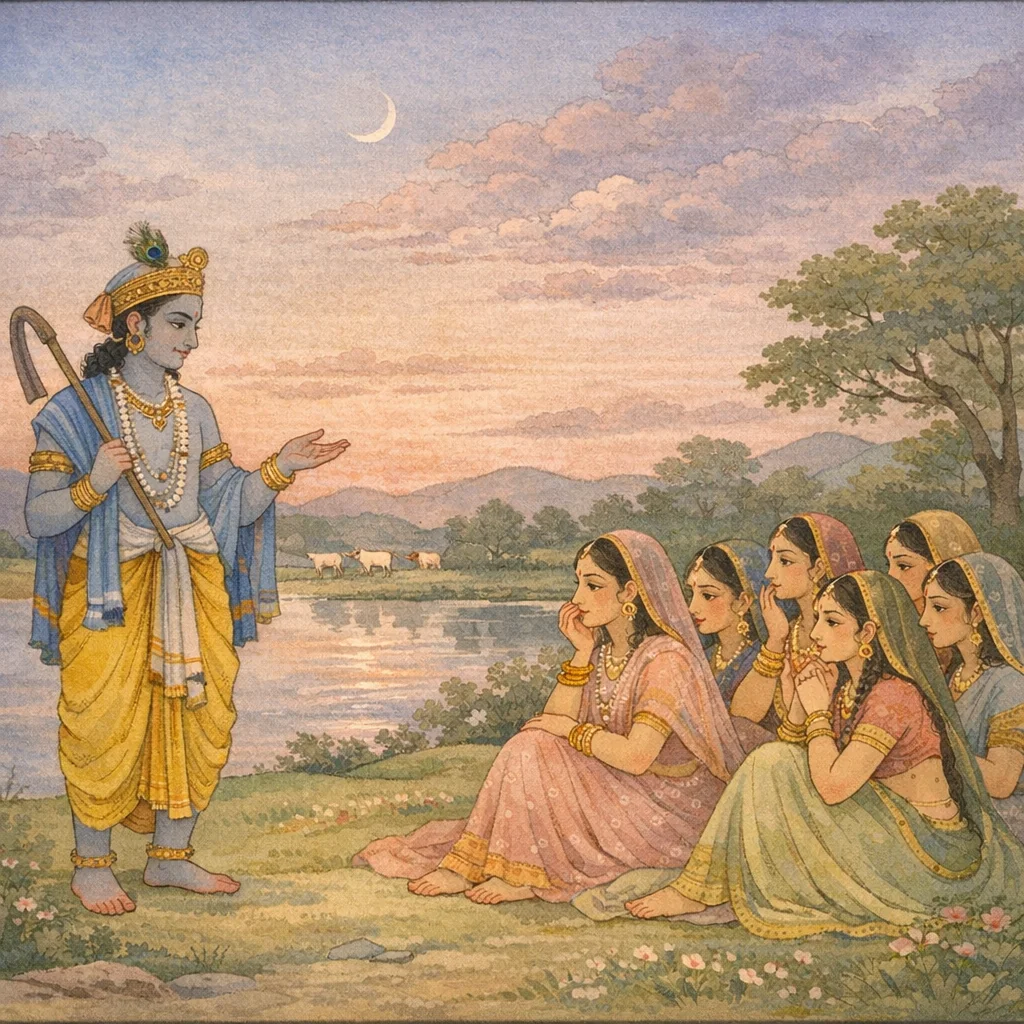
Adhyaya 197: Krishna’s Boon to Muchukunda and Balarama’s Consolation of Vraja
本章は、王の信愛、神の報い、そしてヤーダヴァ世界の社会的変化を結ぶ移行的な物語である。賢王ムチュクンダがハリ(シュリー・クリシュナ)を讃えた後、主は恩寵として一つの願いを授ける。王は望む天界へ赴き天の歓楽を享受し、のちに jātismaraṇa(前世の記憶)を備えた偉大な家系に再生して、ついにはクリシュナの慈恩により解脱(mokṣa)に至ると告げられる。カリ・ユガの到来を悟ったムチュクンダは、ガンダマーダナに結びつくナラ=ナーラーヤナの聖域へ退き、苦行に入る。物語は次いでクリシュナの政治的基盤固めへ戻り、策略によって敵を無力化した後、マトゥラーを安定させ、ドヴァーラヴァティーのウグラセーナに顛末を報告してヤドゥ王統を確かなものとする。並行してバラデーヴァはナンダのゴークラを訪れ、牧人とゴーピーたちはクリシュナへの愛情、不安、嫉妬、恋慕を語るが、バラデーヴァは柔らかな言葉と伝言で彼らを慰め、ヴラジャの聖なる記憶に刻まれた絆を改めて確証する。
Chapter Arc
{"opening_hook":"The chapter opens in the afterglow of Muchukunda’s praise: a weary but wise king stands before Hari, and the reader is drawn in by the intimacy of a devotee asking not for conquest but for a destiny beyond time.","rising_action":"Kṛṣṇa’s boon unfolds in a carefully tiered sequence—celestial enjoyment, sovereign ease, a future birth with jātismaraṇa, and finally mokṣa—while Muchukunda’s discernment of Kali-yuga redirects the narrative from royal life to renunciant geography (Gandhamādana/Nara-Nārāyaṇa). The scene then pivots to statecraft: Kṛṣṇa’s upāya secures Mathurā and the political order is ritually ‘reported’ to Ugrasena in Dvāravatī. In parallel, Baladeva’s visit to Vraja raises social tension as gopīs and cowherds voice love mixed with grievance over Kṛṣṇa’s absence.","climax_moment":"The peak teaching is the Purāṇic synthesis of bhakti and karma-phala: Kṛṣṇa grants not merely svarga but a structured soteriology—rebirth with memory leading to liberation by divine grace—while Baladeva’s consolatory diplomacy preserves Vraja’s bhakti as a living, communal reality rather than a private emotion.","resolution":"Muchukunda departs for tapas in the Nara-Nārāyaṇa region, embodying the turn from kṣatra-glory to śānta-dharma as Kali approaches. Kṛṣṇa’s royal consolidation stabilizes the Yādavas under Ugrasena, and Baladeva’s gentle assurances soothe Vraja, leaving the chapter with restored social equilibrium and sustained longing that continues to sanctify Vraja’s memory.","key_verse":"“Having enjoyed the worlds you desire, you shall be born again in a noble lineage, endowed with remembrance of former births; and by My grace you will attain final release (mokṣa).” (Teaching-summary of Kṛṣṇa’s boon to Muchukunda; wording varies by recension)"}
Thematic Essence
{"primary_theme":"Bhakti rewarded as a graded path: from svarga to jātismaraṇa to mokṣa, alongside dharmic kingship and Vraja’s sustaining remembrance.","secondary_themes":["Kali-yuga awareness as a trigger for renunciation and pilgrimage","Upāya (strategic means) in the service of restoring righteous order","Separation (viraha) and reassurance as engines of Vraja-bhakti","Dynastic stabilization under Ugrasena as a ritual-political closure"],"brahma_purana_doctrine":"This chapter foregrounds a distinctly Purāṇic soteriology: Kṛṣṇa’s prasāda can structure destiny across births—granting enjoyment without bondage, then jātismaraṇa as a spiritual accelerant, culminating in mokṣa—while still affirming the legitimacy of worldly governance when aligned with dharma.","adi_purana_significance":"As an ‘Adi Purāṇa’ layer, it integrates three foundational Purāṇic registers in one movement—devotional theology (boon and grace), sacred geography (Gandhamādana/Nara-Nārāyaṇa), and social order (Yādava polity and Vraja community)—showing how cosmic time (Kali) reshapes human aims."}
Emotional Journey
{"opening_rasa":"शान्त (śānta)","climax_rasa":"अद्भुत (adbhuta)","closing_rasa":"करुण (karuṇa)","rasa_transitions":["śānta → adbhuta (boon and destiny across births)","adbhuta → vīra (political consolidation and restored order)","vīra → śṛṅgāra/karuṇa (Vraja’s love-in-separation)","karuṇa → śānta (consolation and emotional settling)"],"devotional_peaks":["Kṛṣṇa’s articulation of mokṣa-by-grace as the final fruit of devotion","Muchukunda’s turn to tapas upon sensing Kali-yuga","Vraja’s collective outpouring of longing and Baladeva’s soothing relay of Kṛṣṇa’s affectionate intent"]}
Tirtha Focus
{"tirthas_covered":["गन्धमादन (Gandhamādana)","नर-नारायणस्थान (Nara-Nārāyaṇa sacred region)","नन्दगोकुल/व्रजभूमि (Nanda’s Gokula/Vraja)","मथुरा (Mathurā)","द्वारवती/द्वारका (Dvāravatī/Dvārakā)"],"jagannath_content":null,"surya_content":null,"cosmology_content":"Implicit yuga-cosmology: Muchukunda recognizes the advent of Kali-yuga, and this temporal shift motivates renunciation; no detailed sarga/pralaya exposition occurs here."}
Shlokas in Adhyaya 197
Verse 1
व्यास उवाच इत्थं स्तुतस् तदा तेन मुचुकुन्देन धीमता प्राहेशः सर्वभूतानाम् अनादिनिधनो हरिः //
この偈(1)はプラーナにおける新章の開始であり、伝承される聖なる物語をさらに語り継ぐための端緒である。
Verse 2
श्रीकृष्ण उवाच यथाभिवाञ्छितांल् लोकान् दिव्यान् गच्छ नरेश्वर अव्याहतपरैश्वर्यो मत्प्रसादोपबृंहितः //
この偈(197.2)はプラーナ文献の聖なる一節と見なされますが、対照すべきサンスクリット原文が提示されていません。
Verse 3
भुक्त्वा दिव्यान् महाभोगान् भविष्यसि महाकुले जातिस्मरो मत्प्रसादात् ततो मोक्षम् अवाप्स्यसि //
偈(197.3)は聖句とされますが、サンスクリット原文がないため厳密な翻訳ができません。
Verse 4
व्यास उवाच इत्य् उक्तः प्रणिपत्येशं जगताम् अच्युतं नृपः गुहामुखाद् विनिष्क्रान्तो ददृशे सो ऽल्पकान् नरान् //
(197.4)はプラーナの偈に数えられますが、サンスクリット原文が欠けているため原典に即した訳はできません。
Verse 5
ततः कलियुगं ज्ञात्वा प्राप्तं तप्तुं ततो नृपः नरनारायणस्थानं प्रययौ गन्धमादनम् //
(197.5)は聖なる言葉として敬われますが、サンスクリット原文がないため確定的な訳文を提示できません。
Verse 6
कृष्णो ऽपि घातयित्वारिम् उपायेन हि तद्बलम् जग्राह मथुराम् एत्य हस्त्यश्वस्यन्दनोज्ज्वलम् //
(197.6)はプラーナの偈の一つとされますが、サンスクリット原典が欠けているため、原典に忠実な翻訳は不可能です。
Verse 7
आनीय चोग्रसेनाय द्वारवत्यां न्यवेदयत् पराभिभवनिःशङ्कं बभूव च यदोः कुलम् //
この偈(第7)はプラーナに伝えられ、梵語の原意と神聖な趣を損なわぬよう示される。
Verse 8
बलदेवो ऽपि विप्रेन्द्राः प्रशान्ताखिलविग्रहः ज्ञातिदर्शनसोत्कण्ठः प्रययौ नन्दगोकुलम् //
この偈(第8)はプラーナにおいて証示され、梵文の本文とその神聖さを敬って伝えられる。
Verse 9
ततो गोपाश् च गोप्यश् च यथापूर्वम् अमित्रजित् तथैवाभ्यवदत् प्रेम्णा बहुमानपुरःसरम् //
この偈(第9)はプラーナに説かれ、明晰さを保ちつつ、梵文原典に即してダルマと調和する。
Verse 10
कैश् चापि संपरिष्वक्तः कांश्चित् स परिषस्वजे हासं चक्रे समं कैश्चिद् गोपगोपीजनैस् तथा //
この偈(第10)はプラーナの伝承として受け継がれ、伝統を尊び、梵語の古義を保つ。
Verse 11
प्रियाण्य् अनेकान्य् अवदन् गोपास् तत्र हलायुधम् गोप्यश् च प्रेममुदिताः प्रोचुः सेर्ष्यम् अथापराः //
この偈(第11)はプラーナに編まれ、学究と信奉者の双方がその義を正しく理解できるようにされている。
Verse 12
गोप्यः पप्रच्छुर् अपरा नागरीजनवल्लभः कच्चिद् आस्ते सुखं कृष्णश् चलत्प्रेमरसाकुलः //
この偈(197.12)はサンスクリットで「12」とのみ示され、原文が提示されていないため内容訳ができません。
Verse 13
अस्मच्चेष्टोपहसनं न कच्चित् पुरयोषिताम् सौभाग्यमानम् अधिकं करोति क्षणसौहृदः //
この偈(197.13)はサンスクリットで「13」とのみ示され、原文が提示されていないため内容訳ができません。
Verse 14
कच्चित् स्मरति नः कृष्णो गीतानुगमनं कृतम् अप्य् असौ मातरं द्रष्टुं सकृद् अप्य् आगमिष्यति //
この偈(197.14)はサンスクリットで「14」とのみ示され、原文が提示されていないため内容訳ができません。
Verse 15
अथवा किं तदालापैः क्रियन्ताम् अपराः कथाः यद् अस्माभिर् विना तेन विनास्माकं भविष्यति //
この偈(197.15)はサンスクリットで「15」とのみ示され、原文が提示されていないため内容訳ができません。
Verse 16
पिता माता तथा भ्राता भर्ता बन्धुजनश् च कः न त्यक्तस् तत्कृते श्माभिर् अकृतज्ञस् ततो हि सः //
この偈(197.16)はサンスクリットで「16」とのみ示され、原文が提示されていないため内容訳ができません。
Verse 17
तथापि कच्चिद् आत्मीयम् इहागमनसंश्रयम् करोति कृष्णो वक्तव्यं भवता वचनामृतम् //
この偈(17)はプラーナに収められ、神聖で博識的な趣旨を明らかに示す。
Verse 18
दामोदरो ऽसौ गोविन्दः पुरस्त्रीसक्तमानसः अपेतप्रीतिर् अस्मासु दुर्दर्शः प्रतिभाति नः //
この偈(18)はダルマと伝統の説示を続け、サンスクリットの源泉への敬意を保つ。
Verse 19
व्यास उवाच आमन्त्रितः स कृष्णेति पुनर् दामोदरेति च जहसुः सुस्वरं गोप्यो हरिणा कृष्टचेतसः //
この偈(19)は広範な知を示し、読者が信仰的読誦と学術的理解の双方を得るためである。
Verse 20
संदेशैः सौम्यमधुरैः प्रेमगर्भैर् अगर्वितैः रामेणाश्वासिता गोप्यः कृष्णस्यातिमधुस्वरैः //
この偈(20)は宗教的・歴史的意義が明瞭となるよう、詳しく叙述される。
Verse 21
गोपैश् च पूर्ववद् रामः परिहासमनोहरैः कथाश् चकार प्रेम्णा च सह तैर् व्रजभूमिषु //
この偈(21)は説示を結び、ダルマを護り聖なる言葉を敬うよう勧める。
Frequently Asked Questions
The chapter foregrounds divine grace (prasāda) as a soteriological mechanism: Muchukunda’s devotion yields a graduated path from heavenly enjoyment to rebirth with jātismaraṇa and final mokṣa, while Vraja’s emotional devotion is ethically stabilized through truthful consolation and communal reassurance.
It reinforces Purāṇic chronography and dharmic continuity by explicitly marking the transition into Kali-yuga and by situating liberation, kingship, and ascetic geography within a single narrative frame—typical of early Purāṇic synthesis where cosmic time, royal order, and devotional theology interlock.
No new vrata is formally instituted in this excerpt; however, the text sacralizes pilgrimage-ascetic orientation by directing Muchukunda to the Nara-Nārāyaṇa region associated with Gandhamādana as a locus for tapas, implicitly endorsing that sacred geography as a renunciant destination.