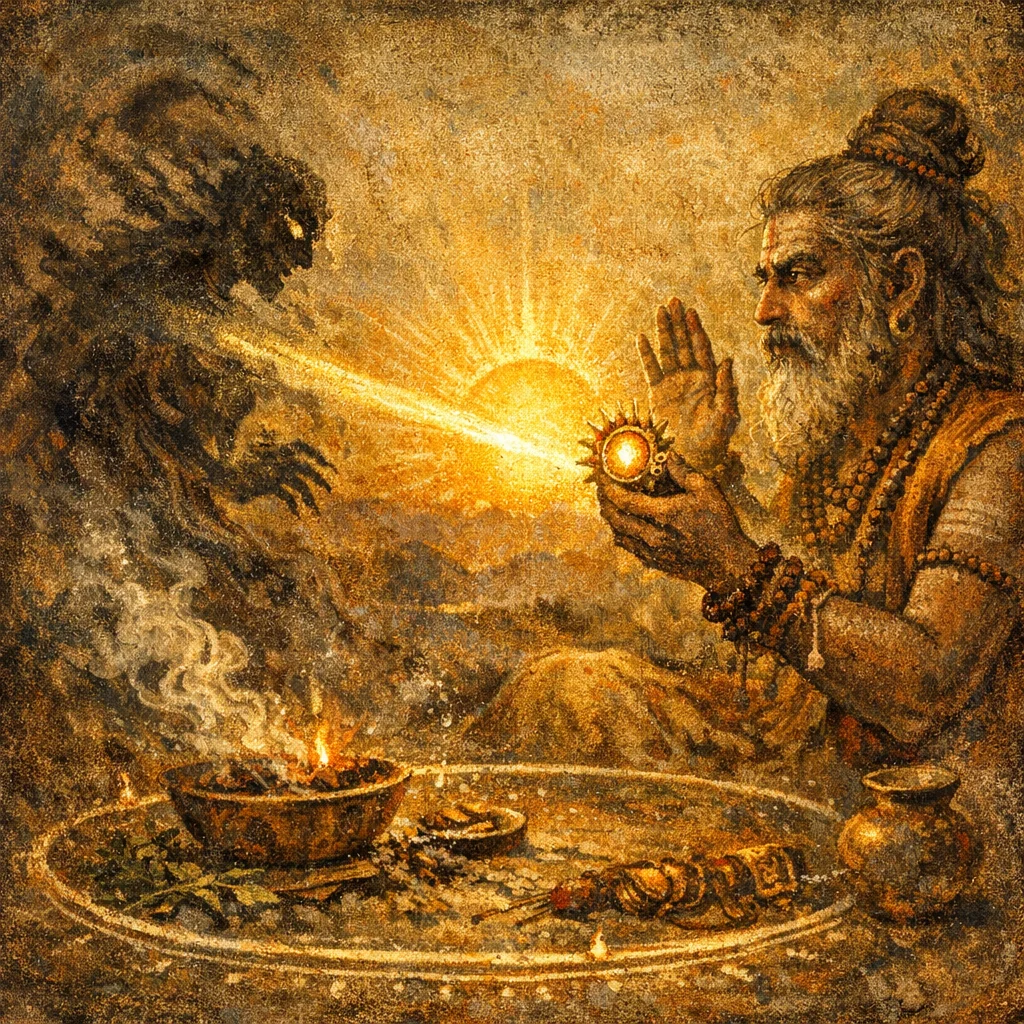
Sukta 21
Rishi: Not determinable from the single-verse input (requires anukramaṇī data for AVŚ 2.21).
Devata: Sūrya (as punitive heat/śóciḥ).
Chandas: Not determinable from the single-verse input with certainty; likely a common Atharvanic meter (often Anuṣṭubh), but requires full verse scansion.
Mantras
Mantra 1
शत्रुनाशनम्। सूर्य यत् ते तपस्तेन तं प्रति तप यो३स्मान् द्वेष्टि यं वयं द्विष्मः
O Sūrya, with what burning power is thine—therewith do thou scorch him back again, who hateth us, whom we do hate.
Mantra 2
सूर्य यत् ते हरस्तेन तं प्रति हर यो३स्मान् द्वेष्टि यं वयं द्विष्मः
O Sūrya, with that thy burning glare—therewith bear him back, him who hateth us, whom we ourselves do hate.
Mantra 3
सूर्य यत् तेऽर्चिस्तेन तं प्रत्यर्च यो३स्मान् द्वेष्टि यं वयं द्विष्मः
O Sūrya, with that ray of thine, shine thou back upon him—who hateth us—him whom we in turn do hate.
Mantra 4
सूर्य यत् ते शोचिस्तेन तं प्रति शोच यो३स्मान् द्वेष्टि यं वयं द्विष्मः
O Sūrya, with that flame of thine—therewith scorch him in requital—who hateth us, whom we ourselves do hate.
Frequently Asked Questions
It is used to repel hostility and return harmful intent to the person who directs it, by invoking Sūrya’s scorching radiance as the agent of reversal.
Not in the cited verses. The hymn primarily treats Sūrya’s heat and rays (tejas) as the operative power, so recitation and intention are central.
During daylight—especially at sunrise or in strong sunlight—because the ritual logic depends on aligning the mantra’s action with Sūrya’s manifest radiance.