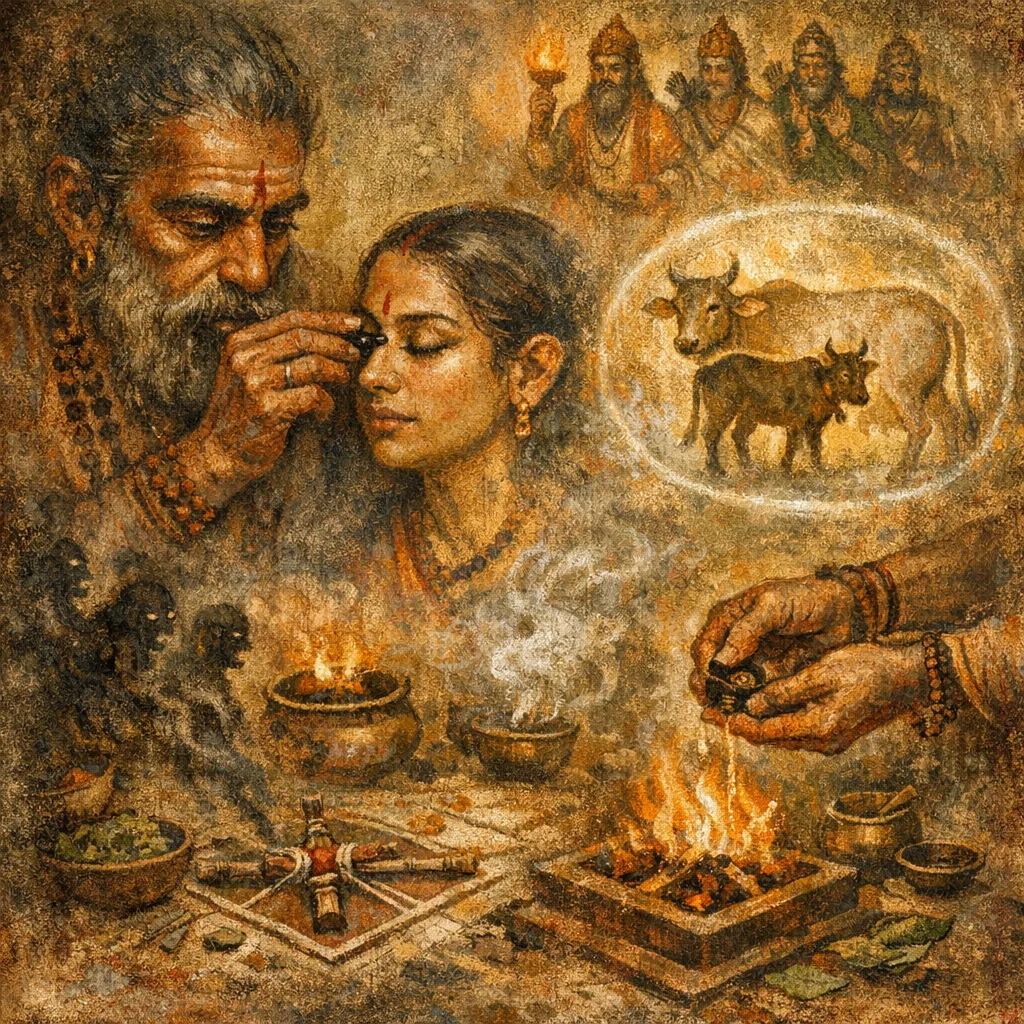
Sukta 45
Rishi: Atharvanic tradition (late AV book; specific ṛṣi attribution varies in ancillary lists)
Devata: Āñjana/Protective charm; Savitar as paradigmatic stabilizer; implicitly the quarters (diś) as pacified powers
Chandas: Mixed/late style; predominantly Anuṣṭubh-like cadence (edition-dependent metrical analysis needed)
Mantras
Mantra 1
आञ्जनम्। ऋणादृणमिव संनयन् कृत्यां कृत्याकृतो गृहम्। चक्षुर्मन्त्रस्य दुर्हार्दः पृष्टीरपि शृणाञ्जन
Anjana! As one settles debt from debt, so, bringing it to account, do thou remove the kṛtyā—yea, the house of him who wrought the kṛtyā. O stout-hearted one, the mantra’s eye, shatter also their backs, O Anjana.
Mantra 2
यदस्मासु दुष्वप्न्यं यद् गोषु यच्च नो गृहे। अनामगस्तं च दुर्हार्दः प्रियः प्रति मुञ्चताम्
What evil dreaming is among us, what (ill) is among the cattle, and what is in our house—let the disease-less, stout-hearted, gracious (Anjana) release that, and send it back again.
Mantra 3
अपामूर्ज ओजसो वावृधानमग्नेर्जातमधि जातवेदसः । चतुर्वीरं पर्वतीयं यदाञ्जनं दिशः प्रदिशः करदिच्छिवास्ते
That Anjana which, waxing with the Waters’ nourishment and with vigor, is born of Agni—of Jātavedas; which is fourfold in strength, mountain-born—may it make for thee the quarters and the sub-quarters benign indeed.
Mantra 4
चतुर्वीरं बध्यत आञ्जनं ते सर्वा दिशो अभयास्ते भवन्तु । ध्रुवस्तिष्ठासि सवितेव चार्य इमा विशो अभि हरन्तु ते बलिम्
Bind on for thee the fourfold-guarded Añjana: let all the quarters for thee be free from fear. Stand thou fast, moving as Savitar moves; let these peoples draw nigh and bring to thee their tribute.
Mantra 5
आक्ष्वैकं मणिमेकं कृष्णुष्व स्नाह्येकेना पिबैकमेषाम्। चतुर्वीरं नैरृतेभ्यश्चतुर्भ्यो ग्राह्या बन्धेभ्यः परि पात्वस्मान्
Smear on one; one amulet make thou black; with one thereof bathe, and of these drink thou one. May the fourfold-guarded (charm) protect us round about from the Nairṛta powers, from the fourfold seizings, from the bonds that bind.
Mantra 6
अग्निर्माग्निनावतु प्राणायापानायायुषे वर्चस ओजसे तेजसे स्वस्तये सुभूतये स्वाहा
May Agni, by Agni’s own might, protect me—for breath and downward-breath, for life, for lustre, for strength, for fiery energy, for welfare, for prosperous being: Svāhā!
Mantra 7
इन्द्रो मेन्द्रियेणावतु प्राणायापानायायुषे वर्चस ओजसे तेजसे स्वस्तये सुभूतये स्वाहा
May Indra, with Indra’s own sovereign force, protect me—for breath and downward-breath, for life, for lustre, for strength, for energy, for welfare, for prosperous being: Svāhā!
Mantra 8
सोमो मा सौम्येनावतु प्राणायापानायायुषे वर्चस ओजसे तेजसे स्वस्तये सुभूतये स्वाहा
May Soma, with Soma’s gracious healing quality, protect me—for breath and downward-breath, for life, for lustre, for strength, for energy, for welfare, for prosperous being: Svāhā!
Mantra 9
भगो मा भगेनावतु प्राणायापानायायुषे वर्चस ओजसे तेजसे स्वस्तये सुभूतये स्वाहा
May Bhaga, by Bhaga’s own might, protect me—for breath and out-breath, for length of days, for lustre, for vigor, for fiery energy, for welfare, for prosperous being: Svāhā!
Mantra 10
मरुतो मा गणैरवन्तु प्राणायापानायुषे वर्चस ओजसे तेजसे स्वस्तये सुभूतये स्वाहा
May the Maruts, with their bands, protect me—for breath and out-breath, for length of days, for lustre, for vigor, for fiery energy, for welfare, for prosperous being: Svāhā!
Frequently Asked Questions
Here āñjana is treated as a ritually empowered black unguent/collyrium that functions as a protective charm. It can be applied or worn, and it is praised as ‘mountain-born’ and strengthened by Waters and Agni.
Many Atharvanic dangers are imagined as approaching from any side. The hymn’s goal is to pacify all directions and sub-directions so the client is ‘fearless’ everywhere, not only in one place.
It indicates social acknowledgment and support—people drawing near with offerings, respect, or due shares. In paustika usage, it signals the client’s stabilized standing and increased prosperity rather than coercion.