Sukta 2
Rishi: Atharvanic/Angiras-type attribution (requires hymn-level colophon confirmation for AVŚ 1.2 in the chosen edition).
Devata: Indra (as repeller of missiles; with mention of Ṛbhu as invoked/celebrated figure).
Chandas: Mixed/Triṣṭubh-like cadence (to be confirmed against pada count and editional metrical marking).
Mantras
Mantra 1
रोगोपशमनम्। विद्मा शरस्य पितरं पर्जन्यं भूरिधायसम्। विद्मो ष्वस्य मातरं पृथिवीं भूरिवर्पसम्
We know the Father of the Reed—Parjanya, rich in stored abundance. We know, yea, the Mother of it—Earth, of form and plenty manifold.
Mantra 2
ज्याऽके परि णो नमाश्मानं तन्वं कृधि । वीडुर्वरीयोऽरातीरप द्वेषांस्याऽकृधि
O Bow-string, round about us—receive our reverence: make thou the body as stone, unyielding. Drive thou away the hostilities; make thou the hatreds to be put afar, and grant the safer, ampler room.
Mantra 3
वृक्षं यद्गावः परिषस्वजाना अनुस्फुरं शरमर्चन्त्यृभुम्। शरुमस्मद्यावय दिद्युमिन्द्र
When round the tree the cows, close-clasping, gather, and praise the deft Ṛbhu with the quivering arrow— That arrow from us drive thou far away, O Indra, the flashing bolt.
Mantra 4
यथा द्यां च पृथिवीं चान्तस्तिष्ठति तेजनम्। एवा रोगं चास्रावं चान्तस्तिष्ठतु मुञ्ज इत्
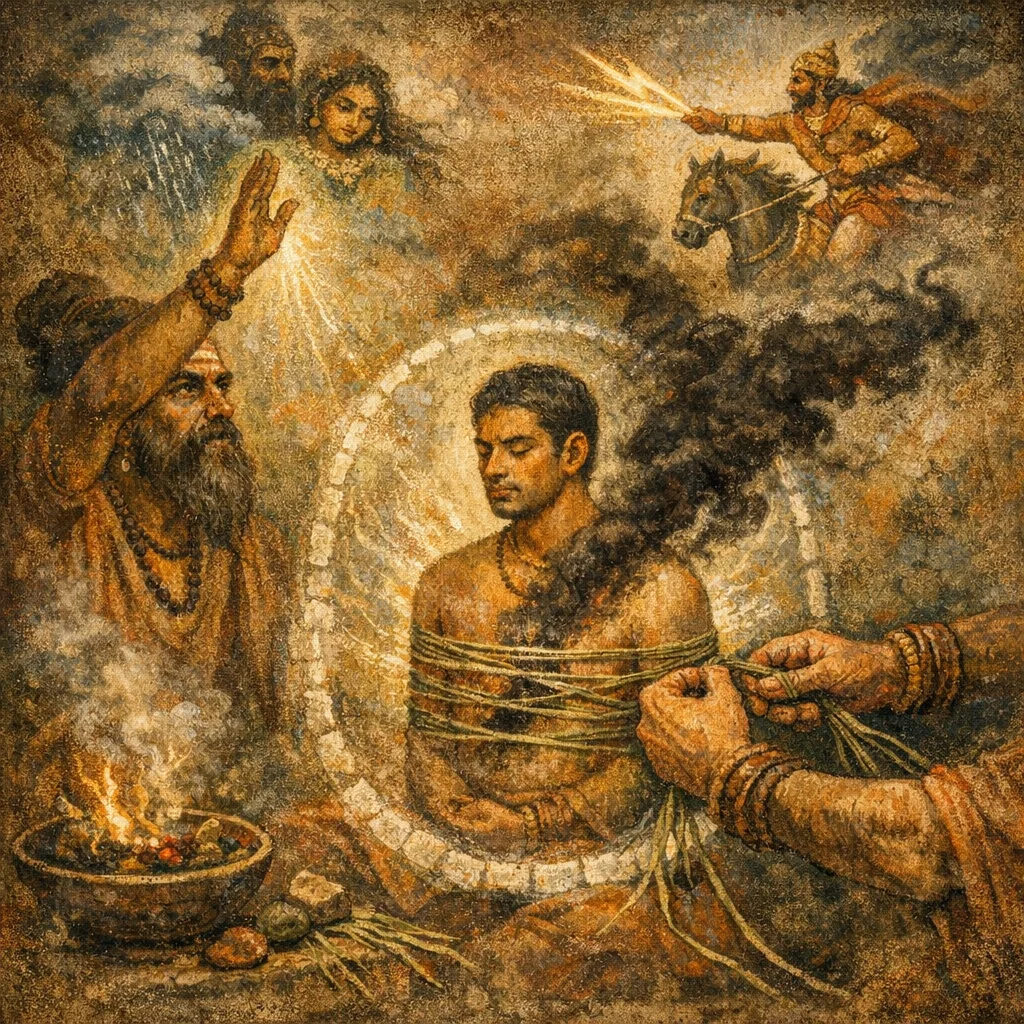
As, within, the fastening-implement stands between Heaven and Earth, even so—within—let Muñja hold fast the disease and the wasting flux, yea, let it stand confined within.
Frequently Asked Questions
It targets harm imagined as a “dart/arrow” (śara/śaru): enemy hostility, curse-like attack, or a sudden affliction that strikes like a projectile. The hymn repels it outward and also binds its effects so they cannot spread.
The bow-string (jyā) symbolizes protective encirclement—creating a boundary around the person—while the stone (aśman) represents making the body firm and unyielding to attack. Together they express both defense (boundary) and resilience (hardness).
Muñja is treated as an empowered binding material: it ‘holds fast’ disease (roga) and wasting discharge (āsrāva) within a confined state, using the model of a firm cosmic fastening between Heaven and Earth. Practically, it points to a tied band/amulet used to restrain and neutralize the affliction.