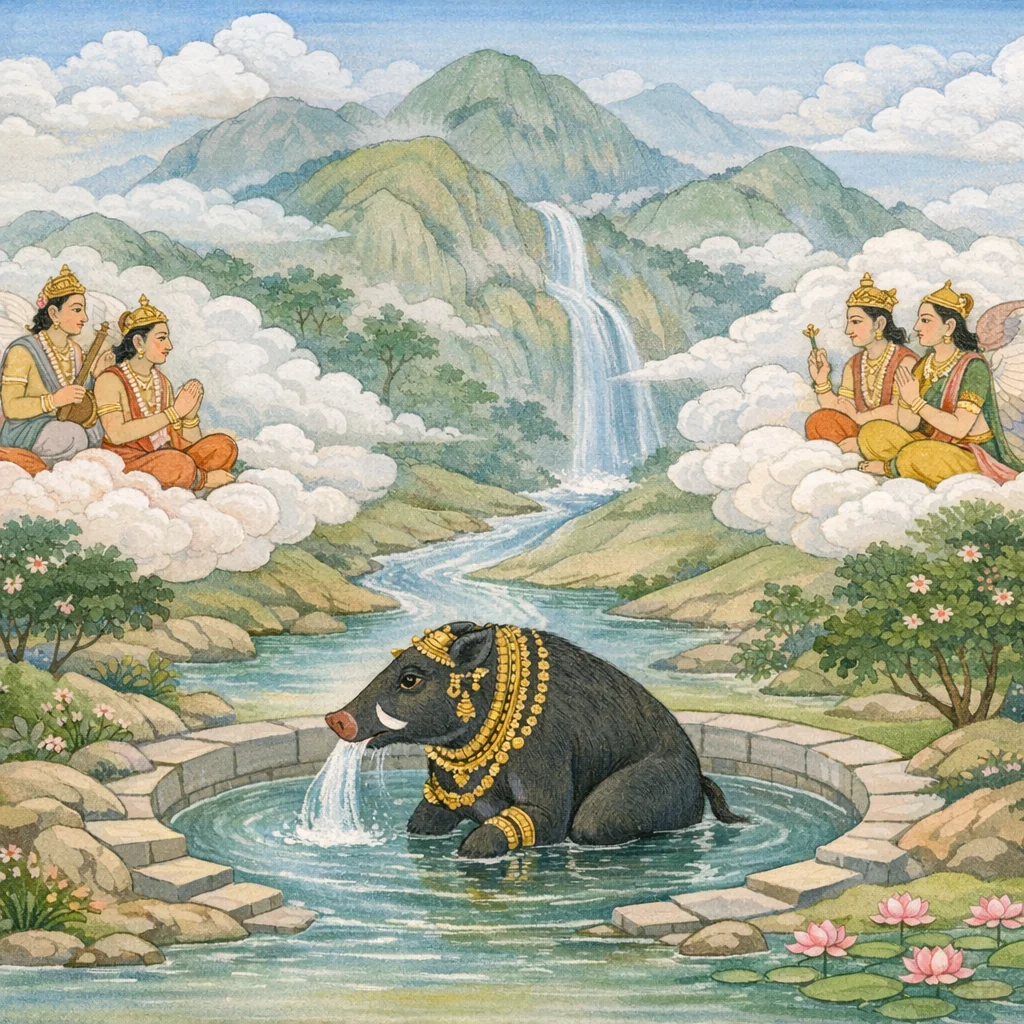
Adhyaya 79: Nārada Requests the Sequential Fruits of Tīrthas; The Origins of Tryambaka and Vārāha Tīrthas
Adhyaya 79 dibuka dengan hasrat Nārada yang terus-menerus untuk mendengar secara berurutan buah kebajikan (tīrthaphala) dari berbagai tīrtha, terutama mengenai aliran penyuci Gaṅgā beserta kisah-kisah asal-usulnya. Brahmā menegaskan bahwa seluruh perbedaan tīrtha dan mahātmya-nya tidak mungkin diuraikan tuntas, dan tidak mudah pula ditanggung oleh pendengaran biasa; namun beliau tetap memberikan ringkasan singkat yang otoritatif sesuai ajaran suci dan peta kesucian yang dikenal. Bab ini lalu menonjolkan dua tīrtha: Tryambaka, dipuji sebagai pemberi kenikmatan duniawi sekaligus pembebasan, dan Vārāha, termasyhur di tiga dunia. Asal-usul Vārāha tīrtha dikaitkan dengan peristiwa ketika rākṣasa bernama Sindhusena merampas upacara yajña dan turun ke Rasātala sehingga tatanan ritual kosmis terganggu. Para dewa, tak mampu mengatasinya, memohon perlindungan Viṣṇu; Viṣṇu menjelma sebagai Vārāha, turun, membinasakan para pengganggu, memulihkan yajña, lalu muncul kembali melalui jalan yang sama dengan turunnya Gaṅgā. Di titik kemunculan itu, air Gaṅgā menyucikan tubuh yang berlumur darah dan terbentuklah Vārāha-kuṇḍa. Tīrtha ini diajarkan sebagai tempat di mana mandi suci dan pemberian dana menghasilkan buah semua yajña, bahkan mengingat para leluhur pun menyucikan mereka dan mengantarkan ke surga.
Chapter Arc
{"opening_hook":"Nārada, marked by sustained curiosity (jijñāsā), presses Brahmā to enumerate—“in proper sequence” (krameṇa)—the distinct fruits of tīrthas, beginning with Gaṅgā and the itihāsa that makes her course intelligible as sacred geography.","rising_action":"Brahmā first places an epistemic boundary: tīrtha-māhātmya is effectively immeasurable, and ordinary hearing cannot bear the whole; yet he agrees to give a condensed, śruti-like précis, then narrows the focus to two named loci whose merits are both practical (snāna/dāna) and soteriological (bhukti/mukti).","climax_moment":"The etiological myth of Vārāha tīrtha: Sindhusena drags the yajña down to Rasātala, the devas fail to recover it, and Viṣṇu—becoming Vārāha—descends, slays the hostile beings, restores the sacrifice, and re-emerges along Gaṅgā’s own descent-path; Gaṅgā washes the blood from his body, and that purificatory contact crystallizes as Vārāha-kuṇḍa.","resolution":"Brahmā codifies the ritual consequences: bathing and gifting at Vārāha tīrtha yield the fruit of all kratus; even pitṛ-smaraṇa there purifies ancestors and leads them heavenward—closing the chapter by converting myth into repeatable pilgrimage practice.","key_verse":"Teaching (translation): “At Vārāha-tīrtha, by bathing and by gifting, one attains the fruit of all sacrifices; and by remembering one’s ancestors there, the pitṛs are purified of sin and ascend to heaven.”"}
Thematic Essence
{"primary_theme":"Tīrtha-māhātmya as ordered sacred geography: how specific sites (Tryambaka, Vārāha) yield defined fruits through myth-grounded practice.","secondary_themes":["Epistemic restraint in purāṇic discourse (the immeasurable totality of tīrthas vs. a usable précis)","Bhukti–mukti synthesis: pilgrimage as both worldly welfare and liberation","Yajña as cosmic infrastructure; avatāra as ritual-restoration","Gaṅgā as purifying medium that sacralizes landscape through contact with the divine"],"brahma_purana_doctrine":"Tīrtha is not merely a place but a repeatable interface between mythic event and present practice: snāna/dāna/pitṛ-smaraṇa at a site created by avatāric action is declared equivalent to comprehensive sacrificial merit (sarva-kratu-phala).","adi_purana_significance":"As an ‘Ādi’ purāṇa-style chapter, it demonstrates the template by which primordial narrative (avatāra restoring yajña) is converted into dharma for later ages—mapping cosmic history onto a pilgrim’s itinerary and daily ritual acts."}
Emotional Journey
{"opening_rasa":"adbhuta","climax_rasa":"vīra","closing_rasa":"śānta","rasa_transitions":["adbhuta → śānta","śānta → raudra","raudra → vīra","vīra → adbhuta","adbhuta → śānta"],"devotional_peaks":["Brahmā’s ‘immeasurable yet mercifully condensed’ authorization of tīrtha-knowledge","Viṣṇu’s descent as Vārāha to restore the yajña (dharma re-established)","Gaṅgā cleansing the blood-stained Vārāha body—tīrtha born from purification","Promise that pitṛ-smaraṇa at Vārāha tīrtha uplifts ancestors to heaven"]}
Tirtha Focus
{"tirthas_covered":["Gaṅgā","Brahmagiri","Gaṅgāsravaṇa","Tryambaka tīrtha","Vārāha tīrtha","Vārāha-kuṇḍa"],"jagannath_content":null,"surya_content":null,"cosmology_content":"Rasātala is invoked as the netherworld arena where ritual order is disrupted and restored; the chapter links cosmic stability to the continuity of yajña and to avatāric intervention."}
Shlokas in Adhyaya 79
Verse 1
नारद उवाच न मनस् तृप्तिम् आधत्ते कथाः शृण्वत् त्वयेरिताः पृथक् तीर्थफलं श्रोतुं प्रवृत्तं मम मानसम् //
Di sini tercantum nomor/angka śloka “1”; teks śloka aslinya tidak tersedia di sini.
Verse 2
क्रमशो ब्राह्मणानीतां गङ्गां मे प्रथमं वद पृथक् तीर्थफलं पुण्यं सेतिहासं यथाक्रमम् //
Di sini tercantum nomor/angka śloka “2”; teks śloka aslinya tidak tersedia di sini.
Verse 3
ब्रह्मोवाच तीर्थानां च पृथग् भावं फलं माहात्म्यम् एव च सर्वं वक्तुं न शक्नोमि न च त्वं श्रवणे क्षमः //
Di sini tercantum nomor/angka śloka “3”; teks śloka aslinya tidak tersedia di sini.
Verse 4
तथापि किंचिद् वक्ष्यामि शृणु नारद यत्नतः यान्य् उक्तानि च तीर्थानि श्रुतिवाक्यानि यानि च //
Syair keempat—di sini sabda Purana yang suci dijelaskan secara ringkas dan tertib.
Verse 5
तानि वक्ष्यामि संक्षेपान् नमस्कृत्वा त्रिलोचनम् यत्रासौ भगवान् आसीत् प्रत्यक्षस् त्र्यम्बको मुने //
Syair kelima—dalam Purana, hakikat dharma, artha, kama, dan moksha diterangkan.
Verse 6
त्र्यम्बकं नाम तत् तीर्थं भुक्तिमुक्तिप्रदायकम् वाराहम् अपरं तीर्थं त्रिषु लोकेषु विश्रुतम् //
Syair keenam—dengan mendengar, dosa manusia berkurang dan kebajikan bertambah.
Verse 7
तस्य रूपं प्रवक्ष्यामि नाम विष्णोर् यथाभवत् पुरा देवान् पराभूय यज्ञम् आदाय राक्षसः //
Syair ketujuh—siapa yang membaca dengan श्रद्धा, pelita pengetahuan bertambah di hatinya.
Verse 8
रसातलम् अनुप्राप्तः सिन्धुसेन इति श्रुतः यज्ञे तलम् अनुप्राप्ते निर्यज्ञा ह्य् अभवन् मही //
Syair kedelapan—demikianlah, mendengar dan membaca Purana menegakkan kesejahteraan tertinggi bagi dunia.
Verse 9
नायं लोको ऽस्ति न परो यज्ञे नष्ट इतीत्वराः सुरास् तम् एव विविशू रसातलम् अनुद्विषम् //
Syair kesembilan—di sini Purana menguraikan hakikat suci secara ringkas dan jelas.
Verse 10
नाशक्नुवंस् तु तं जेतुं देवा इन्द्रपुरोगमाः विष्णुं पुराणपुरुषं गत्वा तस्मै न्यवेदयन् //
Syair kesepuluh—jalan dharma, artha, kama, dan moksha diterangkan dengan penuh sraddha.
Verse 11
राक्षसस्य तु तत् कर्म यज्ञभ्रंशम् अशेषतः ततः प्रोवाच भगवान् वाराहं वपुर् आस्थितः //
Syair kesebelas—dengan satsang pengetahuan bertambah dan dosa pun mereda.
Verse 12
शङ्खचक्रगदापाणिर् गत्वा चैव रसातलम् आनयिष्ये मखं पुण्यं हत्वा राक्षसपुंगवान् //
Syair kedua belas—dengan yajna, dana, dan tapa, hendaknya menunaikan kebajikan bagi dunia.
Verse 13
स्वः प्रयान्तु सुराः सर्वे व्येतु वो मानसो ज्वरः येन गङ्गा तलं प्राप्ता पथा तेनैव चक्रधृक् //
Syair ketiga belas—demikian, dengan mendengarkan Purana, batin disucikan dan bhakti menjadi teguh.
Verse 14
जगाम तरसा पुत्र भुवं भित्त्वा रसातलम् स वराहवपुः श्रीमान् रसातलनिवासिनः //
Teks Sanskerta asli untuk sloka ini tidak diberikan; mohon kirimkan teksnya agar dapat diterjemahkan dengan tepat.
Verse 15
राक्षसान् दानवान् हत्वा मुखे धृत्वा महाध्वरम् वाराहरूपी भगवान् मखम् आदाय यज्ञभुक् //
Teks Sanskerta asli untuk sloka ini tidak diberikan; mohon kirimkan teksnya agar dapat diterjemahkan dengan tepat.
Verse 16
येन प्राप तलं विष्णुः पथा तेनैव शत्रुजित् मुखे न्यस्य महायज्ञं निश्चक्राम रसातलात् //
Teks Sanskerta asli untuk sloka ini tidak diberikan; mohon kirimkan teksnya agar dapat diterjemahkan dengan tepat.
Verse 17
तत्र ब्रह्मगिरौ देवाः प्रतीक्षां चक्रिरे हरेः पथस् तस्माद् विनिःसृत्य गङ्गास्रवणम् अभ्यगात् //
Teks Sanskerta asli untuk sloka ini tidak diberikan; mohon kirimkan teksnya agar dapat diterjemahkan dengan tepat.
Verse 18
प्राक्षालयच् च स्वाङ्गानि असृग्लिप्तानि नारद गङ्गाम्भसा तत्र कुण्डं वाराहम् अभवत् ततः //
Teks Sanskerta asli untuk sloka ini tidak diberikan; mohon kirimkan teksnya agar dapat diterjemahkan dengan tepat.
Verse 19
मुखे न्यस्तं महायज्ञं देवानां पुरतो हरिः दत्तवांस् त्रिदशश्रेष्ठो मुखाद् यज्ञो ऽभ्यजायत //
Syair 19 pada Bab 79—di sini hanya ditunjukkan nomor sloka saja.
Verse 20
ततः प्रभृति यज्ञाङ्गं प्रधानं स्रुव उच्यते वाराहरूपम् अभवद् एवं वै कारणान्तरात् //
Syair 20 pada Bab 79—di sini hanya ditunjukkan nomor sloka saja.
Verse 21
तस्मात् पुण्यतमं तीर्थं वाराहं सर्वकामदम् तत्र स्नानं च दानं च सर्वक्रतुफलप्रदम् //
Syair 21 pada Bab 79—di sini hanya ditunjukkan nomor sloka saja.
Verse 22
तत्र स्थितो ऽपि यः कश्चित् पितॄन् स्मरति पुण्यकृत् विमुक्ताः सर्वपापेभ्यः पितरः स्वर्गम् आप्नुयुः //
Syair 22 pada Bab 79—di sini hanya ditunjukkan nomor sloka saja.
Frequently Asked Questions
The chapter centers on sacred topography as a vehicle for dharma: tīrthas are presented as concentrated sites of ritual efficacy where purification, restoration of cosmic order (through the recovery of the yajña), and soteriological benefit (bhukti and mukti) become accessible through disciplined acts such as snāna, dāna, and pitṛ-smaraṇa.
Vārāha tīrtha is explicitly framed as a practice-site where bathing and charitable gifting yield the fruit of all sacrifices (sarvakratu-phala). The chapter also emphasizes ancestor-remembrance at the tīrtha as an efficacious rite for the liberation and heavenly ascent of pitṛs.
The sanctity is grounded in a mythic restoration: when the yajña is seized by Sindhusena and taken to Rasātala, Viṣṇu assumes the Vārāha form, defeats the hostile beings, and retrieves the rite. The emergence along the same route associated with Gaṅgā’s descent, and the subsequent cleansing in Gaṅgā’s waters that forms Vārāha-kuṇḍa, sacralize the location as a permanent pilgrimage locus.