
Shloka 32
Dhyana Yoga — Atma Samyama Yoga
आत्मौपम्येन सर्वत्र समं पश्यति योऽर्जुन । सुखं वा यदि वा दुःखं स योगी परमो मतः ॥ ६.३२ ॥
ātmaupamyena sarvatra samaṁ paśyati yo 'rjuna | sukhaṁ vā yadi vā duḥkhaṁ sa yogī paramo mataḥ || 6.32 ||

Wahai Arjuna, ia yang melihat kesetaraan di mana-mana dengan membandingkan pada dirinya sendiri—baik dalam suka maupun duka—yogi itu dianggap yang tertinggi.
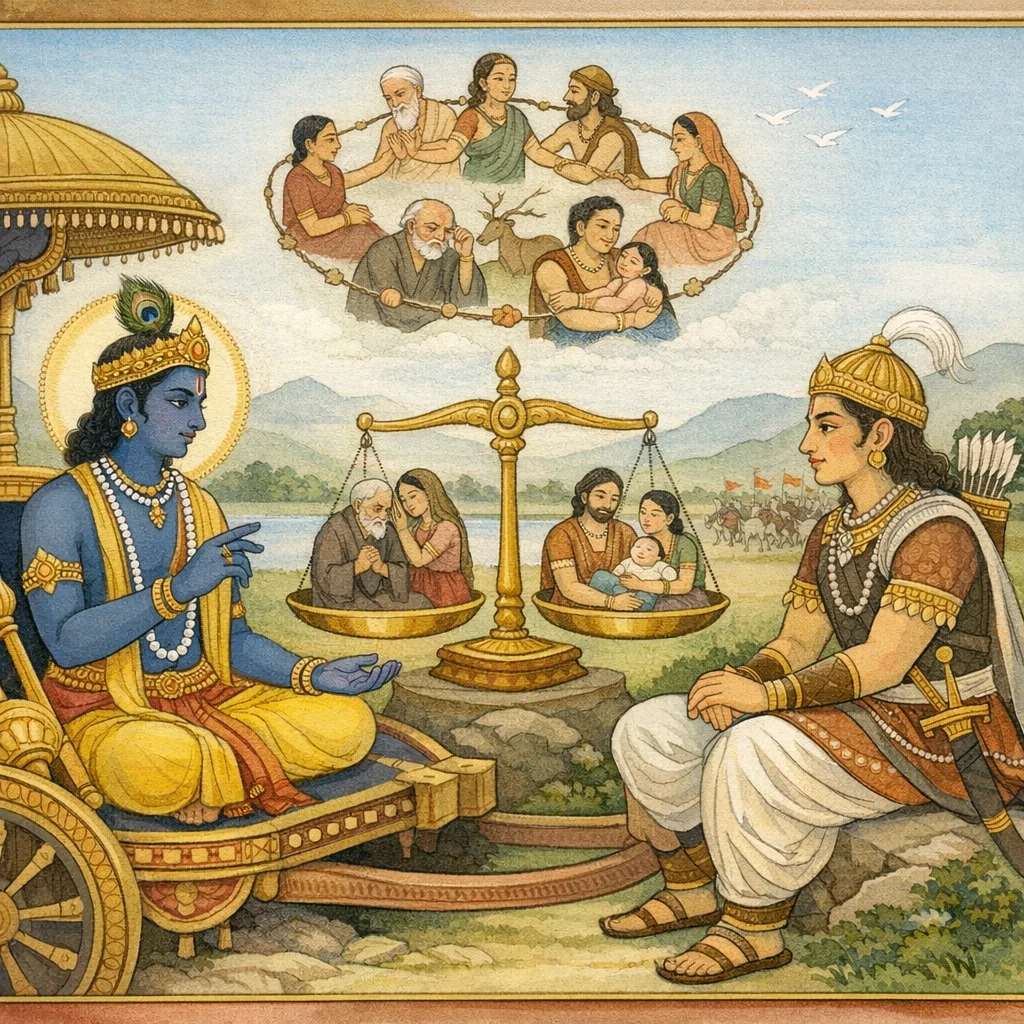
O Arjuna, he is deemed the supreme yogin who sees equality everywhere by comparison with himself, whether in pleasure or pain.
That yogin is considered highest who, by analogy with himself, sees sameness everywhere—whether (others experience) happiness or suffering.
Traditional translations often take this as an ethical directive grounded in empathy (‘as oneself’). Some commentarial traditions connect it to metaphysical sameness (one Self), but the explicit ‘by comparison with oneself’ foregrounds a practical moral-psychological method.
FAQs
The method ‘by analogy with oneself’ describes perspective-taking: using one’s own sensitivity to pleasure and distress as a guide for understanding others, supporting compassion and restraint.
While it can align with doctrines of one Self, the verse’s explicit framing supports a moral phenomenology: shared capacity for happiness and suffering becomes the basis for ‘sameness’ in regard.
After describing yogic realization and divine immanence, the chapter identifies a concrete marker of yogic excellence: impartial, empathic perception in lived relations.
It parallels contemporary ethics of reciprocity: treat others’ well-being as comparable to one’s own, informing non-harm, fairness, and compassionate action.