
Shloka 31
Dhyana Yoga — Atma Samyama Yoga
सर्वभूतस्थितं यो मां भजत्येकत्वमास्थितः । सर्वथा वर्तमानोऽपि स योगी मयि वर्तते ॥ ६.३१ ॥
sarva-bhūta-sthitaṁ yo māṁ bhajaty ekatvam āsthitaḥ | sarvathā vartamāno 'pi sa yogī mayi vartate || 6.31 ||

Ia yang memuja Aku, berdiam dalam keesaan, sebagai yang bersemayam dalam semua makhluk—meski terlibat dalam segala cara, yogi itu tetap berdiam di dalam-Ku.
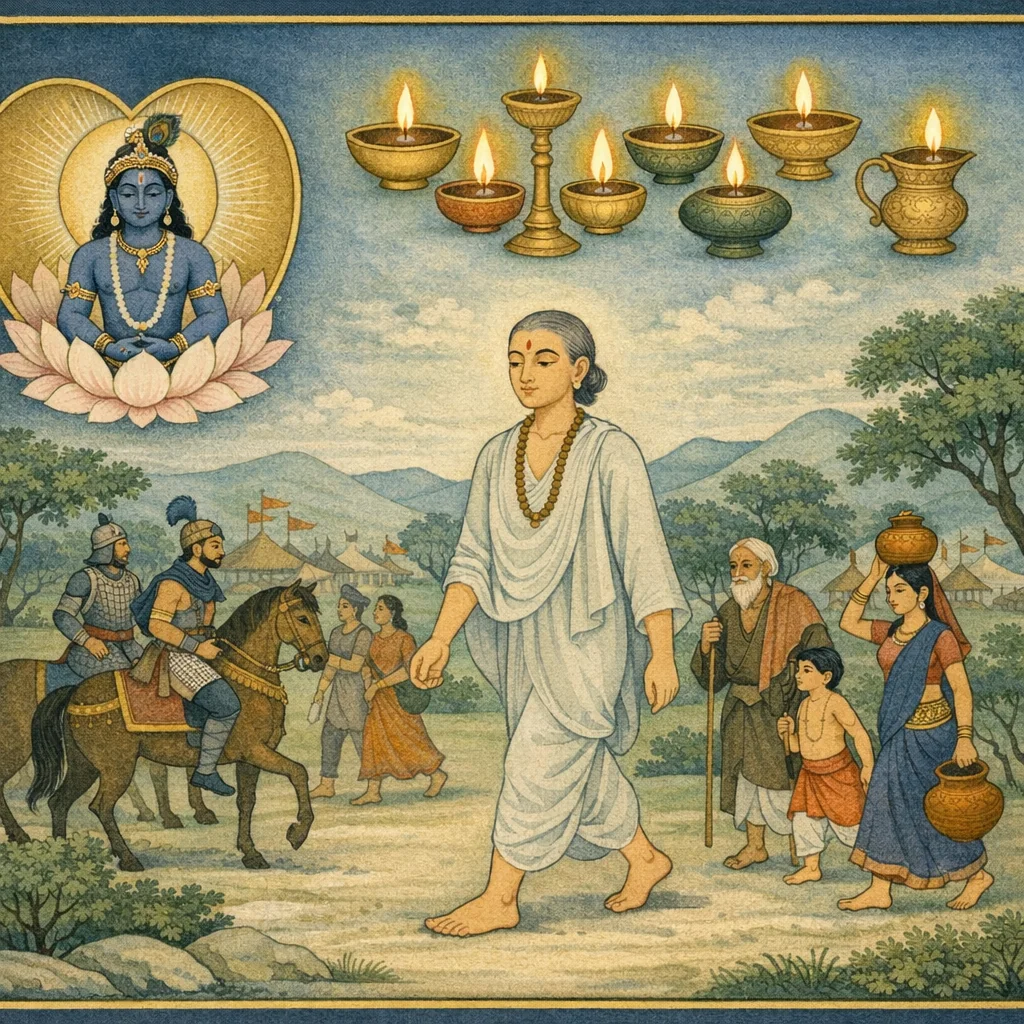
He who worships Me, abiding in oneness, as dwelling in all beings—though engaged in all ways, that yogin abides in Me.
Whoever honors/participates in Me (bhajati), established in unity, as present in all beings—though acting in every manner, that yogin remains in Me.
‘Bhajati’ can mean worship, devotion, or sustained participation. ‘Though acting’ is often used to reconcile renunciation with worldly roles: realization of unity allows action without perceived separation.
FAQs
The verse describes an integrated self: one can remain centered in a unifying commitment while performing diverse tasks, reducing inner conflict and role-fragmentation.
‘Oneness’ implies that the divine is not external to beings; devotion is directed to a reality present in all, supporting a non-dual or panentheistic interpretation.
It clarifies that yogic realization is compatible with continued activity, a recurring concern in the Gita’s synthesis of contemplation, devotion, and action.
It can be applied as ‘values-based action’: maintaining a steady contemplative or devotional orientation while meeting ordinary responsibilities.