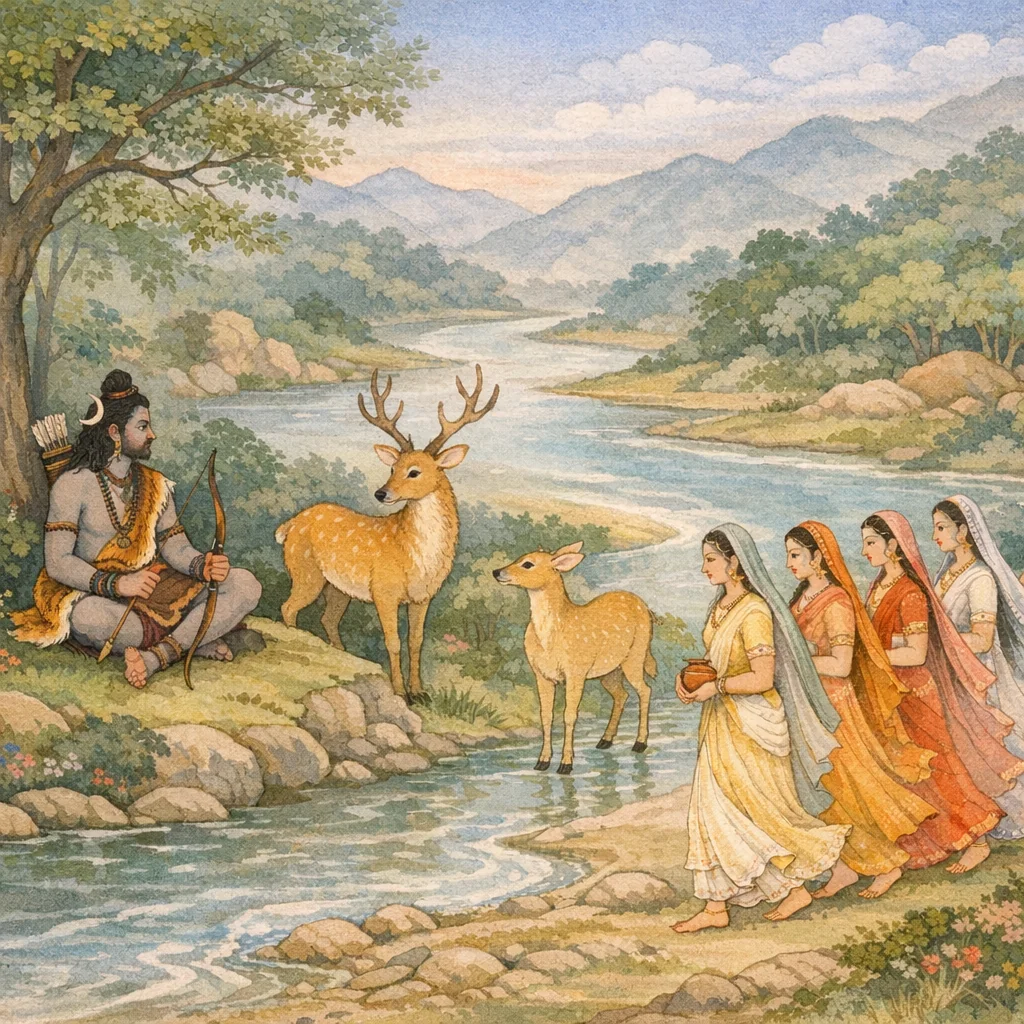
Adhyaya 102: The Five Sacred River-Tirthas: Savitri, Gayatri, Shraddha, Medha, and Sarasvati
અધ્યાય ૧૦૨માં સાવિત્રી, ગાયત્રી, શ્રદ્ધા, મેધા અને સરસ્વતી—આ પાંચ પવિત્ર નદી-તીર્થોનું માહાત્મ્ય તથા ઉત્પત્તિકથા વર્ણવાય છે. બ્રહ્મા નારદને કહે છે કે આ ઋષિઓને વિખ્યાત એવા પ્રસિદ્ધ તીર્થો છે; અહીં સ્નાન અને જલપાનથી સર્વ કલ્મષ નાશ પામે છે. તે તેમને પોતાની જ્યેષ્ઠ પુત્રીઓ કહે છે, જે ધર્મ-પ્રતિષ્ઠા સાથે સંકળાયેલી છે. પછી લોકસુંદરી નામની અતિરૂપવતી કન્યા ભાગે છે; તે મૃગી બને છે, બ્રહ્મા મૃગ બને છે; અને ધર્મરક્ષાર્થે શંભુ મૃગવ્યાધ (શિકારી) રૂપ ધારણ કરે છે. ભયભીત પાંચ પુત્રીઓ ગંગા તરફ જાય છે; બ્રહ્મા અનુચિત ભાવથી નિવૃત્ત થઈ તે કન્યાને વિવસ્વાનને અર્પે છે. અંતે પાંચ નદીઓનો સંગમ તીર્થરૂપે પવિત્ર થાય છે; ત્યાં સ્નાન-દાનથી ભોગ, સ્વર્ગ અને મોક્ષ મળે છે, તેમજ મૃગવ્યાધ-તીર્થ અને બ્રહ્મ-તીર્થના વિશેષ ફળો પણ જણાવાય છે.
Chapter Arc
{"opening_hook":"Brahmā, in dialogue with Nārada, abruptly elevates five named river-tīrthas—Sāvitrī, Gāyatrī, Śraddhā, Medhā, Sarasvatī—as “well-known to munis,” whose mere snāna and pāna erase kalmaṣa; the reader is drawn in by the promise of immediate ritual efficacy tied to specific sacred waters.","rising_action":"The tīrtha-listing turns into an etiological genealogy: the five rivers are disclosed as Brahmā’s elder daughters and as instruments of dharmasaṃsthāna. Tension rises when a uniquely beautiful lokasundarī maiden appears and flees, triggering a chain of metamorphoses and moral peril.","climax_moment":"At the narrative peak, the transgressive pursuit is arrested through cosmic role-reversal: the maiden becomes a doe, Brahmā a stag, and Śambhu assumes the form/function of a hunter (mṛgavyādha) to protect dharma—transforming a potentially scandalous episode into a dharma-restorative charter for a new tīrtha (Mṛgavyādha-tīrtha).","resolution":"Fearful, the five daughters/rivers move toward the Gaṅgā, and the story resolves with Brahmā’s withdrawal from the improper act and the gifting of the maiden to Vivasvat. The chapter closes by re-grounding the myth in sacred geography: the five rivers are sanctified as confluential tīrthas whose snāna and dāna yield sarvakāmaprāpti, svarga, and mokṣa, with special fruits for Mṛgavyādha-tīrtha and Brahma-tīrtha.","key_verse":"null"}
Thematic Essence
{"primary_theme":"Tīrtha-māhātmya of five sacred rivers as dharma-bearing daughters of Brahmā","secondary_themes":["Etiological myth: transformation (doe/stag) as a charter for Mṛgavyādha-tīrtha","Dharma-restoration through divine intervention (Śambhu as protector)","Confluence theology: Gaṅgā as purifier and integrator of subsidiary sacred streams","Ritual efficacy: snāna and dāna as instruments for kāma, svarga, and mokṣa"],"brahma_purana_doctrine":"Sacred geography is validated by creator-authority: Brahmā’s own progeny become rivers, so tīrtha is not merely a place but a dharma-function—waters that cleanse kalmaṣa because they embody śraddhā (faith), medhā (intelligence), and vāk (Sarasvatī).","adi_purana_significance":"As “Adi Purāṇa,” it models how primordial order is mapped onto the earth: cosmic genealogy (Brahmā’s daughters) becomes a pilgrim’s itinerary, making liberation accessible through sanctioned places and rites."}
Emotional Journey
{"opening_rasa":"शान्त (śānta)","climax_rasa":"भयानक (bhayānaka)","closing_rasa":"शान्त (śānta)","rasa_transitions":["śānta → अद्भुत (adbhuta) → शृङ्गार (śṛṅgāra) → भयानक (bhayānaka) → शान्त (śānta)"],"devotional_peaks":["The proclamation that snāna and pāna in the five rivers destroy kalmaṣa","The re-sanctification of the episode through Śambhu’s dharma-protecting intervention, converting fear into a tīrtha-boon","The concluding assurance that dāna and snāna at these confluences grant svarga and mokṣa (especially at Brahma-tīrtha)"]}
Tirtha Focus
{"tirthas_covered":["सावित्री-तीर्थ (Sāvitrī)","गायत्री-तीर्थ (Gāyatrī)","श्रद्धा-तीर्थ (Śraddhā)","मेधा-तीर्थ (Medhā)","सरस्वती-तीर्थ (Sarasvatī)","गङ्गा-संगम/गङ्गा (Gaṅgā and confluence setting)","मृगव्याध-तीर्थ (Mṛgavyādha-tīrtha)","ब्रह्म-तीर्थ (Brahma-tīrtha)"],"jagannath_content":null,"surya_content":"Vivasvat (the Sun) receives the maiden, subtly aligning the resolution with solar ṛta/order; no extended Sūrya-stuti is foregrounded in this chapter’s summary.","cosmology_content":"Cosmology appears in applied form: Brahmā’s progeny become rivers, showing creation as the sacralization of landscape; no full sarga/pralaya sequence is central here."}
Shlokas in Adhyaya 102
Verse 1
ब्रह्मोवाच सावित्री चैव गायत्री श्रद्धा मेधा सरस्वती एतानि पञ्च तीर्थानि पुण्यानि मुनयो विदुः //
પ્રથમ શ્લોક—અહીં પવિત્ર પુરાણવચનનો પ્રવાહ આરંભ થાય છે।
Verse 2
तत्र स्नात्वा तु पीत्वा तु मुच्यते सर्वकल्मषात् सावित्री चैव गायत्री श्रद्धा मेधा सरस्वती //
દ્વિતીય શ્લોક—ધર્માર્થે કહેલું આ જ્ઞાન શ્રોતાઓના હિતનું કારણ બને।
Verse 3
एता मम सुता ज्येष्ठा धर्मसंस्थानहेतवः सर्वासाम् उत्तमां कांचिन् निर्ममे लोकसुन्दरीम् //
તૃતીય શ્લોક—શ્રદ્ધાથી શ્રવણ કરીને મનમાં ધારણ કરવું જોઈએ।
Verse 4
तां दृष्ट्वा विकृता बुद्धिर् ममासीन् मुनिसत्तम गृह्यमाणा मया बाला सा मां दृष्ट्वा पलायिता //
ચતુર્થ શ્લોક—આ પુરાણ પુણ્યપ્રદ અને પાપક્ષયકર કહેવાય છે।
Verse 5
मृगीभूता तु सा बाला मृगो ऽहम् अभवं तदा मृगव्याधो ऽभवच् छंभुर् धर्मसंरक्षणाय च //
પંચમ શ્લોક—જે વાંચે કે સાંભળે, તે મોક્ષમાર્ગે પ્રવર્તે છે।
Verse 6
ता मद्भीताः पञ्च सुता गङ्गाम् ईयुर् महानदीम् ततो महेश्वरः प्रायाद् धर्मसंरक्षणाय सः //
ષષ્ઠ શ્લોક—અહીં પવિત્ર પુરાણવચન ધર્મપ્રવર્તનાર્થે ઉચ્ચારાયું છે।
Verse 7
धनुर् गृहीत्वा सशरम् ईशो ऽपि मृगरूपिणम् माम् उवाच वधिष्ये त्वां मृगव्याधस् तदा हरः //
સપ્તમ શ્લોક—શ્રવણથી મન શુદ્ધ થાય છે અને મનુષ્યોનું જ્ઞાન વધે છે।
Verse 8
तत्कर्मणो निवृत्तो ऽहं प्रादां कन्यां विवस्वते सावित्र्याद्याः पञ्च सुता नदीरूपेण संगताः //
અષ્ટમ શ્લોક—ધર્મ સર્વનું મૂળ છે; તેથી તેને કદી ત્યજવું ન જોઈએ।
Verse 9
ता आगताः पुनश् चापि स्वर्गं लोकं ममान्तिकम् यत्र ताः संगता देव्या पञ्च तीर्थानि नारद //
નવમ શ્લોક—સત્કર્મથી યશ મળે છે અને પાપથી માત્ર દુઃખ જ થાય છે।
Verse 10
संगतानि च पुण्यानि पञ्च नद्यः सरस्वती तेषु स्नानं तथा दानं यत् किंचित् कुरुते नरः //
દશમ શ્લોક—આ રીતે પુરાણ-શ્રવણથી ભક્તિ સદા સ્થિર થાય છે।
Verse 11
सर्वकामप्रदं तत् स्यान् नैष्कर्म्यान् मुक्तिदं स्मृतम् तत्राभवन् मृगव्याधं तीर्थं सर्वार्थदं नृणाम् स्वर्गमोक्षफलं चान्यद् ब्रह्मतीर्थफलं स्मृतम् //
અગિયારમો શ્લોક—અહીં મૂળ શ્લોક આપવામાં આવ્યો નથી; તેથી યથાર્થ અનુવાદ શક્ય નથી।
Frequently Asked Questions
The chapter centers on tīrtha-māhātmya framed by dharma-restoration: sacred waters remove kalmaṣa through snāna and pāna, while the mythic episode of transformation and Śambhu’s intervention functions as an etiological justification for ethical restraint and the re-establishment of dharma.
It emphasizes the five river-tīrthas Savitrī, Gāyatrī, Śraddhā, Medhā, and Sarasvatī, especially at their confluence context with the Gaṅgā, stating that bathing and giving gifts there yield sarvakāmaprada results, svarga-phala, and mokṣa; it also names Mṛgavyādha-tīrtha as sarvārthada and notes Brahma-tīrtha as associated with svarga–mokṣa fruit.
Brahmā identifies the five as his elder daughters who become integrated in river-form; after a disruptive pursuit episode resolved by Śambhu’s dharma-protective role and Brahmā’s renunciation of the act, the daughters proceed to the Gaṅgā and are subsequently described as reunited and sanctified as five punyāḥ nadyaḥ and tīrthas.