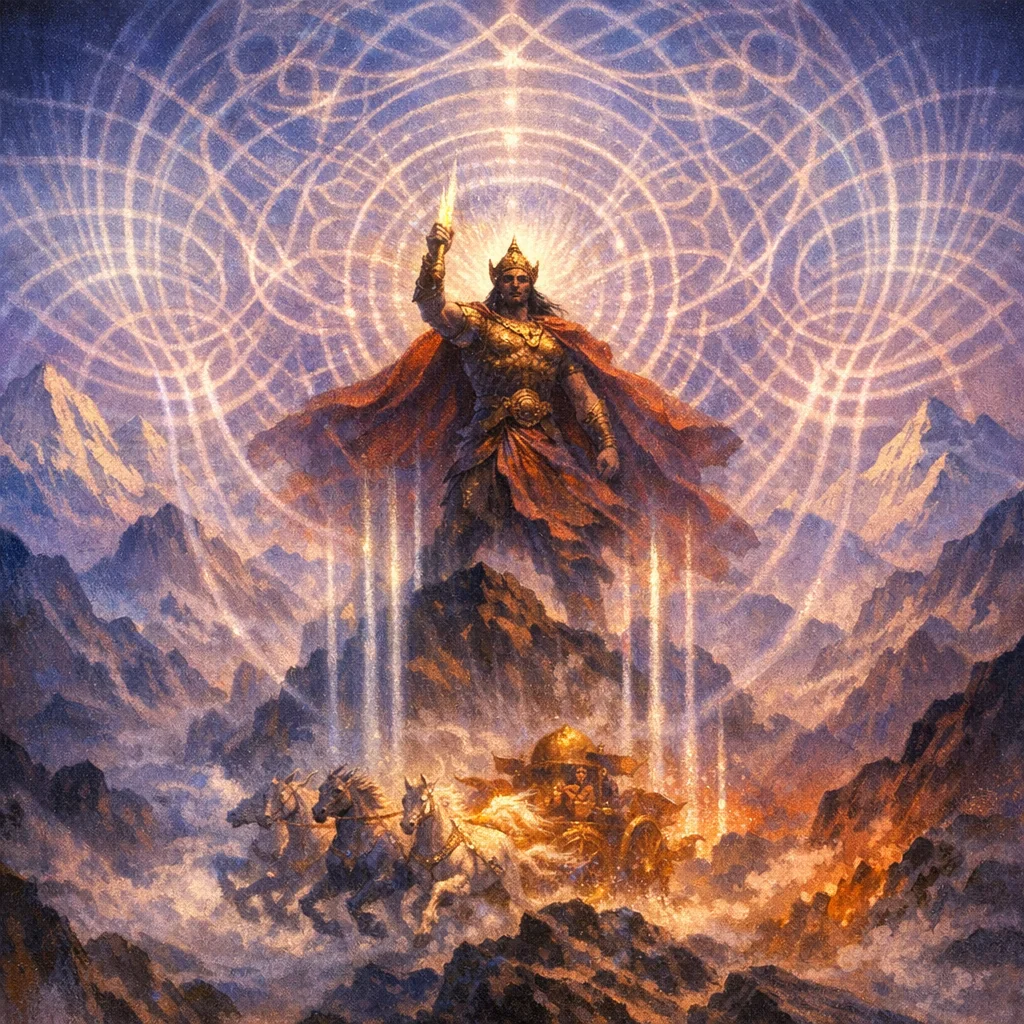
Dashati 7
Aindra praise: awakening and yoking Indra’s power through expertly metered chant for victory and effective sacrifice
Indra
Heroic and energizing (āindra-utsāha) with a crafted technical liturgical tone
Ṛṣi attribution is not recoverable from the supplied excerpt alone; it requires Rigvedic source-hymn concordance for these mantras.
Éloge aindra : éveiller Indra et « atteler » sa puissance par un chant savamment mesuré afin d’obtenir victoire et efficacité sacrificielle. Dans l’assemblée rituelle, la divinité est stimulée ; la parole poétique, comme un acte merveilleux, acquiert une force opérative. La conscience des mètres — Gāyatrī, Triṣṭubh, Jagatī — sert de véhicule à la louange ; les bras irrésistibles d’Indra abattent l’opposition asurique. Son action demeure « aujourd’hui comme jadis » : lorsque Vāc et le Chandas sont correctement mis sous le joug et chantés, ils réveillent Indra et font entrer dans le rite sa puissance victorieuse, restauratrice de l’ordre.
Mantras
Mantra 1
विधुं दद्राणं समने बहूनां युवानं सन्तं पलितो जगार देवस्य पश्य काव्यं महित्वाद्या ममार स ह्यः समान
L’impétueux, s’élançant dans l’assemblée des nombreux — jeune et pourtant demeurant; le (prêtre) aux cheveux gris l’a éveillé par le chant. Vois le prodige poétique du dieu, par la puissance de sa grandeur : aujourd’hui il accomplit (l’œuvre), lui qui, d’autrefois, était le même.
Mantra 2
शाक्मना शाको अरुणः सुपर्ण आ यो महः शूरः सनादनीडः यच्चिकेत सत्यमित्तन्न मोघं वसु स्पार्हमुत जेतोत दाता
Par une aide puissante vient le Radieux, le rougeoyant (aruṇa), le héros aux belles ailes (suparṇa), au siège très ancien. Tout ce qu’il discerne, cela est vraiment vrai et non en vain : il est le vainqueur et le donateur de richesses désirables.
Mantra 3
इन्द्रस्य बाहू स्थविरौ युवानावनाधृष्यौ सुप्रतीकावसह्यौ तौ युञ्जीत प्रथमौ योग आगते याभ्यां जितमसुराणां सहो महत्
Les bras d’Indra sont fermes et pourtant jeunes, inattaquables, de belle prestance, irrésistibles. Qu’il attelle ces deux premiers lorsque le combat s’approche; par eux s’obtient la grande puissance qui vainc les Asuras.
Frequently Asked Questions
It presents Indra as the power awakened in the ritual assembly by skilled song, and it stresses that properly formed speech and meter make the praise effective and victory-giving.
It highlights chandas-conscious chanting: the singer ‘yokes’ the voice through recognized meters, signaling that correct metrical form is itself part of the hymn’s ritual power.
They belong to the Sāma performance domain and would be sung by the Sāmavedic chanters—especially the Udgātṛ, supported by the Prastotṛ and Pratihartṛ—within an Indra-focused stotra sequence.