Dashati 7
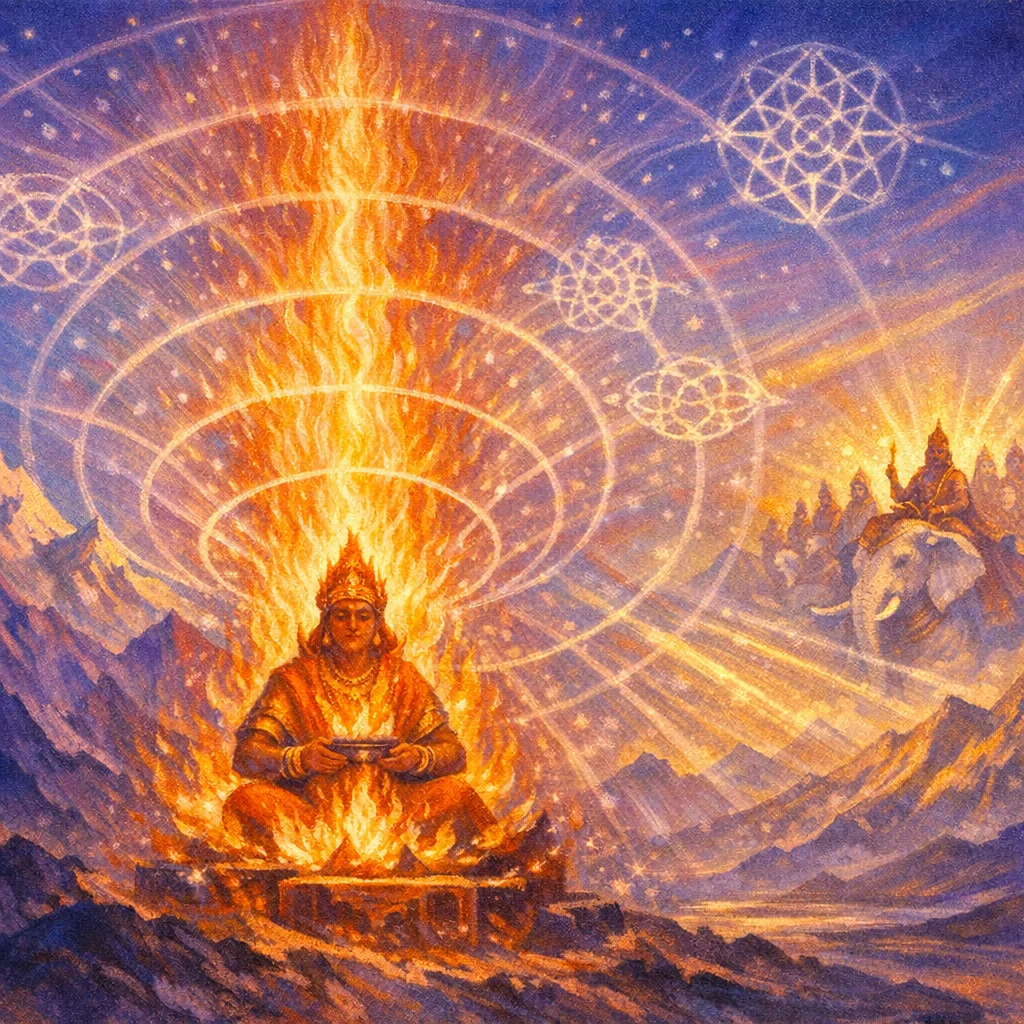
Agni as the manifest, wise carrier of oblations, leading the rite toward Indra’s universal sovereignty
Agni
Bright forward-driving and declarative—moving from kindling/manifestation to royal affirmation
R̥ṣi attribution is not provided in the input; identification requires concordance with the underlying Ṛgvedic sources for these mantras and the Sāmavedic anukramaṇī tradition.
Agni, manifesté et sage porteur des oblations, élève le rite et transporte sûrement le havis vers les dieux ; puis Indra et les Tous-les-Dieux sont invoqués comme destinataires décisifs, conférant au sacrifice souveraineté, victoire et plénitude. Louange et offrandes sont placées auprès des justes récipiendaires divins ; Indra est proclamé roi de l’univers, et les Viśve Devāḥ sont appelés comme l’assemblée collective du sacrifice.
Mantras
Mantra 1
अचेत्यग्निश्चिकितिर्हव्यवाड्न सुमद्रथः
Agni, le Sage, s’est manifesté; porteur des oblations (havyavāḍ) pour nous, de bon conseil et bien attelé pour le transport (de l’offrande).
Mantra 2
अग्ने त्वं नो अन्तम उत त्राता शिवो भुवो वरूथ्यः
Agni, tu es pour nous le plus proche, et aussi le protecteur; de bon augure, tu es un abri qui protège, un refuge dans le monde des êtres.
Mantra 3
भगो न चित्रो अग्निर्महोनां दधाति रत्नम्
Agni, éclatant tel Bhaga, accorde le trésor — la richesse des grands — à l’adorant.
Mantra 4
विश्वस्य प्र स्तोभ पुरो वा सन्यदि वेह नूनम्
Maintenant, ici, que le stobha s’avance en tête de tout le rite, unissant (le chant et l’acte) en prélude.
Mantra 5
उषा अप स्वसुष्टमः सं वर्त्तयति वर्त्तनिं सुजातता
Uṣas, la plus excellente en sa forme lumineuse, née d’heureux augure, met la voie en mouvement et la pousse en avant — maintenant, au-dehors.
Mantra 6
इमा नु कं भुवना सीषधेमेन्द्रश्च विश्वे च देवाः
À qui donc, maintenant, dans les mondes, devons-nous offrir comme il se doit ces oblations et ces louanges ? — À Indra, et à tous les dieux.
Mantra 7
वि स्रुतयो यथा पथ इन्द्र त्वद्यन्तु रातयः
Comme les chemins se déploient en maints chenaux, ainsi, ô Indra, que les dons (vers nous) s’écoulent de toi.
Mantra 8
अया वाजं देवहितं सनेम मदेम शतहिमाः सुवीराः
Par ceci (notre sāman), puissions-nous obtenir le prix de force établi par les dieux ; puissions-nous nous réjouir, durant cent hivers, riches en fils excellents.
Mantra 9
ऊर्जा मित्रो वरुणः पिन्वतेडाः पीवरीमिषं कृणुही न इन्द्र
Par une vigueur nourricière, Mitra et Varuṇa font enfler l’Iḍā ; toi, ô Indra, accorde-nous une nourriture abondante et un aliment qui fortifie.
Mantra 10
इन्द्रो विश्वस्य राजति
Indra est le souverain de tout ; il règne et resplendit partout.
Frequently Asked Questions
It links the rite’s success to Agni, who becomes manifest and carries the offering, and then confirms Indra (with the All-Gods) as the chief recipient and ruler over all.
The question frames correct ritual orientation—offerings and praise must be ‘placed’ with the proper divine recipients, resolved here as Indra and the Viśve Devāḥ.
It serves as a compact climax: a strong, memorable affirmation that Indra reigns over all, sealing the preceding invocations with a statement of universal lordship.