
Bhagavad Gita — Gunatraya Vibhaga Yoga, Shloka 4
Gunatraya Vibhaga Yoga
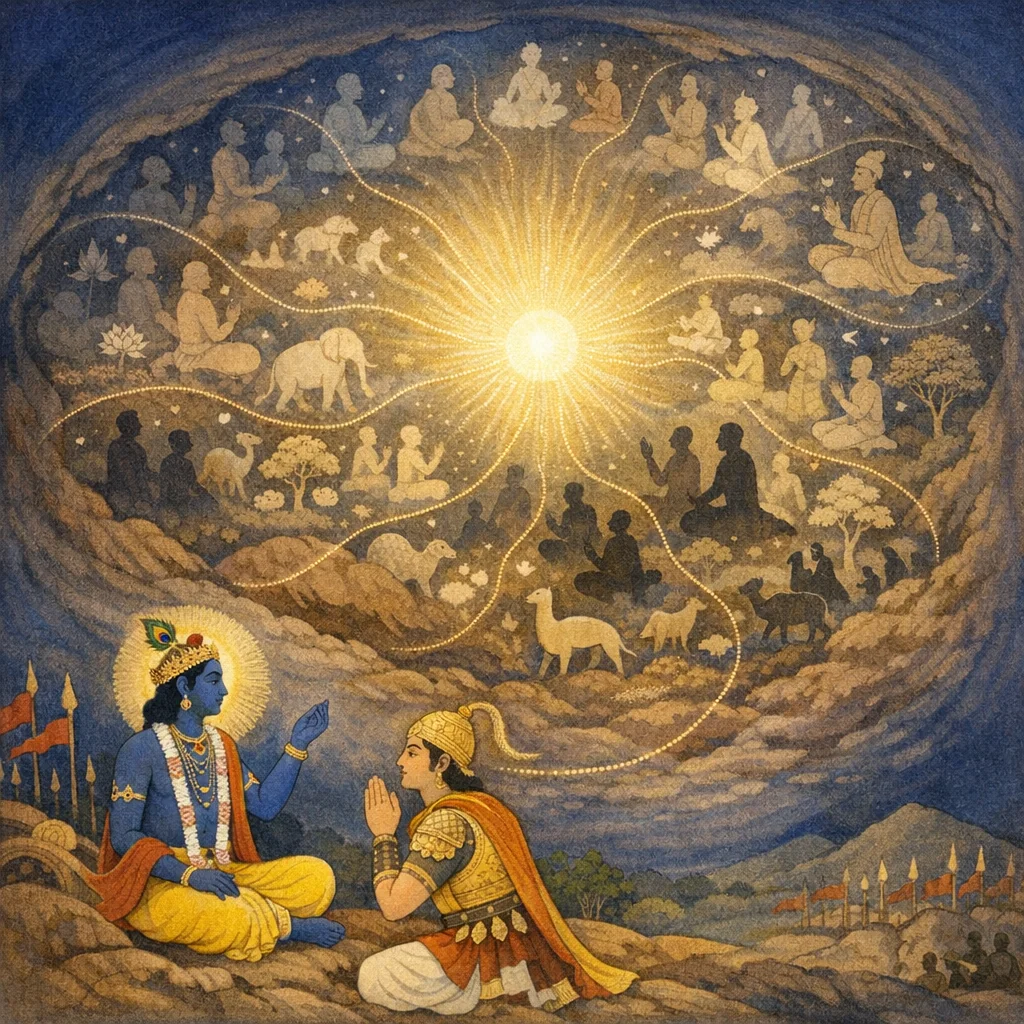
सर्वयोनिषु कौन्तेय मूर्तयः संभवन्ति याः । तासां ब्रह्म महद्योनिरहं बीजप्रदः पिता ॥ १४.४ ॥
sarvayoniṣu kaunteya mūrtayaḥ saṃbhavanti yāḥ | tāsāṃ brahma mahad yonir ahaṃ bīja-pradaḥ pitā || 14.4 ||

Dans tous les ventres, ô fils de Kuntī, quelles que soient les formes qui naissent, de toutes celles-là le grand Brahman est le sein, et Moi je suis le Père qui donne la semence.
In all wombs, O son of Kuntī, whatever forms are born, of them the great Brahman is the womb and I am the seed-giving father.
In all wombs, O Kaunteya, whatever embodied forms arise—of them the great brahman is the womb; I am the father who gives the seed.
This extends 14.3 universally. The verse is often cited in discussions of a unifying origin of diverse life-forms; some read it theistically, others as a metaphysical statement about consciousness/principle and material matrix.
FAQs
A sense of shared origin can support empathy and reduce rigid in-group/out-group thinking, encouraging broader ethical concern.
The verse articulates a twofold causality behind embodiment: a material womb (mahad brahman/prakṛti) and an initiating/seeding principle (the divine).
It prepares for the guṇa doctrine by locating all embodied forms within prakṛti, whose qualities (guṇas) will be analyzed as binding forces.
It can be used to frame a universalist ethic: diverse beings share a deeper commonality, which can inform inclusive social and environmental responsibility.