
Bhagavad Gita — Gunatraya Vibhaga Yoga, Shloka 3
Gunatraya Vibhaga Yoga
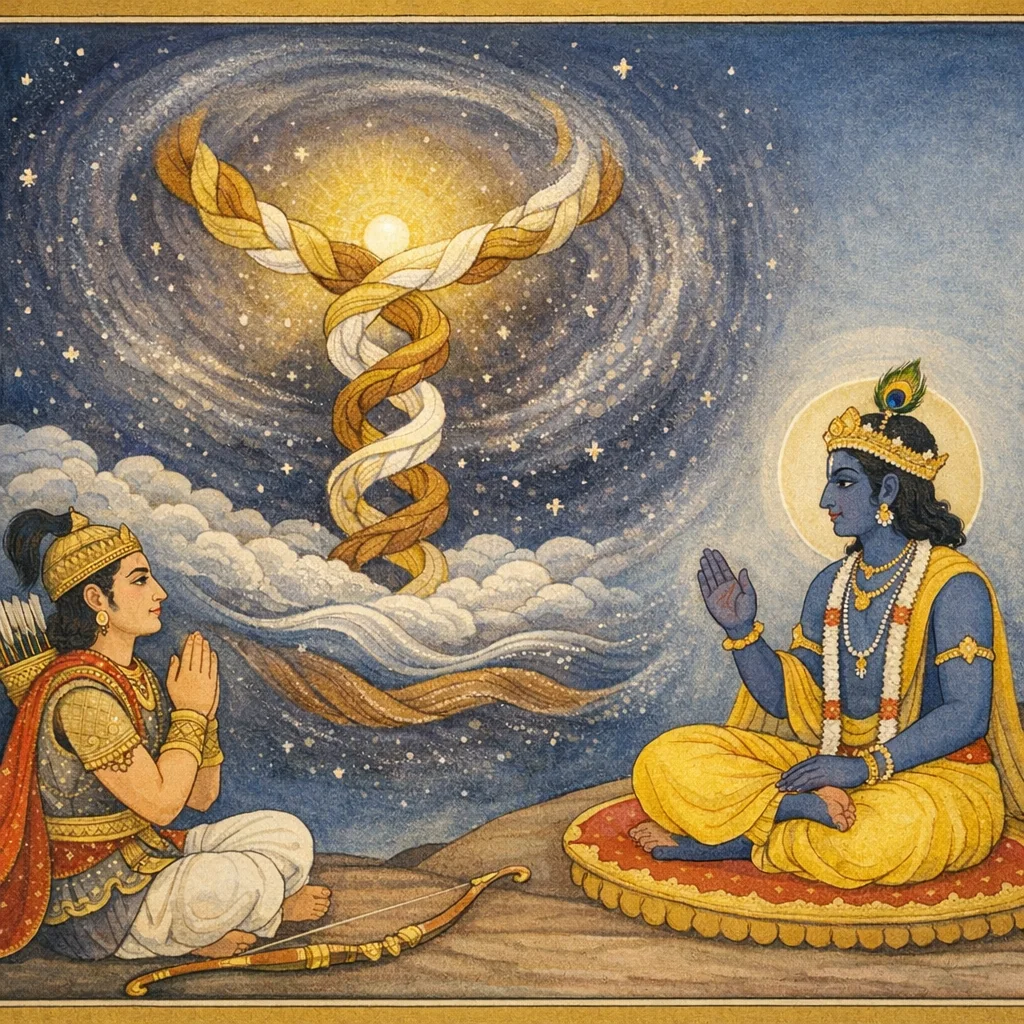
मम योनिर्महद्ब्रह्म तस्मिन्गर्भं दधाम्यहम् । संभवः सर्वभूतानां ततो भवति भारत ॥ १४.३ ॥
mama yonir mahad brahma tasmin garbhaṃ dadhāmy aham | saṃbhavaḥ sarvabhūtānāṃ tato bhavati bhārata || 14.3 ||

Mon sein est le grand Brahman ; en lui je dépose la semence. De là naît l’origine de tous les êtres, ô Bhārata.
My womb is the great Brahman; in that I place the seed; from that arises the origin of all beings, O Bhārata.
The great brahman is my womb; in it I place the embryo/seed; from that comes the emergence of all beings, O Bhārata.
‘Mahad brahma’ is often interpreted as prakṛti or the cosmic principle (mahat) associated with Sāṃkhya cosmology. The verse uses generative imagery to express a theistic-cosmological relation between the divine and material nature.
FAQs
By presenting life as arising from a larger order, the verse can encourage humility and a sense of belonging, countering isolating self-centered narratives.
It depicts a dual-causal model: material nature as the matrix (womb) and the divine as initiating principle, together accounting for the manifestation of beings.
It grounds the forthcoming discussion of guṇas in a cosmological account of how embodied existence arises within prakṛti under divine governance.
Interpreted broadly, it supports ecological and systemic thinking: individuals emerge within conditions not wholly self-created, inviting responsibility toward those conditions.