
Shloka 10
Akshara Brahma Yoga — Akshara Brahma Yoga
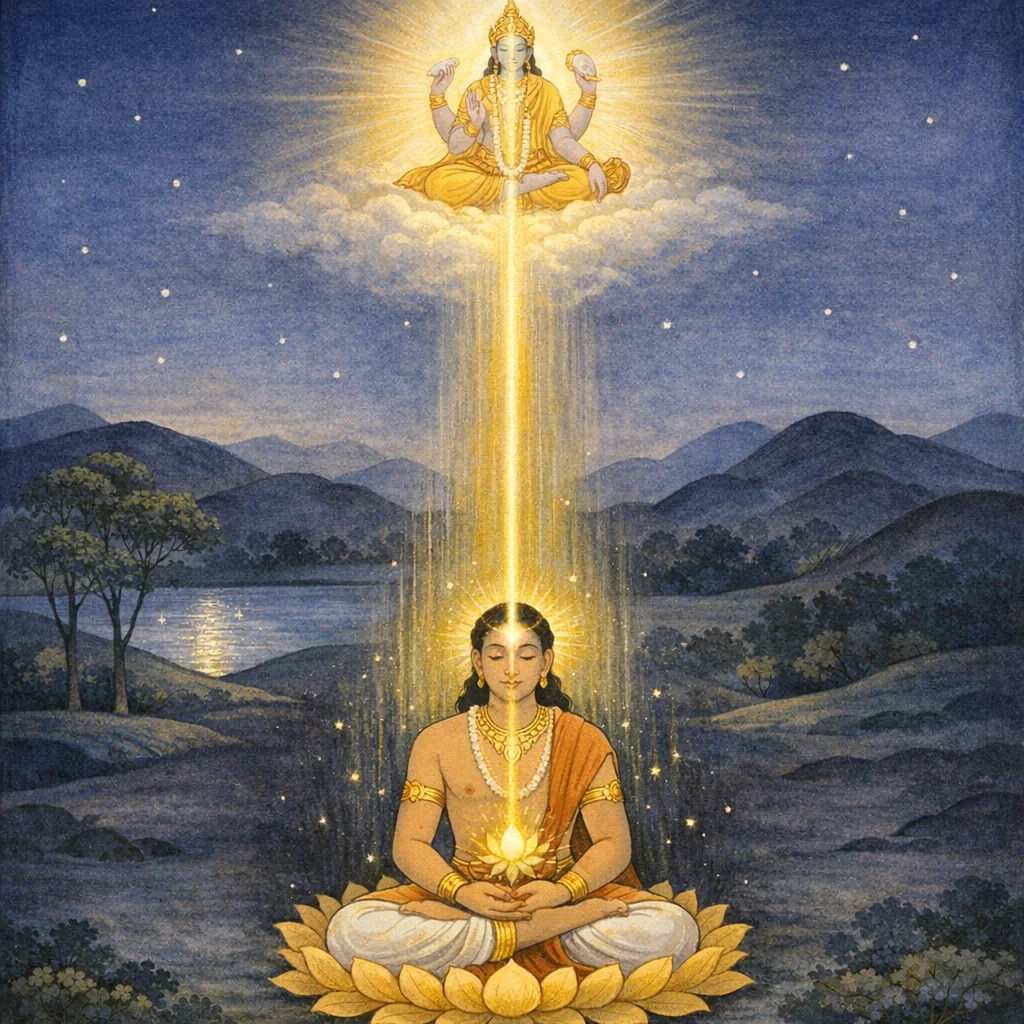
प्रयाणकाले मनसाचलेन भक्त्या युक्तो योगबलेन चैव । भ्रुवोर्मध्ये प्राणमावेश्य सम्यक् स तं परं पुरुषं उपैति दिव्यम् ॥ ८.१० ॥
prayāṇakāle manasā calena bhaktyā yukto yogabalena caiva | bhruvor madhye prāṇam āveśya samyak sa taṁ paraṁ puruṣam upaiti divyam || 8.10 ||

Au moment du départ, l’esprit inébranlable, uni à la dévotion et à la force du yoga, fixant correctement le souffle vital entre les sourcils, il atteint cette Personne suprême et divine.
At the time of departure, with unwavering mind, endowed with devotion and with the strength of yoga, fixing the life-breath properly between the eyebrows, one attains that supreme divine Person.
At death, the practitioner—mind steady, devotionally oriented, supported by yogic discipline—directs the vital energy (prāṇa) to the region between the eyebrows (a standard yogic concentration point). Through this integrated practice, one reaches the supreme divine Puruṣa.
This verse reflects classical yogic physiology (prāṇa-direction, concentration points). Some traditions read it literally as a meditative technique; others interpret it as symbolic of focused attention and regulated breath. Minor textual differences across recensions typically involve sandhi/orthography rather than meaning.
FAQs
It presents an integrated model of regulation—steady attention, affective devotion, and breath-awareness—suggesting that composure is trainable and can support clarity during transitions.
The verse links embodied yogic practice with soteriological outcome, treating the body-mind system as a legitimate vehicle for realizing the supreme.
It concretizes the earlier emphasis on remembrance by describing a disciplined method that supports unwavering recollection at the time of departure.
As a non-sectarian practice, it can be read as combining devotion or core values with breath regulation and focused attention to cultivate steadiness under stress.