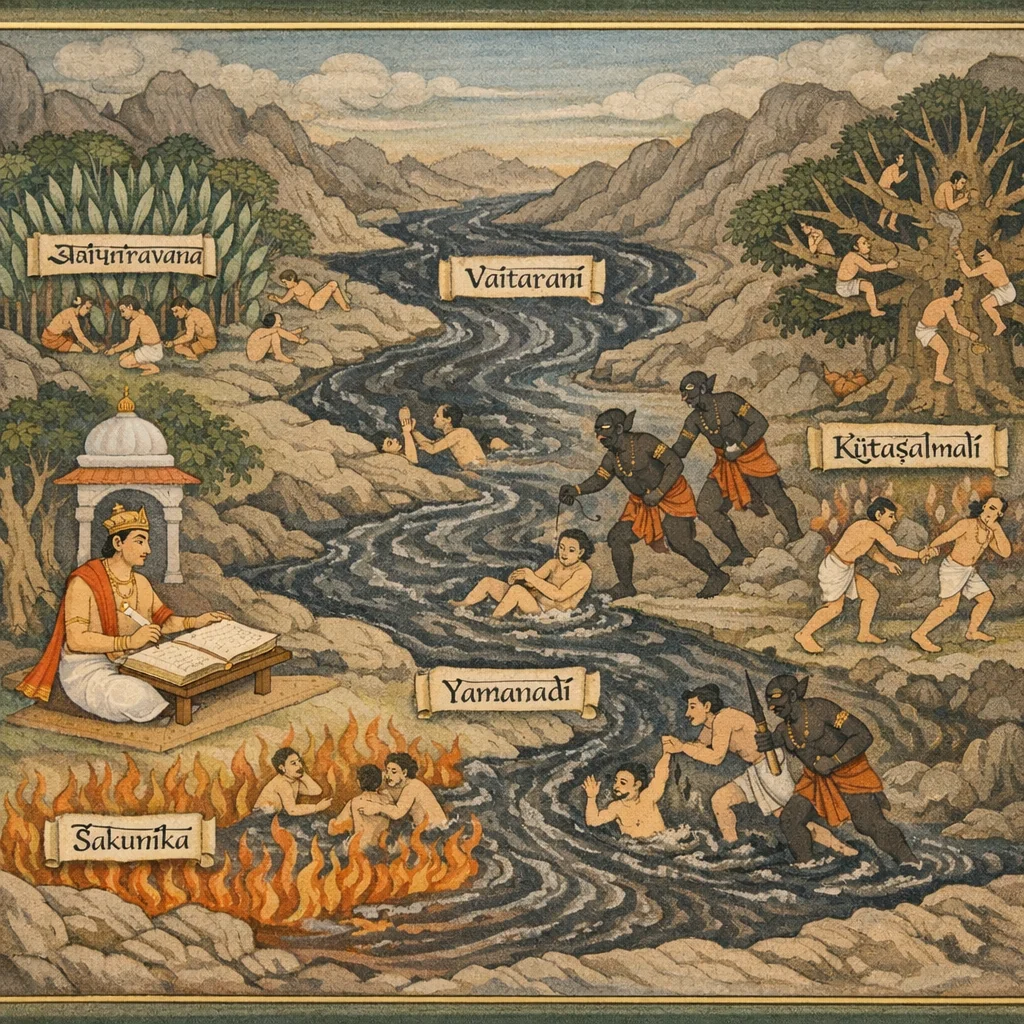
Adhyaya 200: Description of the Forms of Infernal Torments (Naraka Yātanās)
Narakayātanā-svarūpa-varṇanam
Ethical-Discourse (Karmic Retribution and Post-mortem Geographies)
En el marco pedagógico de Varāha y Pṛthivī, este capítulo actúa como advertencia ética al trazar la “geografía” vivida del naraka como consecuencia de conductas dañinas. Enumera ocho infiernos principales—Tapta, Mahātapta, Raurava, Mahāraurava, Saptatāla, Kālasūtra, Andhakāra y Andhakāravara—y afirma una intensificación gradual del sufrimiento. Describe aflicciones sensoriales y corporales: extremos de calor y frío, hambre y sed, cortes, quemaduras y perforaciones; además de la depredación de animales y rākṣasas, y el tránsito por ríos y parajes aterradores como el Vaitaraṇī. Vincula la larga estancia en el naraka con ciclos de transmigración hacia nacimientos inferiores, culminando en el retorno a estratos humanos, y menciona marcas corporales visibles atribuidas a crímenes graves, reforzando la contención moral y la estabilidad de la tierra mediante la responsabilidad kármica.
Primary Speakers
Key Concepts
Shlokas in Adhyaya 200
Verse 1
पुनर्नरकयातनास्वरूपवर्णनम् ॥ ऋषिपुत्र उवाच ॥ तप्तं चैव महातप्तं महारौरवरौरवौ ॥ सप्ततालश्च नरको नरकः कालसूत्रकः ॥
El hijo de un ṛṣi dijo: «Existen Tapta y Mahātapta; asimismo Raurava y Mahāraurava; están Saptatāla, Naraka y Kālasūtraka: estos son los reinos infernales, descritos de nuevo según la forma de sus tormentos».
Verse 2
अन्धकारश्च नरकोऽन्धकारवरस्तथा ॥ अष्टावेतॆ तु नरकाः पच्यन्ते यत्र पापिनः ॥
«Y está Andhakāra (Oscuridad), y asimismo Andhakāravara (la “oscuridad mayor”). Estos, en verdad, son los ocho infiernos, donde los pecadores son “cocidos”, es decir, padecen el castigo».
Verse 3
प्रथमे प्रथमं विद्याद्द्वितीये द्विगुणं तथा ॥ तृतीये त्रिगुणं विद्याच्चतुर्थे तु चतुर्गुणम् ॥
«En el primero, entiéndase (el sufrimiento) como la medida base; en el segundo, como el doble; en el tercero, como el triple; y en el cuarto, como cuádruple».
Verse 4
पञ्चमे तु गुणाः पञ्च षष्ठे षड्गुणमुच्यते ॥ सप्तमे तु गुणाः सप्त अष्टमेऽष्टविधा गुणाः ॥
«En el quinto, el multiplicador es cinco; en el sexto se dice que es seis veces; en el séptimo, siete veces; y en el octavo, los multiplicadores son de ocho clases, es decir, ocho veces».
Verse 5
अहोरात्रेण चाध्वानं प्रेता गच्छन्ति तत्पुरम् ॥ दुःखितानां ततो दुःखं दुःखाद्दुःखतरं ततः ॥
«En un día y una noche recorren el camino; los espíritus de los difuntos (pretas) van a esa ciudad (de ese reino). Para los ya afligidos, viene después sufrimiento; y del sufrimiento, un sufrimiento aún más doloroso».
Verse 6
दुःखमेवात्र न सुखं दुःखैर्दुःखं विवर्ध्यते ॥ उपायस्तत्र नैवास्ति येन स्वल्पं सुखं भवेत् ॥
Aquí sólo hay sufrimiento, no felicidad; por los sufrimientos, el sufrimiento se incrementa. No existe allí medio alguno por el cual pudiera surgir siquiera una pequeña dicha.
Verse 7
मुच्यते च मृतस्तत्र मारकास्तत्र दुर्लभाः ॥ शब्दे स्पर्शे तथा रूपे रसे गन्धे तु पञ्चमे ॥
Y aun si uno «muere» allí, no sigue la liberación; los agentes de la muerte son allí difíciles de hallar. (El sufrimiento se experimenta) por el sonido, el tacto y la forma, por el gusto y—en quinto lugar—por el olor.
Verse 8
न सुखं तत्र तस्यास्ति किञ्चिदेवात्र विद्यते ॥ शारीरैर्मानसैश्चैव दुःखैर्दुःखान्तगामिभिः ॥
Allí, para él, no hay felicidad alguna; sólo esto se halla aquí: sufrimientos—corporales y también mentales—que conducen al término (culminación) del sufrimiento.
Verse 9
आयसैः कण्टकैस्तीक्ष्णैस्तप्तैस्तप्तावृता मही ॥ अन्तरिक्षं खगानीकैर्अग्निजिह्वैः समावृतम् ॥
La tierra está cubierta de espinas de hierro, agudas y al rojo vivo; el espacio del cielo está colmado por todas partes de bandadas de aves cuyas lenguas son como fuego.
Verse 10
पातुकामश्च पानीयं राक्षसैर्नीयते सरः ॥ हंससारससंकिर्णं पद्मोत्पलविभूषितम् ॥
Y quien desea beber es conducido por rākṣasas a un lago, colmado de cisnes y grullas, adornado con lotos y nenúfares.
Verse 11
पातुकामश्च पानीयं सहसा तत्र धावति ॥ सलिलं प्रेक्षते चैव तत्र तप्ततरं तथा
Deseando beber, corre de pronto allí en busca de agua; pero al mirar el agua, la halla aún más intensamente abrasada por el calor.
Verse 12
ततः पक्वानि मांसानि राक्षसैः परिणीयते ॥ क्षारोदकेऽपि च तथा क्षिप्यतेऽत्र महाह्रदे
Entonces, trozos de carne cocida son llevados de un lado a otro por los rākṣasas; y asimismo es arrojado aquí a un gran lago de agua salobre y alcalina.
Verse 13
तत्र चैव ह्रदे नैका मत्स्याः खादन्ति सर्वशः ॥ ततः कालावसाने तु कथञ्चित्प्रपलायिनः
Y allí, en ese mismo lago, muchos peces lo devoran por todos lados. Luego, al término de un lapso de tiempo, llega—de algún modo—a ser quien escapa.
Verse 14
किञ्चिदन्तरमागम्य वेदनार्थाः पतन्ति हि ॥ यातनार्थं पुनस्तत्र मांसं चैवोपजायते
Tras un breve intervalo, vuelven a caer, ciertamente para el dolor; y allí, una vez más, la carne vuelve a surgir en ellos para el propósito de un tormento renovado.
Verse 15
शिरस्येवोपविष्टस्य प्रस्थितस्य प्रधावतः ॥ तस्यार्त्तायामवस्थायां दुःखं भवति दारुणम्
Como si estuviera sentado sobre su cabeza, al ponerse en marcha y correr, en ese estado afligido su sufrimiento se vuelve terrible.
Verse 16
करीषगर्त्तस्तत्रैव कुम्भीपाकः सुदारुणः ॥ पद्मपत्राकृतिस्तस्य पेशी तत्र शरीरजः
Allí mismo está el foso de inmundicia y el sumamente terrible Kumbhīpāka. Allí, la carne de su cuerpo toma la forma de una hoja de loto.
Verse 17
पाटयन्ति सुमार्गेण राक्षसाः करपत्रिकाः ॥ निपीड्य दशनै रोषं भीमनादाः सुरोषिताः
Los Rākṣasas, portando cuchillas en la mano, los despedazan de manera deliberada; y, apretando con los dientes en furia, esos seres de voz aterradora arden de ira.
Verse 18
असिपत्रवनं चात्र शृङ्गाटकवनं तथा ॥ तत्र शृङ्गाटकाश्चैव तप्तवालुकमिश्रिताः
Aquí también está el bosque de hojas-espada, y asimismo el bosque de śṛṅgāṭakas; allí, los śṛṅgāṭakas están en verdad mezclados con arena abrasadora.
Verse 19
श्यामाश्च शबलाश्चैव श्वानस्तेऽत्र दुरासदाः ॥ खादन्ति च सुसंरब्धाः सर्पवृश्चिकसन्निभैः
Aquí, esos perros—oscuros y moteados—son difíciles de ahuyentar; y, sumamente enfurecidos, devoran, semejantes a serpientes y escorpiones.
Verse 20
कण्टकैः प्रतिकूलैश्च तत्रान्या कूटशाल्मली ॥ कर्षन्ति तत्र चैवैनं यावदस्थ्यवशेषितः
Y allí hay otra, la Kūṭaśālmalī, con espinas vueltas contra él; allí, en verdad, lo arrastran hasta que queda reducido a sólo huesos.
Verse 21
यद्दुःखं तस्य दुर्बुद्धेः प्रतिकूलं च तस्य यत् ॥ तत्तदोत्पद्यते शीघ्रं यातनार्थाय यत्नतः ॥
Whatever suffering belongs to that ill-intentioned person, and whatever is adverse to him—those very torments arise swiftly, with deliberate force, for the purpose of punishment.
Verse 22
शीतकामस्य वै चोष्णमुष्णकामस्य शीतलम् ॥ सुखकामस्य वै दुःखं सुखं नैवात्र विद्यते ॥
For one who longs for cold, there is heat; for one who longs for heat, there is cold. For one who longs for comfort, there is suffering—here, comfort is not found at all.
Verse 23
छिन्नाश्च शतधाप्येवं ह्यनिशं तैः सहस्रशः ॥ छिन्नाङ्गाः सर्वगात्रेषु सर्वमेव स विन्दति ॥
Thus, cut into a hundred parts—unceasingly, and by them in thousands—his limbs are severed across all his body; he experiences it all in full.
Verse 24
सलिलं च नदीं घोरां व्यालाकीर्णां भयानकाम् ॥ उत्तार्यन्ते च तां प्रेतां यां दृष्ट्वैव भयं भवेत् ॥
There is a dreadful river of waters, filled with serpentine creatures and terrifying; and the departed are made to cross that river—one which, merely upon seeing, fear would arise.
Verse 25
करम्भवालुका नाम शतयोजनमायता ॥ अग्निज्वालासमा घोरा यथा येन स गच्छति ॥
There is [a region] called Karambhavālukā, extending a hundred yojanas; dreadful, comparable to flames of fire—through which, and in what manner, he proceeds.
Verse 26
ततो वैतरणी नाम क्षारोदा तु महानदी ॥ योजनानि तु पञ्चाशदधस्तात्पञ्चयोजनम् ॥
Luego viene el gran río llamado Vaitaraṇī, cuyas aguas son salinas y corrosivas. Se extiende por cincuenta yojanas, y su hondura hacia abajo es de cinco yojanas.
Verse 27
अगाधपङ्का वै तत्र चर्ममांसास्थिभेदनाः ॥ तत्र कर्कटका घोरा वज्रदंष्ट्रा विशन्ति ताम् ॥
Allí el fango es insondable y desgarra piel, carne y hueso. Allí se internan cangrejos terribles, de colmillos como rayos, y atacan dentro de aquel lodazal.
Verse 28
समुत्तीऱ्य तु कृच्छ्रेण तस्माद्योजनकर्दमात् ॥ वसन्त्यत्र धरे केचिच्छून्यागारे निराश्रये ॥
Habiendo cruzado con gran dificultad aquel lodazal de una yojana, algunos moran allí en el suelo, en una casa vacía, sin amparo.
Verse 29
यत्र वै मूषिकगणा भक्षयन्ति ह्यनेकशः ॥ मूषकैर्जग्ध गात्रस्तु ह्यस्थिमात्रावशेषितः ॥
Donde bandas de ratones lo devoran repetidas veces de muchas maneras; su cuerpo, roído por los ratones, queda reducido a sólo huesos.
Verse 30
प्रभाते वायुना स्पृष्टः पुनर्मांसं स विन्दति ॥ शून्यागारप्रवेशात्तु गव्यूतेर्नातिदूरतः ॥
Al amanecer, tocado por el viento, vuelve a recobrar carne; y desde la entrada de la casa vacía, no muy lejos, a una distancia de un gavyūti.
Verse 31
सहकारवनं नाम रौद्रा यत्र च पक्षिणः ॥ निस्त्वगस्थिस्तैः क्रियते निर्मांसश्चैव मानवः
There is a forest called Sahakāravana, terrifying, where birds (of punishment) are found; by them a human is made skinless and boneless, and indeed rendered without flesh.
Verse 32
संध्याभ्र इव चाभाति प्रदीप्तो नित्यमेव तु ॥ दशयोजनविस्तार्णा अधः शतसमायता
It shines like a twilight cloud, ever aflame; it extends ten yojanas in breadth, and downward it stretches for a hundred (yojanas).
Verse 33
यमचुल्लीति विख्याता गम्भीरा सा त्रियोजनम् ॥ नित्यं प्रज्वलिता सा तु नित्यं धूमान्धकारिता
Known as ‘Yama’s Furnace,’ it is deep to the measure of three yojanas; it is perpetually blazing, and perpetually made dark by smoke.
Verse 34
तत्र प्रेतसहस्राणि प्रयुतान्यर्बुदानि च ॥ प्रक्षिप्यन्ते त्वहोरात्रं राक्षसैर्यमकिङ्करैः
There, thousands of departed spirits—tens of thousands and even vast multitudes—are cast in day and night by rākṣasas, the attendants of Yama.
Verse 35
निःशिराजालकश्चैव निरक्षिश्रवणस्तथा ॥ वटवृक्षो नातिदूरे दक्षिणे तु त्रियोजनम्
And (there are beings) such as the ‘Headless-Jālaka’ and likewise the ‘Earless-and-Eyeless’; not far away, to the south by three yojanas, there is a banyan tree.
Verse 36
मासमेकं वसत्यन्यो तस्यां चुल्ल्यां परिभ्रमन् ॥ ततः शकुनिका नाम वसामेदोवहा नदी
Otro mora allí durante un mes, vagando en aquel horno; luego aparece un río llamado Śakunikā, que arrastra grasa y médula.
Verse 37
एकैकं दुस्तरं घोरं यथापूर्वं यथाक्रमात् ॥ अनुभुङ्क्ते स कृच्छ्रेण दुष्कृती तीव्रवेदनाः
Cada tormento, difícil de atravesar y terrible, según lo anterior y en el debido orden, lo padece con gran esfuerzo; el malhechor soporta dolores intensos.
Verse 38
दश तत्र लताः शूलाः कुम्भीपाकास्त्रयोदश ॥ याति पापमहोरात्रं तस्मिन्नियमितेन तु
Allí hay diez lanzas como lianas enredaderas y trece (estancias de) Kumbhīpāka; el pecador pasa día y noche en ese lugar, constreñido por la regla.
Verse 39
राक्षसैर्निरनुक्रोशैर्दुर्निरीक्ष्यैस्ततस्ततः ॥ अङ्गारेषु विधूमेषु शूलप्रोतस्तु पच्यते
Por rākṣasas sin compasión, terribles de mirar, aquí y allá, es cocido sobre brasas sin humo, empalado en una lanza.
Verse 40
शुष्कोदपाने धूमे च अधःशीर्षोऽवलम्बते ॥ ज्वाल्यते तीक्ष्णतैले तु कटाहे स तु पच्यते
En un pozo seco, entre humo, cuelga cabeza abajo; y es abrasado en aceite ardiente y penetrante: en un caldero, en verdad, es cocido.
Verse 41
करीषगर्त्ते स पुनः पच्यते मेदवह्निना ॥ एकैकस्मिन्दशाहं च शूलादिषु स पच्यते
Again he is cooked in a pit of filth by a fire fed with fat; and, for ten days in each (station), he is cooked upon stakes and the like.
Verse 42
यातनाः सप्तकास्तस्य निष्क्रान्तस्य त्रियोजने ॥ यतो यमनदी नाम तप्तत्रपुजलोर्मिणी
Sevenfold are the torments for him who has departed—over a distance of three yojanas—up to the river called Yamanadī, whose waves are of water like molten tin.
Verse 43
समुत्तीर्य तु कृच्छ्रेण दह्यमानस्त्वचेतनः ॥ ततो मुहूर्त्तं विश्रान्तः किञ्चिदन्तरमागतः
Having crossed with great difficulty—burning and insensible—he then rests for a moment, and proceeds onward a short distance.
Verse 44
दीर्घिकां मोक्षते कान्तां शीतोदां शीतकाननाम् ॥ सर्वकामान्स लभते भगिनी सा यमस्य तु
He reaches a lovely long pool, with cool water and a cool grove; he obtains every desired comfort—yet she is (called) the ‘sister’ of Yama.
Verse 45
भक्ष्यं भोज्यं च सर्वैस्तु पापिभिस्तत्र लभ्यते ॥ स सर्वं विस्मरत्यत्र त्रिरात्रमुषितोऽपि सन्
There, food to chew and food to eat is obtained by all the sinners; having stayed there for three nights, he forgets everything in that place.
Verse 46
तत्र वर्षति पर्जन्यस्तत्र तप्तजलं सदा ॥ तत्र कृच्छ्रेण तरति अहोरात्रेण मानवः
Allí llueve la nube, y allí el agua está siempre hirviente; allí el hombre sólo logra cruzar con gran dificultad, en el transcurso de un día y una noche.
Verse 47
शृङ्गारकवनं नाम तत्र पश्यन्ति शाद्वलम् ॥ नीलमक्षिकदंशैश्च सुव्याप्तं तद्वनं महत्
Allí contemplan una extensión de pradera en el gran bosque llamado Śṛṅgāraka-vana, enteramente invadido por las picaduras de moscas azules.
Verse 48
यैस्तु स्पृष्टश्च दष्टश्च कृमिरूपश्च जायते ॥ प्रेतो वर्षति मांसासृगस्मात्कृच्छ्रात्तु निर्गतः
Pero por aquellas (moscas) que lo tocan y lo muerden, llega a tomar forma de gusano; y el espíritu del difunto, al salir de esa penuria, hace llover carne y sangre.
Verse 49
ततोऽन्यल्लभते चैव यातनार्थं प्रयत्नतः ॥ ततः पश्यति पुत्रांस्तु महद्दुःखं सुदारुणम्
Luego padece aún otra experiencia destinada al tormento, provocada por su propio esfuerzo; después ve a sus hijos, y surge un gran sufrimiento, sumamente terrible.
Verse 50
मातरं पितरं चैव पुत्रान्दारांस्तथा प्रियान् ॥ पुरस्ताद्बध्यमानं स क्रन्दमानमचेतनम्
Ve ante sí a su madre y a su padre, así como a sus hijos, a su esposa y a sus amados: atados delante de él, llorando a gritos y sin sentido.
Verse 51
हा त्राहि त्राहि पुत्रेति क्रन्दमानस्ततस्ततः ॥ लगुडैर्मुद्गरैर्दण्डैर्जानुभिर्वेणुभिस्तथा
Crying out again and again, “Ah! Save me, save me, my child!”, he wails here and there—struck with clubs, mallets, staffs, knees, and also with bamboo rods.
Verse 52
मुष्टिभिश्च कशाभिश्च व्यालैरङ्कगतैरपि ॥ तद्दृष्ट्वा तादृशं दुःखं ततो मोहं स गच्छति
And with fists and whips, and even with serpents clinging to his body—seeing such suffering, he then falls into bewilderment.
Verse 53
एवमेवात्मकर्माणि पर्यायेण पुनः पुनः ॥ प्राप्नुवन्तीह तेऽत्रैव नरा दुष्कृतकारिणः
Just so, their own deeds—cycle after cycle, again and again—are encountered here itself by those people who commit wrongdoing.
Verse 54
पातकानि च चत्वारि समाचारेण पञ्चमम् ॥ कृत्वा तानि नरा यान्ति तं देशं पापकािरणः
Having committed four sins—and a fifth by (corrupt) conduct—such people, doers of wrongdoing, go to that realm.
Verse 55
तदा वा स्थावरे तेषु जातस्य हि भवेन नरः ॥ क्रमशः स भवेत्प्रेतस्तदा पशुगणेष्वपि
Or then, having been born among those immobile beings, he becomes (again) human; in due sequence he becomes a preta, and then even among groups of animals.
Verse 56
षष्टिवर्षसहस्राणि षष्टिवर्षशतानि च ॥ गतः स वसति प्रेतो नरके तु पुनःपुनः
Durante sesenta mil años, y también durante sesenta centenas de años, permanece allí como un preta, una y otra vez en el infierno.
Verse 57
ततो निवृत्तकर्मा तु स्वेदजः सम्भवेत्पुनः ॥ स्वेदजानां ततो नित्यं सर्वसंसारचङ्क्रमात्
Luego, cesada la (anterior) actividad kármica, vuelve a nacer como un ser nacido del sudor; y después, por el constante vagar a través de todo el circuito del saṃsāra entre los nacidos del sudor…
Verse 58
ततश्च पक्षिणां योनिं सर्वां सन्तरते पुनः ॥ गयोनाु तु ततो गत्वा पुनर्मानुषतां व्रजेत्
Y entonces atraviesa de nuevo toda matriz entre las aves; luego, habiendo ido a la matriz de una vaca, vuelve a alcanzar la condición humana.
Verse 59
मानुषे शूद्रतां याति लब्ध्वा यदि तु तुष्यति ॥ ततो वैश्यत्वमागच्छेत्कर्मणा अनेन वेष्टितः
En nacimiento humano llega al estado de un Śūdra; y si, habiéndolo obtenido, se contenta (con ello), entonces puede llegar al estado de un Vaiśya, envuelto y atado por este karma.
Verse 60
वैश्यात्क्षत्रियतां याति तस्माच्च ब्राह्मणो भवेत् ॥ ब्राह्मणत्वमपि प्राप्तः पापकर्मा दुरात्मवान्
De ser un Vaiśya pasa al estado de un Kṣatriya, y de ahí puede llegar a ser un Brāhmaṇa. Aun habiendo alcanzado la condición de Brāhmaṇa, quien obra con pecado—de mala disposición—(permanece atado a sus consecuencias).
Verse 61
दुःशिक्षितेन मनसा ह्यात्मद्रोग्धा भवेत् तदा ॥ शरीरेण मानसिकं घोरं व्यसनैरुपपादितम् ॥
With a mind badly trained, one then becomes a betrayer of one’s own self; and a terrible suffering—both bodily and mental—is brought about through afflictions.
Verse 62
उपयुक्तो नरो जातः पूर्वकर्मभिरन्वितः ॥ ज्ञेयश्च ब्रह्महा कुष्ठी काकाक्षः काकतालुकः ॥
A person is born conditioned by former actions; one should understand that a slayer of a brāhmaṇa is (reborn) as a leper, with crow-like eyes, and with a crow-like palate/tongue.
Verse 63
सुरापः श्यावदन्तश्च पूतिगन्धश्च पापकृत् ॥ राजहा पितृहाचैव सुरापश्चापि यो भवेत् ॥
A drinker of intoxicants becomes one whose teeth are dark and who bears a foul odor—one who has committed sin. Likewise, whoever becomes a killer of a king, a killer of a father, or a drinker of intoxicants (is described in such marked terms).
Verse 64
सुवर्णहर्ता च नरो ब्रह्मघ्नेन समो हि सः ॥ क्वचिच्चात्र विरूपाणां नराणां पापकर्मिणाम् ॥
And a person who steals gold is indeed equal to a slayer of a brāhmaṇa. Here and there, among people who commit sin, there are those who are deformed (as a result).
Verse 65
यावद्भिः कर्मभिस्तैस्तैस्तेषु निर्याणवेश्मसु ॥ छिन्नभिन्नविशस्तानां रुधिरेण समन्ततः ॥
In those ‘houses of execution’ (places of torment), corresponding to the particular deeds performed, the blood of those who are cut, broken, and slaughtered spreads all around.
Verse 66
व्याप्तं महीतलं सर्वमापगाश्चापि निर्गताः ॥ अजस्रं क्लिश्यमानानां क्रन्दतां च सुदारुणम् ॥
Toda la faz de la tierra quedó impregnada, y aun los ríos se desbordaron; sin cesar se alzó un sonido sumamente terrible de los atormentados que clamaban y lloraban.
Verse 67
समुत्तस्थौ महानादो हाहाकारसमाकुलः ॥ बध्नतो विविधैर्बन्धैर्घातयन्तश्च दारुणम् ॥
Se alzó un gran tumulto, colmado de gritos de «hā hā»; los ataban con diversas ligaduras y los golpeaban con violencia terrible.
Verse 68
लौहयष्टिप्रहारैश्च आयुधैश्च सुदारुणैः ॥ छेदनैर्भेदनैश्चोग्रैः पीडनाभिश्च सर्वशः ॥
Con golpes de varas de hierro y con armas sumamente terribles; con feroces cortes y hendiduras, y con tormentos de toda clase por doquier.
Verse 69
श्रान्ताः कर्मकरा दूताः मोहेनायत्तचेतसः ॥ यदा श्रान्ताश्च खिन्नाश्च हन्तारः पापकर्मिणाम् ॥
Los mensajeros—funcionarios que trabajaban, con la mente sometida por el engaño—se fatigaron; y cuando los verdugos de los pecadores se cansaron y quedaron exhaustos,
Verse 70
विज्ञापयेत्तदा दूताश्चित्रगुप्तं महौजसम् ॥
Entonces los mensajeros informarían del asunto a Citragupta, el de gran poder y esplendor.
Verse 71
अतीव च बुभुक्षात्र पिपासा चाप्यतीव हि ॥ उष्णमत्युष्णमेवात्र शीतलं चातिशीतलम् ॥
Here there is extreme hunger, and likewise extreme thirst; here heat is intensely hot, and cold is intensely cold.
Verse 72
दह्यते छिद्यते चैव विध्यते भिद्यते पथा ॥ पात्यते पीड्यते चैव कृष्यते च विशस्यते ॥
One is burned, cut, and also pierced; one is split along a path; one is thrown down and crushed; one is dragged and slaughtered.
Verse 73
उलूकाश्च धनुर्मात्रा वज्रजिह्वास्थिभेदनाः ॥ महाविषा महाक्रोधा दुर्विषह्याः सुदारुणाः ॥
And owls, of the measure of a bow, with thunderbolt-like tongues that shatter bones—highly venomous, greatly wrathful, hard to withstand, and exceedingly fierce.
Verse 74
चुल्लीकुक्षौ तु विश्रान्ता वेगिनी वहते तु सा ॥ तां समुत्तीऱ्य कृच्छ्रेण यातनाः सप्तकाः पुनः ॥
Having rested in the belly of the (river called) Cullī, that swift-flowing one carries (them onward). After crossing it with difficulty, the sevenfold torments occur again.
Verse 75
ततः शूलवहो नाम पर्वतः शतयोजनः ॥ निराश्रयः स सत्त्वानामेकपाषाण एव च ॥
Then there is a mountain named Śūlavaha, a hundred yojanas (in extent); it offers no refuge for beings, and it is made of a single mass of stone.
Verse 76
तदादिषु च सर्वेषु गुणान्तरपथं गतः ॥ यदा भवति स प्रेतस्तदा स्थावरतां व्रजेत् ॥
Y en todas esas etapas, comenzando por aquella, habiendo entrado en un curso de cualidades transformadas; cuando llega a ser un preta, entonces pasa a la condición de un ser inmóvil (estado estacionario).
Frequently Asked Questions
The text frames post-mortem suffering as a systematic consequence (karmaphala) of harmful actions, using a graded naraka taxonomy to teach restraint, accountability, and adherence to social-ethical norms; it implies that destabilizing conduct against beings and order ultimately rebounds upon the agent through punitive “administration” (yamakiṅkara, Chitragupta).
No lunar (tithi) or seasonal timings are prescribed. The chapter instead uses duration markers for suffering and transit—ahorātra (day-night cycles), trirātra (three nights), māsam eka (one month), daśāha (ten-day periods), and very long spans such as ṣaṣṭivarṣa-sahasrāṇi/śatāni—to quantify punitive sequences and karmic aftermath.
Although set in infernal space, the chapter’s didactic function supports terrestrial balance (Pṛthivī’s stability) indirectly: by detailing consequences for destructive actions and grave crimes, it promotes behavioral constraints that reduce harm within the living world. The depiction of hostile landscapes (burning sands, corrosive rivers, thorn-forests) operates as a negative mirror of ecological order—an anti-environment that illustrates what results when ethical governance of life and land collapses.
The passage references administrative figures of the afterlife rather than royal genealogies: Chitragupta (as the authority informed by the dūtas), and Yama’s agents (yamakiṅkara). A speaker label “Ṛṣiputra” appears in the transmission, indicating a sage-descendant narrator in the manuscript tradition, but no specific terrestrial dynasty or king-lineage is named in this adhyāya.