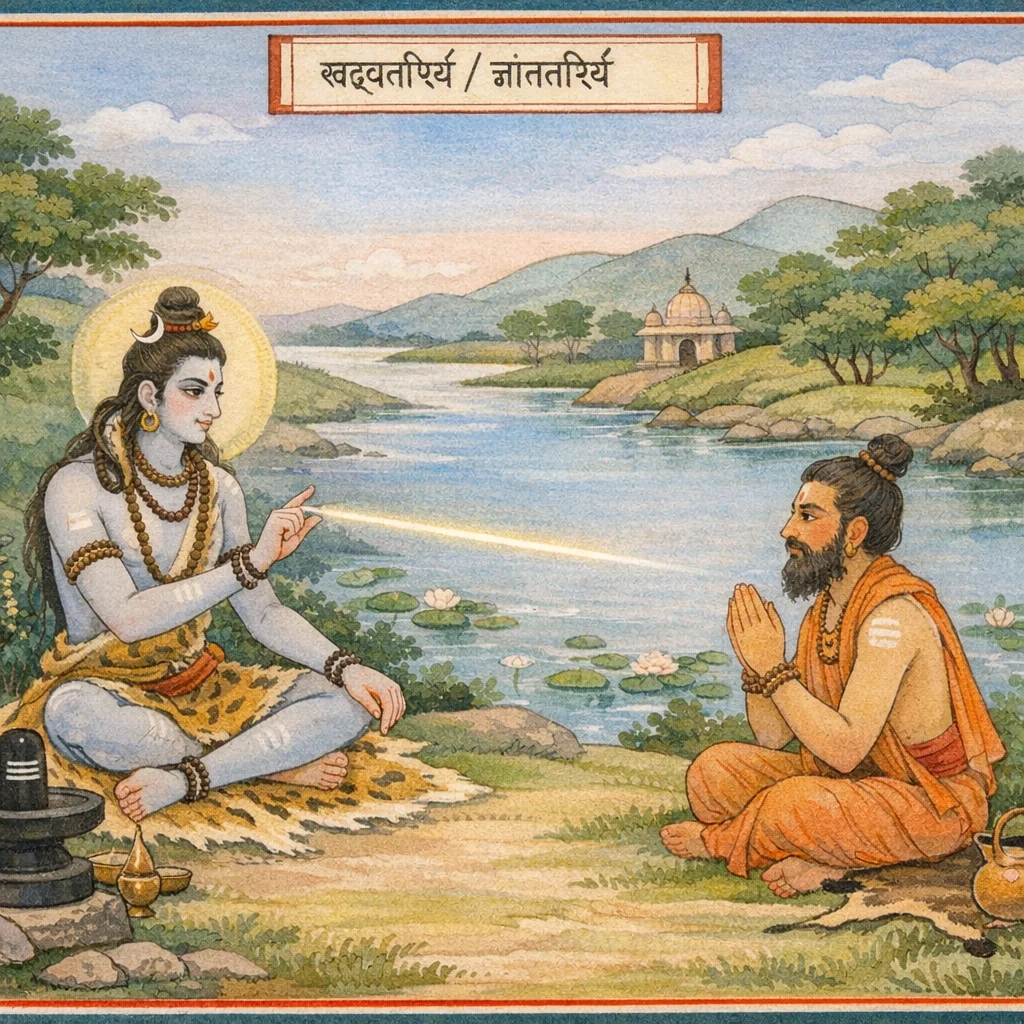
Adhyaya 139: Khaḍga Tīrtha: The Knowledge-Sword that Cuts Anger, Craving, and Doubt
El Adhyāya 139 expone la grandeza de Khaḍgatīrtha, un vado célebre en la ribera norte del río Gautamī. Brahmā declara que bañarse y hacer dádivas allí otorga mérito y aptitud para alcanzar mokṣa. Luego se presenta al brāhmaṇa Pailūṣa, hijo de Kavaṣa, cuyas cargas domésticas y repetidos fracasos para sostenerse lo conducen a una disciplina de vairāgya (desapego). Al considerar la inutilidad del mero esfuerzo bajo un destino adverso, reconoce el desapego como el principal apoyo de los sabios. Buscando cortar las ataduras del saṃsāra—en especial la ira, la codicia y el ansia—consulta a su padre, quien le indica adorar a Īśāna (Śiva) como fuente del conocimiento liberador. Por su devoción, Pailūṣa recibe jñāna de Maheśa y recita gāthās sobre la “espada del conocimiento” que corta krodha, tṛṣṇā, saṅga y saṃśaya, culminando en la liberación; así el lugar es llamado Khaḍgatīrtha y Jñānatīrtha.
Chapter Arc
{"opening_hook":"The chapter opens in tīrtha-māhātmya mode: Brahmā points to a specific, name-bearing ford on the northern bank of the Gautamī and declares it immediately “mokṣa-eligible” through snāna and dāna—drawing the listener in with a concrete place and a concrete promise.","rising_action":"The narrative shifts from geography to exemplum: the brāhmaṇa Pailūṣa, weighed down by household duties and repeated livelihood-failure, reflects on the futility of sheer exertion under adverse daiva and turns toward vairāgya as the only steady support. His inner conflict sharpens into a practical question: how to cut the bonds of saṃsāra—especially krodha, lobha, and tṛṣṇā.","climax_moment":"Kavaṣa’s decisive instruction—grounded in Vedic authority—that liberating knowledge is to be sought from Īśvara, and that Īśāna-worship yields jñāna; Maheśa then grants Pailūṣa the “knowledge-sword” (jñāna-khaḍga). Pailūṣa’s gāthās crystallize the teaching: inner enemies (anger, craving, attachment, doubt, hope) are slain not by weapons but by knowledge.","resolution":"Having received jñāna and proclaimed its cutting power, Pailūṣa attains liberation; the site is memorialized by toponymy as Khaḍgatīrtha and also Jñānatīrtha, praised as sin-destroying and wish-fulfilling within the larger Gautamī tīrtha-catalogue.","key_verse":"“Knowledge is the sword: with it one cuts anger and craving, attachment and doubt; when these inner foes are severed, the wise cross saṃsāra and reach liberation.” (sense of Pailūṣa’s gāthā on the jñāna-khaḍga)"}
Thematic Essence
{"primary_theme":"Gautamī tīrtha-māhātmya fused with Śaiva jñāna-soteriology (Khaḍgatīrtha as ‘knowledge-sword’ ford).","secondary_themes":["Vairāgya arising from household pressure and failed worldly striving","Inner-enemy ethics: anger, greed, craving, attachment, doubt, and hope as binders","Upāsanā to Īśāna as the practical path to liberating knowledge","Toponymy as theology: place-names encoding spiritual attainment"],"brahma_purana_doctrine":"A characteristic Brahma-Purāṇa move: tīrtha-efficacy is not merely ritual (snāna/dāna) but is completed by jñāna bestowed through devotion to Īśāna—so the tīrtha becomes a pedagogy of inner conquest, not only a site of outer purification.","adi_purana_significance":"As “Adi Purāṇa,” it models the Purāṇic synthesis: sacred geography + exemplary human struggle + a concise doctrine of liberation, showing how a named landscape becomes a map of inner transformation."}
Emotional Journey
{"opening_rasa":"अद्भुत (adbhuta)","climax_rasa":"शान्त (śānta)","closing_rasa":"शान्त (śānta)","rasa_transitions":["adbhuta → करुण (karuṇa) → चिन्ता/उद्वेग (bhayānaka-tinged anxiety) → वीर (vīra) → śānta"],"devotional_peaks":["Pailūṣa’s decisive turn to vairāgya and his resolve to ‘cut’ saṃsāra’s bonds","Kavaṣa’s śruti-grounded direction to worship Īśāna","Maheśa’s granting of jñāna and Pailūṣa’s gāthās on the jñāna-khaḍga"]}
Tirtha Focus
{"tirthas_covered":["खड्गतीर्थ (Khaḍgatīrtha)","ज्ञानतीर्थ (Jñānatīrtha)","गौतमी नदी (Gautamī/Goḍāvarī)","गङ्गा-तीर (Gaṅgā riverbank—contextual mention)"],"jagannath_content":null,"surya_content":null,"cosmology_content":null}
Shlokas in Adhyaya 139
Verse 1
ब्रह्मोवाच खड्गतीर्थम् इति ख्यातं गौतम्या उत्तरे तटे तत्र स्नानेन दानेन मुक्तिभागी भवेन् नरः //
Este verso: «1» — recíbase con reverencia como letra sagrada en el Purāṇa.
Verse 2
तत्र वृत्तं प्रवक्ष्यामि शृणु नारद यत्नतः पैलूष इति विख्यातः कवषस्य सुतो द्विजः //
Este verso: «2» — es palabra pura, apta para la lectura devocional y el estudio erudito.
Verse 3
कुटुम्बभारात् परितो ह्य् अर्थार्थी परिधावति न किमप्य् आससादासौ ततो वैराग्यम् आस्थितः //
Este verso: «3» — que el oyente y el lector lo guarden en el corazón con respeto.
Verse 4
अत्यन्तविमुखे दैवे व्यर्थीभूते तु पौरुषे न वैराग्याद् अन्यद् अस्ति पण्डितस्यावलम्बनम् //
Este verso: «4» — de sentido antiguo, expone conocimiento y dharma con serena claridad.
Verse 5
इति संचिन्तयाम् आस तदासौ निःश्वसन् मुहुः क्रमागतं धनं नास्ति पोष्याश् च बहवो मम //
Este verso: «5» — que este Purāṇa sea guía hacia el bien y la comprensión.
Verse 6
मानी चात्मा न कष्टार्हो हा धिग् दुर्दैवचेष्टितम् स कदाचिद् वृत्तियुतो वृत्तिभिः परिवर्तयन् //
Este verso (n.º 6) pertenece al Brahma Purāṇa y conserva un tono sagrado y enciclopédico conforme a la tradición sánscrita.
Verse 7
न लेभे तद् धनं वृत्तेर् विरागम् अगमत् तदा सेवा निषिद्धा या काचिद् गहना दुष्करं तपः //
Este verso (n.º 7) del Brahma Purāṇa prosigue la enseñanza solemne, apta para la devoción y el estudio.
Verse 8
बलाद् आकर्षतीयं मां तृष्णा सर्वत्र दुष्कृते त्वयापकृतम् अज्ञानात् तस्मात् तृष्णे नमो ऽस्तु ते //
Este verso (n.º 8) debe entenderse como un registro sagrado del Brahma Purāṇa, destinado a la recitación devocional y al estudio.
Verse 9
एवं विचिन्त्य मेधावी तृष्णाछेदाय किं भवेत् इत्य् आलोच्य स पैलूषः पितरं वाक्यम् अब्रवीत् //
Este verso (n.º 9) del Brahma Purāṇa expone un sentido conciso y venerable, conforme al estilo de las escrituras sánscritas.
Verse 10
पैलूष उवाच ज्ञानासिना क्रोधलोभौ संसृतिं चातिदुस्तराम् छेद्मीमां केन हे तात तम् उपायं वद प्रभो //
Este verso (n.º 10) cierra esta sección del Brahma Purāṇa con tono sagrado, como clave para la comprensión.
Verse 11
कवष उवाच ईश्वराज् ज्ञानम् अन्विच्छेद् इत्य् एषा वैदिकी श्रुतिः तस्माद् आराधयेशानं ततो ज्ञानम् अवाप्स्यसि //
Este verso (cap. 139, v. 11) se consigna en el Purana con tono sagrado, preservando el sentido original para devoción y estudio.
Verse 12
ब्रह्मोवाच तथेत्य् उक्त्वा स पैलूषो ज्ञानायेश्वरम् आर्चयत् ततस् तुष्टो महेशानो ज्ञानं प्रादाद् द्विजातये प्राप्तज्ञानो महाबुद्धिर् गाथाः प्रोवाच मुक्तिदाः //
El verso (v. 12) continúa la exposición en el Purana, manteniendo la sacralidad y la claridad del significado transmitido.
Verse 13
पैलूष उवाच क्रोधस् तु प्रथमं शत्रुर् निष्फलो देहनाशनः ज्ञानखड्गेन तं छित्त्वा परमं सुखम् आप्नुयात् //
El verso (v. 13) es tenido por una enseñanza venerable en la tradición puránica, orientada a la recta comprensión.
Verse 14
तृष्णा बहुविधा माया बन्धनी पापकारिणी छित्त्वैतां ज्ञानखड्गेन सुखं तिष्ठति मानवः //
El verso (v. 14) muestra la continuidad de la palabra sagrada en el Purana, expuesta con el debido decoro religioso.
Verse 15
सङ्गस् तु परमो ऽधर्मो देवादीनाम् इति श्रुतिः असङ्गस्यात्मनो ह्य् अस्य सङ्गो ऽयं परमो रिपुः //
El verso (v. 15) concluye la exposición con voz sagrada en el Purana, apta para la práctica devocional y el estudio crítico.
Verse 16
छित्त्वैनं ज्ञानखड्गेन शिवैकत्वम् अवाप्नुयात् संशयः परमो नाशो धर्मार्थानां विनाशकृत् //
Este verso expone el Dharma y el orden del mundo conforme a la enseñanza sagrada de Brahmā.
Verse 17
छित्त्वैनं संशयं जन्तुः परमेप्सितम् आप्नुयात् पिशाचीव विशत्य् आशा निर्दहत्य् अखिलं सुखम् पूर्णाहन्तासिना छित्त्वा जीवन् मुक्तिम् अवाप्नुयात् //
Los sabios deben escuchar y recordar esta antigua enseñanza para conocer el origen y vivir conforme al Dharma.
Verse 18
ब्रह्मोवाच ततो ज्ञानम् अवाप्यासौ गङ्गातीरं समाश्रितः ज्ञानखड्गेन निर्मोहस् ततो मुक्तिम् अवाप सः //
Por la veneración a lo divino y la observancia de la disciplina, surgen dicha y honor en este mundo y en el venidero.
Verse 19
ततः प्रभृति तत् तीर्थं खड्गतीर्थम् इति स्मृतम् ज्ञानतीर्थं च कवषं पैलूषं सर्वकामदम् //
Quien abandona el mal y se aferra a la verdad trasciende el sufrimiento y avanza por el buen camino.
Verse 20
इत्यादिषट्सहस्राणि तीर्थान्य् आहुर् महर्षयः अशेषपापतापौघहराणीष्टप्रदानि च //
Por ello, practica el Dharma con corazón puro y honra a los antepasados y a los maestros para preservar el orden del mundo.
Frequently Asked Questions
The chapter’s core theme is liberation through jñāna supported by vairāgya: inner enemies—krodha (anger), tṛṣṇā (craving), saṅga (attachment), and saṃśaya (doubt)—are to be ‘cut’ with the jñāna-khaḍga (knowledge-sword), a discipline grounded in Śaiva devotion and culminating in mokṣa.
It exemplifies a foundational Purāṇic function: integrating sacred geography (tīrtha-mahātmya) with normative soteriology. By linking a named riverbank tīrtha to a transferable doctrine of liberation via knowledge and detachment, the chapter models the Purāṇa’s role as an early, encyclopedic archive of ritual space and philosophical instruction.
Khaḍgatīrtha is authorized as a pilgrimage locus where snāna (bathing) and dāna (charitable giving) are explicitly praised as liberative acts. Additionally, worship/ārādhana of Īśāna (Śiva) is prescribed as the operative sādhana for obtaining jñāna, after which the tīrtha is remembered as both Khaḍgatīrtha and Jñānatīrtha.