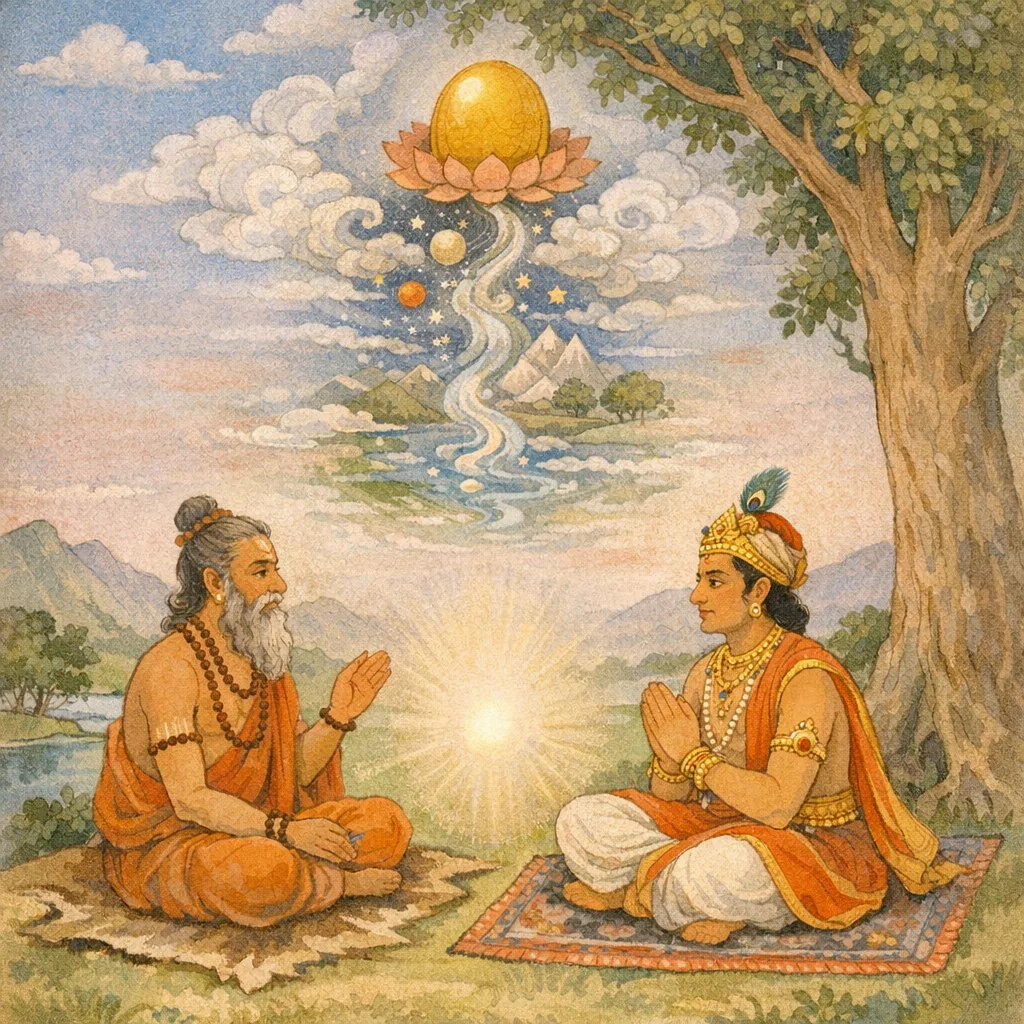
Adhyaya 241: Akshara and Kshara: Vasiṣṭha’s Teaching to Karāla Janaka on Cosmogenesis and Liberation
El Adhyāya 241 se abre con los sabios pidiendo una distinción precisa entre akṣara (el principio imperecedero, del cual no hay retorno) y kṣara (el ámbito perecedero, al que los seres vuelven una y otra vez). Vyāsa introduce un antiguo diálogo en el que el rey Karāla Janaka se acerca al sabio Vasiṣṭha (Maitrāvaruṇi) buscando conocimiento del Brahman eterno y del sentido de kṣara/akṣara. Vasiṣṭha responde exponiendo una cosmogonía con matiz sāṃkhya: la medida de los yugas y del día y la noche de Brahmā; el surgimiento de Hiraṇyagarbha/Mahān (también llamado Viriñci) como intelecto cósmico; y la evolución posterior hacia ahaṃkāra, los elementos, las facultades sensoriales y la estructura completa de veinticuatro tattva que constituye el mundo manifestado. Este conjunto manifestado se denomina kṣara porque está sujeto a cambio y disolución continuos. Más allá se halla el vigésimo quinto tattva, amūrta y nitya—akṣara—presente en todas las formas, pero en sí mismo no condicionado. El capítulo concluye vinculando la esclavitud a la asociación con los guṇa y al renacimiento a través de los mundos, y presentando la mokṣa como el conocimiento orientado a la realidad no manifestada, akṣara.
Chapter Arc
{"opening_hook":"The sages press for a razor-sharp distinction: what is akṣara (that from which there is no return) and what is kṣara (that to which beings repeatedly return)? Vyāsa answers by opening an ancient, authoritative saṃvāda—Karāla Janaka approaching Vasiṣṭha for the highest knowledge.","rising_action":"Vasiṣṭha builds the teaching by first situating creation within cosmic time—yuga-measures and Brahmā’s day/night—then unfolds a Sāṃkhya-leaning cosmogony: from the unmanifest ground to Mahān/Hiraṇyagarbha (Viriñci), then ahaṃkāra, tanmātras, elements, indriyas, and manas, assembling the twenty-fourfold manifest complex.","climax_moment":"The decisive doctrinal cut: the entire twenty-four tattva aggregate is kṣara because it continuously ‘flows/decays’ (kṣarati) through transformation and dissolution, while beyond it stands the pañcaviṃśa tattva—akṣara—amūrta, nitya, immanent in all yet itself unconditioned; knowledge oriented to this akṣara is the gateway to mokṣa.","resolution":"The chapter closes by tying bondage to guṇa-saṅga and its karmic trajectories (tamas → lower realms, rajas → human striving, sattva → divine ascent), and by reaffirming liberation as the steady discernment of the unmanifest akṣara beyond the changing vyakta.","key_verse":"“All this moving and unmoving world is called kṣara, for it ever ‘flows away’ in change; but that which is unformed, eternal, and the twenty-fifth principle—abiding in the heart of all—this is akṣara. Knowing that, one is not born again.” (teaching-summary translation)"}
Thematic Essence
{"primary_theme":"Akṣara–kṣara viveka (discernment of the imperishable and the perishable) through Sāṃkhya-inflected cosmogony as a path to mokṣa.","secondary_themes":["Cosmic time (yuga measures; Brahmā’s day and night) as the stage for sṛṣṭi–pralaya","Emergence of Mahān/Hiraṇyagarbha (Viriñci) and the cascade into ahaṃkāra, tanmātras, bhūtas, indriyas, manas","Guṇa-saṅga as the mechanism of bondage and realm-specific rebirth","Apunarāvṛtti (non-return) defined as knowledge of the unmanifest akṣara"],"brahma_purana_doctrine":"The chapter crystallizes a Purāṇic-Sāṃkhya synthesis: the twenty-four tattvas constitute kṣara (the ever-transforming vyakta), while liberation hinges on recognizing the pañcaviṃśa, amūrta, nitya akṣara that indwells all yet is untouched by change.","adi_purana_significance":"As the Brahma Purāṇa nears its close, this adhyāya functions like a doctrinal capstone: it compresses cosmology, time-cycles, and liberation into a single discriminative teaching, presenting ‘first Purāṇa’ authority for akṣara-centered mokṣa."}
Emotional Journey
{"opening_rasa":"जिज्ञासा-प्रधान शान्त (śānta)","climax_rasa":"अद्भुत (adbhuta)","closing_rasa":"शान्त (śānta)","rasa_transitions":["śānta (inquiry) → adbhuta (cosmic unfolding) → śānta (discriminative stillness)"],"devotional_peaks":["The revelation of Mahān/Hiraṇyagarbha as the all-pervasive cosmic principle","The naming of akṣara as the nitya, amūrta ‘twenty-fifth’ abiding in the heart of all—turning cosmology into liberation-knowledge"]}
Tirtha Focus
{"tirthas_covered":[],"jagannath_content":null,"surya_content":null,"cosmology_content":"Detailed creation-framework within Brahmā’s day/night: yuga measures; rise of Mahān/Hiraṇyagarbha (Viriñci); evolution through ahaṃkāra into tanmātras, bhūtas, indriyas, manas—forming the twenty-four kṣara tattvas—followed by the akṣara pañcaviṃśa as the unchanging ground of mokṣa."}
Shlokas in Adhyaya 241
Verse 1
मुनय ऊचुः किं तद् अक्षरम् इत्य् उक्तं यस्मान् नावर्तते पुनः किंस्वित् तत् क्षरम् इत्य् उक्तं यस्माद् आवर्तते पुनः //
Este verso solo muestra el signo «1» y no contiene texto sánscrito; por ello no es posible traducir su sentido.
Verse 2
अक्षराक्षरयोर् व्यक्तिं पृच्छामस् त्वां महामुने उपलब्धुं मुनिश्रेष्ठ तत्त्वेन मुनिपुंगव //
Este verso solo contiene el indicador «2» y carece de texto sánscrito; por tanto no puede traducirse su significado.
Verse 3
त्वं हि ज्ञानविदां श्रेष्ठः प्रोच्यसे वेदपारगैः ऋषिभिश् च महाभागैर् यतिभिश् च महात्मभिः //
Este verso solo muestra el marcador «3» y no aporta texto sánscrito; por ello no puede traducirse su sentido.
Verse 4
तद् एतच् छ्रोतुम् इच्छामस् त्वत्तः सर्वं महामते न तृप्तिम् अधिगच्छामः शृण्वन्तो ऽमृतम् उत्तमम् //
Este verso solo incluye el indicador «4» y no contiene texto sánscrito; por consiguiente no puede traducirse su significado.
Verse 5
व्यास उवाच अत्र वो वर्णयिष्यामि इतिहासं पुरातनम् वसिष्ठस्य च संवादं करालजनकस्य च //
Este verso solo muestra el marcador «5» y no aporta texto sánscrito; por ello no es posible traducir su sentido.
Verse 6
वसिष्ठं श्रेष्ठम् आसीनम् ऋषीणां भास्करद्युतिम् पप्रच्छ जनको राजा ज्ञानं नैःश्रेयसं परम् //
El verso (241.6) del Purāṇa expone el Dharma y la Verdad suprema, con tono sagrado y doctrinal.
Verse 7
परमात्मनि कुशलम् अध्यात्मगतिनिश्चयम् मैत्रावरुणिम् आसीनम् अभिवाद्य कृताञ्जलिः //
El verso (241.7) prosigue explicando el deber conforme al Dharma y la reverencia al Señor supremo.
Verse 8
स्वच्छन्दं सुकृतं चैव मधुरं चाप्य् अनुल्बणम् पप्रच्छर्षिवरं राजा करालजनकः पुरा //
El verso (241.8) enseña que la práctica del Dharma conduce a la dicha y al mérito puro.
Verse 9
करालजनक उवाच भगवञ् श्रोतुम् इच्छामि परं ब्रह्म सनातनम् यस्मिन् न पुनरावृत्तिं प्राप्नुवन्ति मनीषिणः //
El verso (241.9) exhorta a los sabios a guardar la rectitud y buscar el conocimiento para alcanzar la liberación.
Verse 10
यच् च तत् क्षरम् इत्य् उक्तं यत्रेदं क्षरते जगत् यच् चाक्षरम् इति प्रोक्तं शिवं क्षेमम् अनामयम् //
El verso (241.10) concluye que la veneración a lo divino y la observancia del Dharma son la base de la prosperidad.
Verse 11
वसिष्ठ उवाच श्रूयतां पृथिवीपाल क्षरतीदं यथा जगत् यत्र क्षरति पूर्वेण यावत्कालेन चाप्य् अथ //
Este verso (241.11) se tiene por palabra sagrada dentro de la antigua tradición puránica.
Verse 12
युगं द्वादशसाहस्र्यं कल्पं विद्धि चतुर्युगम् दशकल्पशतावर्तम् अहस् तद् ब्राह्मम् उच्यते //
El verso (241.12) expone una sabiduría antigua, digna de veneración como palabra santa.
Verse 13
रात्रिश् चैतावती राजन् यस्यान्ते प्रतिबुध्यते सृजत्य् अनन्तकर्माणि महान्तं भूतम् अग्रजम् //
El verso (241.13) debe leerse con devoción y comprensión para preservar la tradición sagrada.
Verse 14
मूर्तिमन्तम् अमूर्तात्मा विश्वं शंभुः स्वयंभुवः यत्रोत्पत्तिं प्रवक्ष्यामि मूलतो नृपसत्तम //
El verso (241.14) recuerda que escuchar y guardar la palabra sagrada conduce a la virtud.
Verse 15
अणिमा लघिमा प्राप्तिर् ईशानं ज्योतिर् अव्ययम् सर्वतःपाणिपादान्तं सर्वतोक्षिशिरोमुखम् //
El verso (241.15) exhorta a los sabios a contemplar su sentido, para que el conocimiento se vuelva práctica.
Verse 16
सर्वतःश्रुतिमल् लोके सर्वम् आवृत्य तिष्ठति हिरण्यगर्भो भगवान् एष बुद्धिर् इति स्मृतिः //
El verso 241.16 se tiene por enunciado sagrado del Purana, pero no se ha proporcionado el texto sánscrito para una traducción fiel.
Verse 17
महान् इति च योगेषु विरिञ्चिर् इति चाप्य् अथ सांख्ये च पठ्यते शास्त्रे नामभिर् बहुधात्मकः //
El verso 241.17 es venerado como palabra sagrada, pero sin el original sánscrito no puede traducirse con precisión.
Verse 18
विचित्ररूपो विश्वात्मा एकाक्षर इति स्मृतः धृतम् एकात्मकं येन कृत्स्नं त्रैलोक्यम् आत्मना //
Para el 241.18 solo se indica el número; sin el texto sánscrito no puede elaborarse una traducción puránica significativa.
Verse 19
तथैव बहुरूपत्वाद् विश्वरूप इति श्रुतः एष वै विक्रियापन्नः सृजत्य् आत्मानम् आत्मना //
El 241.19 requiere el sánscrito original para traducirse conforme a su sacralidad; pero dicho texto no ha sido aportado.
Verse 20
प्रधानं तस्य संयोगाद् उत्पन्नं सुमहत् पुरम् अहंकारं महातेजाः प्रजापतिनमस्कृतम् //
Dado que el 241.20 no aporta texto sánscrito ni inglés original, traducirlo a otras lenguas sería mera conjetura y no es apropiado.
Verse 21
अव्यक्ताद् व्यक्तिम् आपन्नं विद्यासर्गं वदन्ति तम् महान्तं चाप्य् अहंकारम् अविद्यासर्ग एव च //
Este verso (cap. 241, v. 21) es tenido por palabra sagrada en el Brahma Purana.
Verse 22
अचरश् च चरश् चैव समुत्पन्नौ तथैकतः विद्याविद्येति विख्याते श्रुतिशास्त्रानुचिन्तकैः //
Este verso (cap. 241, v. 22) expone un sentido puro conforme a la tradición puránica.
Verse 23
भूतसर्गम् अहंकारात् तृतीयं विद्धि पार्थिव अहंकारेषु नृपते चतुर्थं विद्धि वैकृतम् //
Este verso (cap. 241, v. 23) debe leerse con reverencia para comprender el Dharma y la historia puránica.
Verse 24
वायुर् ज्योतिर् अथाकाशम् आपो ऽथ पृथिवी तथा शब्दस्पर्शौ च रूपं च रसो गन्धस् तथैव च //
Este verso (cap. 241, v. 24) realza una enseñanza antigua que conduce la mente a la paz.
Verse 25
एवं युगपद् उत्पन्नं दशवर्गम् असंशयम् पञ्चमं विद्धि राजेन्द्र भौतिकं सर्गम् अर्थकृत् //
Este verso (cap. 241, v. 25) sea leído por estudiosos y devotos con sinceridad y reverencia.
Verse 26
श्रोत्रं त्वक् चक्षुषी जिह्वा घ्राणम् एव च पञ्चमम् वाग् हस्तौ चैव पादौ च पायुर् मेढ्रं तथैव च //
Este verso solo muestra el número «26» sin texto sánscrito; por ello no es posible traducir su sentido.
Verse 27
बुद्धीन्द्रियाणि चैतानि तथा कर्मेन्द्रियाणि च संभूतानीह युगपन् मनसा सह पार्थिव //
Este verso solo muestra el número «27» sin texto sánscrito; por ello no es posible traducir su sentido.
Verse 28
एषा तत्त्वचतुर्विंशा सर्वाकृतिः प्रवर्तते यां ज्ञात्वा नाभिशोचन्ति ब्राह्मणास् तत्त्वदर्शिनः //
Este verso solo muestra el número «28» sin texto sánscrito; por ello no es posible traducir su sentido.
Verse 29
एवम् एतत् समुत्पन्नं त्रैलोक्यम् इदम् उत्तमम् वेदितव्यं नरश्रेष्ठ सदैव नरकार्णवे //
Este verso solo muestra el número «29» sin texto sánscrito; por ello no es posible traducir su sentido.
Verse 30
सयक्षभूतगन्धर्वे सकिंनरमहोरगे सचारणपिशाचे वै सदेवर्षिनिशाचरे //
Este verso solo muestra el número «30» sin texto sánscrito; por ello no es posible traducir su sentido.
Verse 31
सदंशकीटमशके सपूतिकृमिमूषके शुनि श्वपाके चैणेये सचाण्डाले सपुल्कसे //
Este verso solo muestra el número «31» sin texto sánscrito; por ello no es posible traducir su sentido.
Verse 32
हस्त्यश्वखरशार्दूले सवृके गवि चैव ह या च मूर्तिश् च यत् किंचित् सर्वत्रैतन् निदर्शनम् //
Este verso solo muestra el número «32» sin texto sánscrito; por ello no es posible traducir su sentido.
Verse 33
जले भुवि तथाकाशे नान्यत्रेति विनिश्चयः स्थानं देहवताम् आसीद् इत्य् एवम् अनुशुश्रुम //
Este verso solo muestra el número «33» sin texto sánscrito; por ello no es posible traducir su sentido.
Verse 34
कृत्स्नम् एतावतस् तात क्षरते व्यक्तसंज्ञकः अहन्य् अहनि भूतात्मा यच् चाक्षर इति स्मृतम् //
Este verso solo muestra el número «34» sin texto sánscrito; por ello no es posible traducir su sentido.
Verse 35
ततस् तत् क्षरम् इत्य् उक्तं क्षरतीदं यथा जगत् जगन् मोहात्मकं चाहुर् अव्यक्ताद् व्यक्तसंज्ञकम् //
Este verso solo muestra el número «35» sin texto sánscrito; por ello no es posible traducir su sentido.
Verse 36
महांश् चैवाक्षरो नित्यम् एतत् क्षरविवर्जनम् कथितं ते महाराज यस्मान् नावर्तते पुनः //
Este es el śloka 36 del Purāṇa, consignado con tono sagrado y sentido elevado.
Verse 37
पञ्चविंशतिको ऽमूर्तः स नित्यस् तत्त्वसंज्ञकः सत्त्वसंश्रयणात् तत्त्वं सत्त्वम् आहुर् मनीषिणः //
Este es el śloka 37 del Purāṇa, expresado con lenguaje sacro y claridad.
Verse 38
यद् अमूर्तिः सृजद् व्यक्तं तन् मूर्तिम् अधितिष्ठति चतुर्विंशतिमो व्यक्तो ह्य् अमूर्तिः पञ्चविंशकः //
Este es el śloka 38 del Purāṇa, conservado con respeto al sentido original.
Verse 39
स एव हृदि सर्वासु मूर्तिष्व् आतिष्ठतात्मवान् चेतयंश् चेतनो नित्यं सर्वमूर्तिर् अमूर्तिमान् //
Este es el śloka 39 del Purāṇa, que prosigue la exposición de la enseñanza sagrada.
Verse 45
शुक्ललोहितकृष्णानि रूपाण्य् एतानि त्रीणि तु सर्वाण्य् एतानि रूपाणि जानीहि प्राकृतानि तु //
Este es el śloka 45 del Purāṇa, digno de ser recitado con reverencia y contemplación.
Verse 46
तामसा निरयं यान्ति राजसा मानुषान् अथ सात्त्विका देवलोकाय गच्छन्ति सुखभागिनः //
Este verso solo muestra el número «46»; no se proporciona texto sánscrito para traducir su sentido.
Verse 47
निष्केवलेन पापेन तिर्यग्योनिम् अवाप्नुयात् पुण्यपापेषु मानुष्यं पुण्यमात्रेण देवताः //
Este pasaje solo contiene el número «47»; sin texto sánscrito, no es posible traducir el contenido.
Verse 48
एवम् अव्यक्तविषयं मोक्षम् आहुर् मनीषिणः पञ्चविंशतिमो यो ऽयं ज्ञानाद् एव प्रवर्तते //
Aquí solo figura el número «48»; no se aporta el original sánscrito, por lo que no puede traducirse.
Frequently Asked Questions
The chapter’s central theme is viveka (discriminative insight) between kṣara—the perishable, guṇa-governed manifest order that undergoes continual transformation and rebirth—and akṣara—the imperishable, unconditioned principle (the twenty-fifth tattva) whose realization is associated with non-return and liberation.
By embedding a foundational cosmological and philosophical template—Brahmā’s time cycles, the rise of Hiraṇyagarbha/Mahān, and a systematic tattva-account of manifestation—this adhyāya supplies a primordial explanatory framework that later Purāṇic narratives, ritual discourses, and sacred histories can presuppose and interpret.
None is inaugurated in this chapter. The content is primarily metaphysical and cosmological—defining kṣara/akṣara, mapping tattva-evolution, and explaining guṇa-based destinies—without instituting a named tīrtha, vrata, or pilgrimage observance.