
Shloka 11
Karma Yoga — Karma Yoga
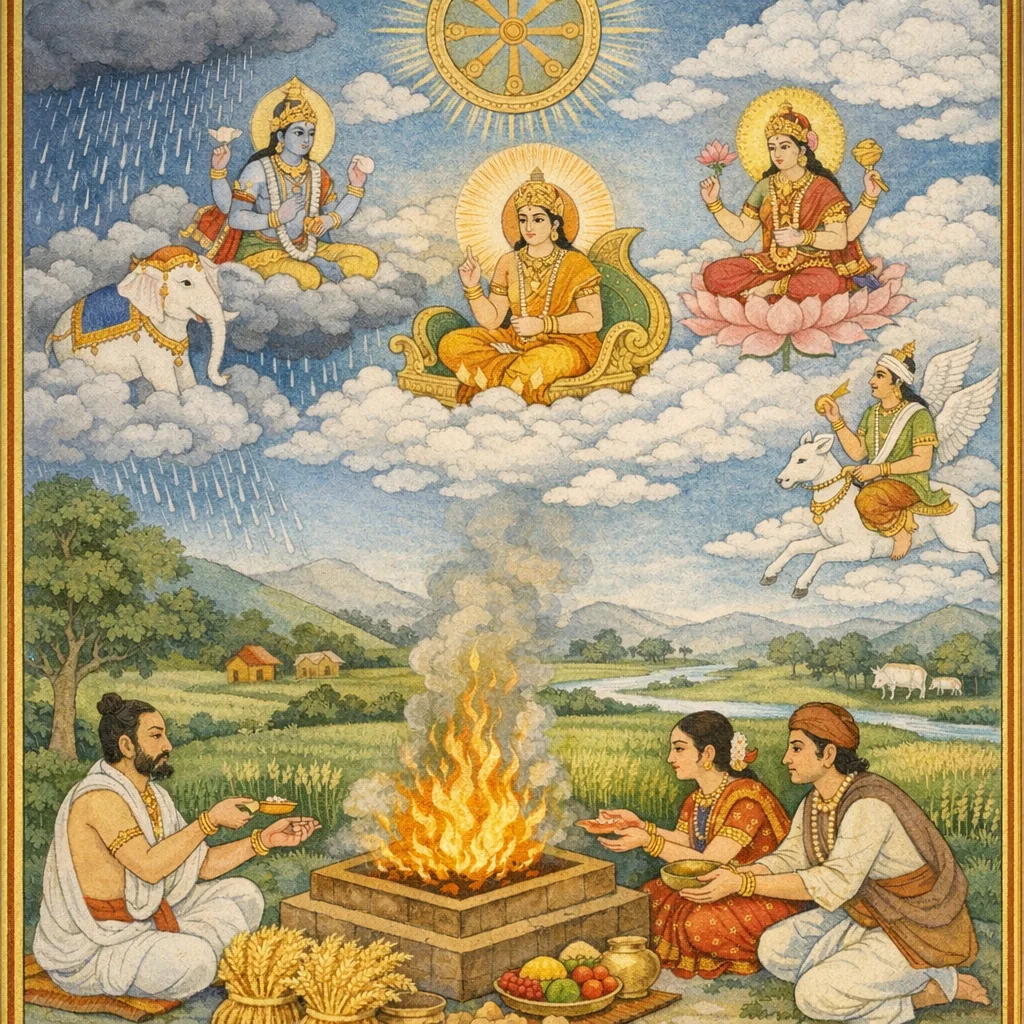
देवान्भावयतानेन ते देवा भावयन्तु वः । परस्परं भावयन्तः श्रेयः परमवाप्स्यथ ॥ ३.११ ॥
devān bhāvayatānena te devā bhāvayantu vaḥ | parasparaṃ bhāvayantaḥ śreyaḥ param avāpsyatha || 3.11 ||

Con esto, nutrid a los devas, y que los devas os nutran; nutriéndoos así mutuamente, alcanzaréis el bien supremo.
Nourish the gods by this (sacrifice), and let the gods nourish you; thus nourishing one another, you shall attain the highest good.
By this, support the devas, and let the devas support you; mutually supporting one another, you will obtain the highest good.
‘Devas’ may be read theistically (divine beings) or functionally (powers of nature / cosmic principles) depending on interpretive framework. The central idea is reciprocity: offerings and obligations sustain a wider order that sustains human life.
FAQs
It encourages a relational self-concept: well-being arises through mutual support rather than isolated self-maximization. This can foster gratitude and pro-social motivation.
The verse presumes an interdependent cosmos in which human action participates in sustaining broader forces; ‘highest good’ emerges when action aligns with that sustaining order.
Krishna continues to justify action by embedding it in a reciprocal system: duties are not arbitrary but part of a sustaining network linking humans, nature, and the sacred.
Interpreting ‘devas’ as ecological and social systems, the verse supports sustainable living: contribute to shared goods (environment, institutions), and those systems in turn support human flourishing.