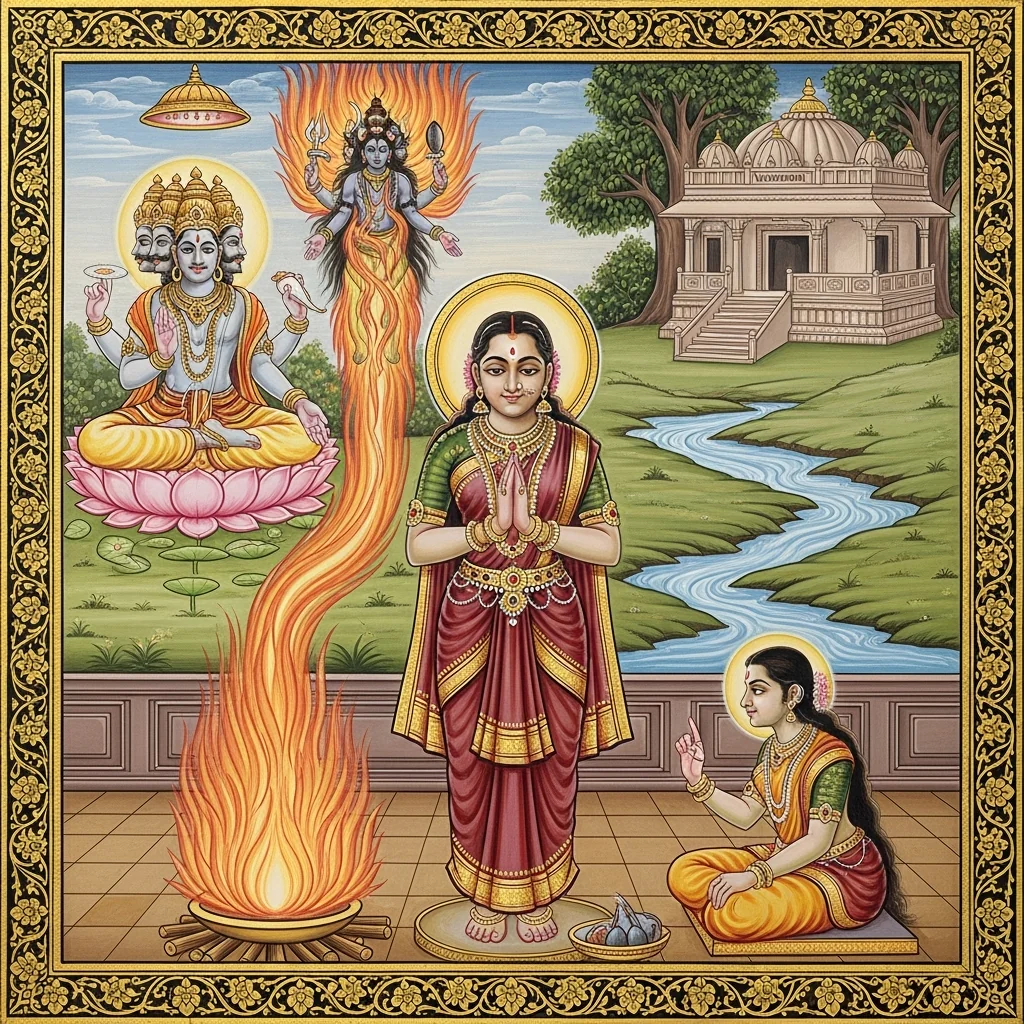
Adhyaya 9
Chapter 9 presents a multi‑stage theological account of how Vastrāpatha Tīrtha becomes a firmly established sacred site within Prabhāsa. It opens with Brahmā’s ritual act of creation through Atharvaveda recitation and the manifestation of Rudra, who divides into multiple Rudras, providing a cosmological ground for Śaiva plurality. The narrative then turns to the Dakṣa–Satī–Śiva conflict: Satī is given to Rudra, Dakṣa’s disrespect intensifies, and Satī self‑immolates, setting in motion cycles of curse and eventual restoration for Dakṣa. The destruction of the yajña by Vīrabhadra and the gaṇas portrays ritual collapse as the consequence of excluding the “worthy” from worship and violating the ethics of reverence. A doctrinal reconciliation follows, declaring Śiva and Viṣṇu non‑different in essence, alongside practical guidance for devotion in kali‑yuga—such as the merit of alms to Śiva in ascetic form and modes of household worship. The account extends to conflict with Andhaka and the integration of divine feminine forms, culminating in localized divine presence: Bhava is stationed at Vastrāpatha, Viṣṇu at Raivataka, and Ambā on the mountain peak; Suvarṇarekhā is defined as a purifying river. The closing phalaśruti states that hearing or reciting brings purification and heavenly attainment, and that bathing, performing sandhyā/śrāddha at Suvarṇarekhā, and worshipping Bhava yield exalted results.
Shlokas
Verse 1
ब्रह्मोवाच । यदि सृष्टं मया सर्वं त्रैलोक्यं सचराचरम् । तदा मूर्तिमिमां त्यक्त्वा भवः सृष्टो मयाऽधुना
Brahmā said: “If indeed I have created all the three worlds, moving and unmoving, then—casting off this form—let Bhava (Śiva) now be created by me.”
Verse 2
पितामहमहत्त्वं स्यात्तथा शीघ्रं विधीयताम् । ब्रह्मणो वचनं श्रुत्वा विष्णुना स प्रमोदितः
“Let the greatness and office of ‘Pitāmaha’ be established—let it be done quickly.” Hearing Brahmā’s words, he was gladdened by Viṣṇu.
Verse 3
महदाश्चर्यजनके संप्राप्तो गिरिमूर्द्धनि । न विचारस्त्वयाकार्यः कर्त्तव्यं ब्रह्मभाषितम्
“At this great wonder-producing moment, having arrived upon the mountain’s summit, you should not deliberate; what Brahmā has spoken must be carried out.”
Verse 4
तथेत्युक्त्वा शिवो देवस्तत्रैवांतरधीयत । ब्रह्मा ययौ मेरुशृंगं मनसः शिरसि स्थितम्
Saying, “So be it,” Lord Śiva vanished then and there. Thereupon Brahmā went to the summit of Meru, set upon the crown of his mind—reached by divine resolve.
Verse 5
तपस्तेपे प्रजानाथो वेदोच्चारणतत्परः । अथर्ववेदोच्चरणं यावच्चक्रे पितामहः
The Lord of creatures performed austerity, intent upon Vedic recitation. Pitāmaha continued, reciting the Atharva Veda for as long as was required.
Verse 6
मुखाद्रुद्रः समभवद्रौद्ररूपो भवापहः । अर्द्धनारीनरवपुर्दुष्प्रेक्ष्योऽतिभयंकरः
From Brahmā’s mouth arose Rudra—terrible in form, the remover of worldly bondage. His body was half woman and half man, hard to behold, exceedingly fearsome.
Verse 7
विभजात्मानमित्युक्त्वा ब्रह्मा चांतर्दधे भयात् । तथोक्तोसौ द्विधा स्त्रीत्वं पुरुषत्वं तथाऽकरोत्
Saying, “Divide yourself,” Brahmā disappeared out of fear. Thus instructed, Rudra indeed became twofold—femalehood and malehood.
Verse 8
बिभेद पुरुषत्वं च दशधा चैकधा पुनः । एकादशैते कथिता रुद्रास्त्रिभुवनेश्वराः
He split the male aspect into ten parts, and again made it one. These are declared to be the eleven Rudras, lords of the three worlds.
Verse 9
कृत्वा नामानि सर्वेषां देवकार्ये नियोजिताः । विभज्य पुनरीशानी स्वात्मानं शंकराद्विभोः
Having bestowed names upon them all, they were appointed to the works of the gods. Then Īśānī, dividing her own being from Śaṅkara, the all-pervading Lord, stood apart.
Verse 10
महादेवनियोगेन पितामहमुपस्थिता । तामाह भगवान्ब्रह्मा दक्षस्य दुहिता भव
By Mahādeva’s command she approached Pitāmaha (Brahmā). The blessed Brahmā said to her: “Become the daughter of Dakṣa.”
Verse 11
सापि तस्य नियोगेन प्रादुरासीत्प्रजापतेः । नियोगाद्ब्रह्मणो दक्षो ददौ रुद्राय तां सतीम्
By his command she manifested as the daughter of the Prajāpati. And by Brahmā’s injunction, Dakṣa gave that Satī to Rudra in marriage.
Verse 12
दाक्षीं रुद्रोऽपि जग्राह स्वकीयामेव शूलभृत् । अथ ब्रह्मा बभाषे तं सृष्टिं कुरु सतीपते
Rudra, the bearer of the trident, accepted Dākṣī (Satī) as his very own. Then Brahmā spoke to him: “O lord of Satī, undertake creation.”
Verse 13
रुद्र उवाच । सृष्टिर्मया न कर्त्तव्या कर्त्तव्या भवता स्वयम् । पालनं विष्णुना कार्यं संहर्ताऽहं व्यवस्थितः
Rudra said: “Creation is not to be done by me; it is to be done by you yourself. Preservation is to be performed by Viṣṇu; I am established as the destroyer.”
Verse 14
स्थाणुवत्संस्थितो यस्मा त्तस्मात्स्थाणुर्भवाम्यहम्
Because I remain stationed like an unmoving pillar, therefore I am known as “Sthāṇu”.
Verse 15
रजोरूपाः सत्त्वरूपास्तमोरूपाश्च ये नराः । सर्वे ते भवता कार्या गुणत्रयविभागतः
(Brahmā said:) “Those beings who are of the nature of rajas, of the nature of sattva, and of the nature of tamas—create them all according to the division of the three guṇas.”
Verse 16
यदा ते तामसैः कार्यं तदा रौद्रो भव स्वयम् । यदा ते राजसैः कार्यं तदा त्वं राजसो भव । सात्त्विकैस्ते यदा कार्यं तदा त्वं सात्त्विको भव
“When your task calls for tamas, then of your own accord become fierce (raudra). When your task calls for rajas, then become rajasic. And when your task calls for sattva, then become sattvic.”
Verse 17
ईश्वर उवाच । इत्याज्ञाप्य च ब्रह्माणं स्वयं सृष्ट्यादिकर्मसु । गृहीत्वा तां सतीं रुद्रः कैलासमधितिष्ठति
Īśvara said: “Thus, after commanding Brahmā regarding the works of creation and the like, Rudra took Satī with him and dwelt upon Kailāsa.”
Verse 18
दक्षः कालेन महता हरस्यालयमाययौ
After a long time, Dakṣa came to the dwelling of Hara (Śiva).
Verse 19
अथ रुद्रः समुत्थाय कृतवान्गौरवं बहु । ततो यथोचितां पूजां न दक्षो बहु मन्यते
Then Rudra rose and bestowed great honor upon him. Yet Dakṣa did not esteem the respectful worship offered in due measure.
Verse 20
तदा वै तमसाविष्टः सोऽधिकं ब्राह्मणः शुभः । पूजामनर्घ्यामन्विच्छञ्जगाम कुपितो गृहम्
Then, seized by tamas, that eminent and otherwise auspicious brāhmaṇa (Dakṣa), seeking incomparable honors, went home in anger.
Verse 21
कदाचित्तां गृहं प्राप्तां सतीं दक्षः सुदुर्मनाः । भर्त्रा सह विनिंद्यैनां भर्त्सयामास वै रुषा
Once, when Satī came to his house, Dakṣa—deeply displeased—reviled her along with her husband and scolded her in anger.
Verse 22
पंचवक्त्रो दशभुजो मुखे नेत्रत्रयान्वितः । कपर्द्दी खंडचंद्रोसौ तथासौ नीललोहितः
“He has five faces and ten arms; on his face is the triad of eyes. He is Kapardī, bearing the broken crescent-moon; and he is Nīlalohita as well.”
Verse 23
कपाली शूलहस्तोऽसौ गजचर्मावगुंठितः । नास्य माता न च पिता न भ्राता न च बान्धवः
“He is Kapālī, holding a trident; he is wrapped in an elephant-hide. He has neither mother nor father, neither brother nor kinsman.”
Verse 24
सर्पास्थिमंडितग्रीवस्त्यक्त्वा हेमविभूषणम् । भिक्षया भोजनं यस्य कथमन्नं प्रदास्यति
His neck is adorned with serpents and bones, having cast away golden ornaments. He whose food is obtained by begging—how could he provide food to others?
Verse 25
कदाचित्पूर्वतो याति गच्छन्याति स पश्चिमे । दक्षिणस्यां वृषो याति स्वयं याति स चोत्तरे
At times he goes east; while moving he goes west. His bull goes to the south, while he himself goes to the north.
Verse 26
तिर्यगूर्ध्वमधो याति नैव याति न तिष्ठति । इति चित्रं चरित्रं ते भर्त्तुर्नान्यस्य दृश्यते
He moves sideways, upward, and downward; yet he neither truly “goes” nor ever stands still. Such is the wondrous, paradoxical conduct of your Lord—seen in none other.
Verse 27
निर्गुणः स गुणातीतो निःस्नेहो मूकवत्स्थितः । सर्वज्ञः सर्वगः सर्वः पठ्यते भुवनत्रये
He is without qualities, beyond all qualities; without attachment, abiding like one silent. All-knowing, all-pervading, the All—so is he proclaimed throughout the three worlds.
Verse 28
कदाचिन्नैव जानाति न शृणोति न पश्यति । दैत्यानां दानवानां च राक्षसानां ददाति यः
At times he neither knows, nor hears, nor sees—yet he is the one who grants boons even to Daityas, Dānavas, and Rākṣasas.
Verse 29
न चास्य च पिता कश्चिन्न च भ्रातास्ति कश्चन । एक एव वृषारूढो नग्नो भ्रमति भूतले
He has no father at all, nor any brother. Alone, mounted upon the bull, naked, he roams upon the earth.
Verse 30
न गृहं न धनं गोत्रमनादिनिधनोव्ययः । स्थिरबुद्धिर्न चैवासौ क्रीडते भुवनत्रये
He has no house, no wealth, no lineage—beginningless, endless, undecaying. With unwavering awareness, he sports through the three worlds.
Verse 31
कदाचित्सत्यलोके सौ पातालमधितिष्ठति । गिरिसानुषु शेतेऽसावशिवोपि शिवः स्मृतः
At times he abides in Satyaloka; at times he presides in Pātāla. He lies upon mountain-slopes—though seeming ‘inauspicious’, he is remembered as Śiva, the Auspicious One.
Verse 32
श्रीखंडादीनि संत्यज्य सदा भस्मावगुंठितः । सर्वदेति वचः सत्यं किमन्यत्स प्रदास्यति
Casting away sandalwood and the like, ever covered with sacred ash—‘He gives to all’: this saying is true. What else, indeed, would he not bestow?
Verse 33
धिक्त्वां जामातरं धिक्तं ययोः स्नेहः परस्परम् । तस्य त्वं वल्लभा भार्या स च प्राणाधिकस्तव
Shame on you, and shame on that son-in-law—upon you two whose affection is only for each other! You are his beloved wife, and he is dearer to you than life itself.
Verse 34
न च पित्रास्ति ते कार्यं न मात्रा न सखीषु च । केवलं भर्तृभक्ता त्वं तस्माद्गच्छ गृहान्मम
Here you have no duty to your father, nor to your mother, nor to your companions. You are devoted only to your husband; therefore go now from my house.
Verse 35
अन्ये जामातरः सर्वे भर्तुस्तव पिनाकिनः । त्वमद्यैवाशु चास्माकं गृहाद्गच्छ वरं प्रति
All other sons-in-law are fit for ordinary husbands; but your husband is Pinākin—Śiva, bearer of the bow. So today itself—quickly—leave our house and go to your bridegroom.
Verse 36
तस्य तद्वाक्यमाकर्ण्य सा देवी शंकरप्रिया । विनिंद्य पितरं दक्षं ध्यात्वा देवं महेश्वरम्
Hearing those words, the Goddess—beloved of Śaṅkara—rebuked her father Dakṣa and, meditating upon the Lord Maheśvara, fixed her mind on Śiva alone.
Verse 37
श्वेतवस्त्रा जले स्नात्वा ददाहात्मानमात्मना । याचितस्तु शिवो भर्त्ता पुनर्जन्मांतरे तया
Clad in white garments, she bathed in water and, by her own will, consigned her body to the fire. Thereafter, in another birth, she sought Śiva as her husband.
Verse 38
पिता मे हिमवानस्तु मेनागर्भे भवाम्यहम् । अत्रांतरे हिमवता तपसा तोषितो हरः । प्रत्यक्षं दर्शनं दत्त्वा हिमवंतं वचोऽब्रवीत्
“Let Himavān be my father, and let me be born from Menā’s womb.” Meanwhile, Hara (Śiva) was pleased by Himavān’s austerities; appearing directly before him, He granted him darśana and spoke to Himavān.
Verse 39
एषा दत्ता सुता तुभ्यं परिणेष्यामि तामहम् । देवानां कार्य्यसिद्ध्यर्थं गिरिराजो भविष्यसि
“This daughter is bestowed upon you; I shall wed her. For the fulfillment of the gods’ purpose, you shall become the king of mountains.”
Verse 40
आत्ममूर्त्तौ प्रविष्टां तां ज्ञात्वा देवो महेश्वरः । शशाप दक्षं कुपितः समागत्याथ तद्गृहम्
Knowing that she had entered her own essential form (leaving the body behind), the Lord Maheśvara, inflamed with wrath, came to Dakṣa’s house and pronounced a curse upon him.
Verse 41
त्यक्त्वा देहमिमं ब्राह्म्यं क्षत्रियाणां कुले भव । स्वायंभुवत्वं संत्यज्य दक्ष प्राचेतसो भव
“Cast off this Brahmin-born body and be born in a Kṣatriya lineage. Forsaking your Svāyambhuva status, O Dakṣa, become Prācetasa.”
Verse 42
स्वस्यां सुतायामूढायां पुत्रमुत्पादयिष्यसि । एवं शप्त्वा महादेवो ययौ कैलासपर्वतम्
“Upon your own deluded daughter you shall beget a son.” Having thus cursed him, Mahādeva departed for Mount Kailāsa.
Verse 43
स्वायभुवोऽपि कालेन दक्षः प्राचेतसोऽभवत् । भवानीं स सुतां लब्ध्वा गिरिस्तुष्टो हिमा लयः
In time, even Dakṣa the Svāyambhuva became Prācetasa. And when Himālaya obtained Bhavānī as his daughter, the king of mountains rejoiced.
Verse 44
मेनापि तां सुतां लब्ध्वा धन्यं मेने गृहाश्रमम् । तां दृष्ट्वा जायमानां च स्वेच्छयैव वराननाम्
Menā too, having obtained that daughter, deemed her household life blessed. Seeing the lovely-faced girl being born—almost as if by her own will—she rejoiced in her good fortune.
Verse 45
मेना हिमवतः पत्नी प्राहेदं पर्वतेश्वरम् । पश्य बालामिमां राजन्राजीवसदृशाननाम्
Menā, the wife of Himavān, said to the lord of mountains: “O King, behold this little girl, whose face is like a lotus.”
Verse 46
हिताय सर्वभूतानां जातां च तपसा शुभाम् । सोऽपि दृष्ट्वा महादेवीं तरुणादित्यसन्निभाम्
Born through auspicious austerity for the welfare of all beings, she appeared. Seeing that Great Goddess, radiant like the rising sun, he too beheld her with awe.
Verse 47
कपर्दिनीं चतुर्वक्त्रां त्रिनेत्रामतिलालसाम् । अष्टहस्तां विशालाक्षीं चंद्रावयवभूषणाम्
He saw her with matted locks, four-faced, three-eyed, and intensely splendid—eight-armed, wide-eyed, adorned with ornaments shaped like the moon.
Verse 48
प्रणम्य शिरसा भूमौ तेजसा तु सुविह्वलः । भीतः कृतांजलिः स्तब्धः प्रोवाच परमेश्वरीम्
Bowing with his head to the ground, overwhelmed by her splendor, fearful and motionless, he joined his palms and spoke to the Supreme Goddess.
Verse 49
हिमवानुवाच । का त्वं देवि विशालाक्षि शंस मे संशयो महान्
Himavān said: “Who are you, O wide-eyed Goddess? Tell me—my doubt is great.”
Verse 50
देव्युवाच । मां विद्धि परमां शक्तिं महेश्वरसमाश्रयाम् । अनन्यामव्ययामेकां यां पश्यंति मुमुक्षवः
The Goddess said: “Know me as the Supreme Power, abiding in Mahādeva. I am the one, imperishable, without a second—whom seekers of liberation behold.”
Verse 51
दिव्यं ददामि ते चक्षुः पश्य मे रूपमैश्वरम् । एतावदुक्त्वा विज्ञानं दत्त्वा हिमवते स्वयम्
“I grant you divine sight—behold my sovereign form.” Having said this, she herself bestowed true discernment upon Himavān.
Verse 52
सूर्यकोटिप्रतीकाशं तेजोबिंबं निराकुलम् । ज्वाला मालासहस्राढ्यं कालानलशतोपमम्
He beheld a sphere of splendor shining like ten million suns—untroubled and serene—abounding in thousands of garlands of flame, comparable to a hundred cosmic fires at the end of time.
Verse 53
दंष्ट्राकरालमुद्धर्षं जटामंडलमंडितम् । प्रशांतं सौम्यवदनमनंताश्चर्यसंयुतम्
Terrifying with bared fangs and fiercely exalted, yet adorned with a circle of matted locks—peaceful, with a gentle face, filled with endless wonders.
Verse 54
चंद्रावयवलक्ष्माणं चंद्रकोटिसमप्रभम् । किरीटिनं गदाहस्तं नुपुरैरुपशोभितम्
Marked with moon-like features and radiant with the splendor of ten million moons, He stood crowned, a mace in His hand, and further adorned with shining anklets.
Verse 55
दिव्यमाल्यांबरधरं दिव्यगंधानुलेपनम् । शंखचक्रधरं काम्यं त्रिनेत्रं कृत्तिवाससम्
Wearing divine garlands and garments, anointed with heavenly fragrances; bearing conch and discus, wondrous to behold—three-eyed, and clad in a hide.
Verse 56
अंडस्थं चांडबाह्यस्थं बाह्यमभ्यंतरं परम् । सर्वशक्तिमयं शुभ्रं सर्वालंकारसंयुतम्
He beheld the Supreme—present within the cosmic egg and also beyond it; outward and inward, transcending all—filled with every power, radiant and pure, adorned with all divine ornaments.
Verse 57
ब्रह्मेन्द्रोपेन्द्रयोगीन्द्रैर्वन्द्यमान पदांबुजम् । सर्वतः पाणिपादांतं सर्वतोऽक्षिशिरोमुखम्
His lotus-feet were worshipped by Brahmā, Indra, Upendra (Viṣṇu), and the lords of Yogins; He had hands and feet on every side, and eyes, heads, and faces in every direction.
Verse 58
सर्वमावृत्य तिष्ठंतं ददर्श परमेश्वरम् । दृष्ट्वा नन्दीश्वरं देवं देव्या महेश्वरं परम्
He saw Parameśvara standing, enveloping everything. Having beheld Nandīśvara—the god—he also beheld the supreme Maheśvara together with the Goddess.
Verse 59
भयेन च समाविष्टः स राजा हृष्टमानसः । आत्मन्याधाय चात्मानमोंकारं समनुस्मरन्
Overwhelmed with reverent awe yet gladdened at heart, that king gathered himself within and unceasingly remembered the Oṃkāra (Om).
Verse 60
नाम्नामष्टसहस्रेण स्तुत्वाऽसौ हिम वान्गिरिः
Then Himavān—the august lord of mountains—praised (the Deity) with an eight-thousandfold litany of names.
Verse 61
भूयः प्रणम्य भूतात्मा प्रोवाचेदं कृतांजलिः । यदेतदैश्वरं रूपं जातं ते परमेश्वरि
Bowing again, the noble-souled one, with folded hands, spoke: “O Parameśvarī, this sovereign, awe-inspiring form that has appeared of you—”
Verse 62
भीतोऽस्मि सांप्रतं दृष्ट्वा तत्त्वमन्यत्प्रदर्शय । एवमुक्ता च सा देवी तेन शैलेन पार्वती
“I am afraid upon seeing this just now; show me another, truer principle (a different reality).” Thus addressed by that mountain, Pārvatī—the Goddess—(responded).
Verse 63
संहृत्य दर्शयामास स्वरूपमपरं परम् । नीलोत्पलदलप्रख्यं नीलोत्पलसुगंधिकम्
Withdrawing that awe-inspiring manifestation, she revealed another supreme form—like the petal of a blue lotus, and fragrant like the blue lotus itself.
Verse 64
द्विनेत्रं द्विभुजं सौम्यं नीलालकविभूषितम् । रक्तपादांबुजतलं सुरक्तकरपल्लवम्
She appeared gentle—two-eyed and two-armed, adorned with dark-blue tresses; the soles of her lotus-feet were red, and her tender hands shone with a lovely crimson.
Verse 65
श्रीमद्विशालसद्वृत्तं ललाटतिलकोज्ज्वलम् । भूषितं चारुसर्वांगं भूषणैरतिकोमलम्
Glorious and radiant—broad in form and perfectly proportioned—her forehead shone with a luminous tilaka. Her lovely limbs were adorned with ornaments, exceedingly delicate and graceful.
Verse 66
दधानं चोरसा मालां विशालां हेमनिर्मिताम् । ईषत्स्मितं सुबिंबोष्ठं नूपुरारावशोभितम्
Upon her breast she wore a broad garland fashioned of gold; with a gentle smile and lips like a ripe bimba-fruit, she shone all the more by the sweet resonance of her anklets.
Verse 67
प्रसन्नवदनं दिव्यं चारुभ्रूमहिमास्पदम् । तदीदृशं समालोक्य स्वरूपं शैलसत्तमः । भयं संत्यज्य हृष्टात्मा बभाषे परमेश्वरीम्
Her face was serene and divine, a seat of splendour crowned by her lovely brows. Beholding such a form, the greatest of mountains cast away fear; his heart rejoiced, and he spoke to the Supreme Goddess.
Verse 68
हिमवानुवाच । अद्य मे सफलं जन्म अद्य मे सफलाः क्रियाः । यन्मे साक्षात्त्वमव्यक्ता प्रसन्ना दृष्टिगोचरा । इदानीं किं मया कार्यं तन्मे ब्रूहि महेश्वरि
Himavān said: “Today my birth is fulfilled; today my deeds have borne fruit—since you, the Unmanifest (Avyakta), have graciously become directly visible to my eyes. Now what should I do? Tell me, O Maheśvarī.”
Verse 69
महेश्वर्युवाच । शिवपूजा त्वया कार्या ध्यानेन तपसा सदा । अहं तस्मै प्रदातव्या केनचित्कारणेन वै
Maheśvarī said: “You should always worship Śiva—through meditation and austerity. For by a certain divine purpose, I am to be bestowed upon Him.”
Verse 70
यादृशस्तु त्वया दृष्टो ध्येयो वै तादृशस्त्वया । एक एव शिवो देवः सर्वाधारो धराधरः
“Just as you have seen Him, so indeed should you meditate upon Him. Śiva is one alone—the divine Lord, the support of all, O bearer of the earth.”
Verse 71
सारस्वत उवाच । तपश्च कृतवान्रुद्रः समागम्य हिमाचलम् । तस्योमा परमां भक्तिं चकार शिवसंनिधौ
Sārasvata said: “Rudra performed austerities after coming to Himācala; and there Umā, in Śiva’s very presence, offered Him supreme devotion.”
Verse 72
देवकार्येण केनापि देवो वै ज्ञापितः प्रभुः । उपयेमे हरो देवीमुमां त्रिभुवनेश्वरीम्
By some divine purpose, the Lord was duly informed; and Hara took in marriage the Goddess Umā, the sovereign Lady of the three worlds.
Verse 73
स शप्तः शंभुना पूर्वं दक्षः प्राचेतसो नृपः । विनिंद्य पूर्ववैरेण गंगाद्वारेऽयजद्धरिम्
That king Dakṣa, son of Prācetas, had previously been cursed by Śambhu. Driven by former enmity, he reviled Him and performed a sacrifice to Hari at Gaṅgādvāra.
Verse 74
देवाश्च यज्ञभागार्थमाहूता विष्णुना स्वयम् । सहैव मुनिभिः सर्वैरागता मुनिपुंगवाः
The gods, seeking their shares in the sacrifice, were personally summoned by Viṣṇu; and together with all the sages, the foremost seers arrived there.
Verse 75
दृष्ट्वा देवकुलं कृत्स्नं शंकरेण विनाऽगतम् । दधीचो नाम विप्रर्षिः प्राचेतसमथाब्रवीत्
Seeing the entire host of gods arrive without Śaṅkara, the brahmin-sage named Dadhīci then spoke to Dakṣa, the son of Prācetas.
Verse 76
दधीचिरुवाच । ब्रह्माद्यास्तु पिशाचांता यस्याज्ञानुविधायिनः । स हि वः सांप्रतं रुद्रो विधिना किं न पूज्यते
Dadhīci said: “From Brahmā onward, even down to the piśācas, all follow His command. That very Rudra is now present among you—why, then, should he not be worshiped according to proper rite?”
Verse 77
दक्ष उवाच । सर्वेष्वेव हि यज्ञेषु न भागः परिकल्पितः । न मंत्रा भार्यया सार्द्धं शंकरस्येति नेष्यते
Dakṣa said: “In all sacrifices, no share has been allotted to him. Nor is it accepted that Śaṅkara should be invoked with mantras together with his wife.”
Verse 78
विहस्य दक्षं कुपितो वचः प्राह महामुनिः । शृण्वतां सर्वदेवानां सर्वज्ञानमयः स्वयम्
Having laughed at Dakṣa, the great sage—angered—spoke these words while all the gods listened, he himself being filled with complete knowledge.
Verse 79
यतः प्रवृत्तिर्विश्वात्मा यश्चासौ भुवनेश्वरः । न त्वं पूजयसे रुद्रं देवैः संपूज्यते हरः
From whom all activity arises—the Soul of the universe, the Lord of the worlds—yet you do not worship Rudra, though Hara is fully worshiped by the gods.
Verse 80
दक्ष उवाच । अस्थिमालाधरो नग्नः संहर्ता तामसो हरः । विषकंठः शूलहस्तः कपाली नागवेष्टितः
Dakṣa said: “Hara wears a garland of bones, is naked, a destroyer, of dark (tāmasa) nature—poison-throated, trident-in-hand, skull-bearing, and wrapped with serpents.”
Verse 81
ईश्वरो हि जगत्स्रष्टा प्रभुर्योऽसौ सनातनः । सत्त्वात्मकोऽसौ भगवानिज्यते सर्वकर्मसु
For the Lord is the creator of the world, the eternal Master. That blessed one, whose nature is sattva, is worshiped in all rites and actions.
Verse 82
दधीचिरुवाच । किं त्वया भगवानेष सहस्रांशुर्न दृश्यते । सर्वलोकैकसंहर्ता कालात्मा परमेश्वरः
Dadhīci said: “Why do you not recognize this Blessed Lord, the thousand-rayed one? He is the sole destroyer of all worlds, Time itself, the Supreme Lord.”
Verse 83
एष रुद्रो महादेवः कपर्द्दी चाग्रणीर्हरः । आदित्यो भगवान्सूर्यो नीलग्रीवो विलोहितः
This is Rudra—Mahādeva—Kapardī, and Hara, the foremost. He is Āditya, the blessed Sun; the blue-necked one, the ruddy one.
Verse 85
एवमुक्ते तु मुनयः समायाता दिदृक्षवः । बाढमित्यब्रुवन्दक्षं तस्य साहाय्यकारिणः
When this was spoken, the sages gathered, eager to behold it. They replied to Dakṣa, “So be it,” and became his helpers.
Verse 86
तपसाविष्टमनसो न पश्यंति वृषध्वजम् । सहस्रशोऽथ शतशो बहुशोऽथ य एव हि
With minds seized by austerity, they do not behold Vṛṣadhvaja—Śiva whose banner bears the bull—though he stands present in thousands, in hundreds, in manifold forms indeed.
Verse 87
देवांश्च सर्वे भागार्थमागता वासवादयः । नापश्यन्देवमीशानमृते नारायणं हरिम्
All the gods—beginning with Vāsava (Indra)—came to claim their sacrificial shares, yet they saw the Lord Īśāna (Śiva) nowhere; only Nārāyaṇa, Hari, was seen.
Verse 88
रुद्रं क्रोधपरं दृष्ट्वा ब्रह्मा ब्रह्मासनाद्ययौ । अन्तर्हिते भगवति दक्षो नारायणं हरिम्
Seeing Rudra inflamed with anger, Brahmā rose from his seat and went forth. And when the Blessed Lord withdrew from sight, Dakṣa turned to Nārāyaṇa, Hari.
Verse 89
रक्षकं जगतां देवं जगाम शरणं स्वयम् । प्रवर्तयामास च तं यज्ञं दक्षोऽथ निर्भयः
Dakṣa himself sought refuge in the divine Protector of the worlds; and then, free from fear, he set that sacrifice in motion once more.
Verse 90
रक्षको भगवान्विष्णुः शरणागतरक्षकः । पुनः प्राहाध्वरे दक्षं दधीचो भगवन्नृप
The Protector is Bhagavān Viṣṇu, the savior of those who seek refuge. Then, in that sacrifice, Dadhīca again spoke to Dakṣa—O king.
Verse 91
निर्भयः शृणु दक्ष त्वं यज्ञभंगो भवि ष्यति । अपूज्यपूजनाद्दक्ष पूज्यस्य च विवर्जनात्
Hear me, Dakṣa, without fear: the sacrifice will be shattered—because you honor the unworthy, and because you neglect the One who is truly worthy of worship.
Verse 92
नरः पापमवाप्नोति महद्वै नात्र संशयः । असतां प्रग्रहो यत्र सतां चैव विमानता
A person incurs great sin—of this there is no doubt—where the wicked are favored and the good are dishonored.
Verse 93
दण्डो देवकृतस्तत्र सद्यः पतति दारुणः । एवमुक्त्वा स विप्रर्षिः शशापेश्वरविद्विषः
There, a terrible punishment wrought by the gods falls at once. Saying this, that brahmin-sage pronounced a curse upon the haters of the Lord.
Verse 94
यस्माद्बहिष्कृतो देवो भवद्भिः परमेश्वरः । भविष्यध्वं त्रयीबाह्याः सर्वेऽपीश्वरविद्विषः
Because you have excluded the God who is the Supreme Lord, you shall become outsiders to the Vedic triad—every one of you, haters of Īśvara.
Verse 95
मिथ्यारीतिसमाचारा मिथ्याज्ञानप्रभाषिणः । प्राप्ते कलियुगे घोरे कलिजैः किल पीडिताः
They will follow false customs and conduct, speaking pretended knowledge; and when the dreadful Kali age arrives, they will indeed be tormented by the evils born of Kali.
Verse 96
कृत्वा तपोबलं घोरं गच्छध्वं नरकं पुनः । भविष्यति हृषीकेशः स्वामी वोऽपि पराङ्मुखः
Even after performing dreadful austerities and amassing ascetic power, you shall go again to hell; and Hṛṣīkeśa (Viṣṇu), though your Lord, will also turn away from you.
Verse 97
सारस्वत उवाच । एवमुक्त्वा स ब्रह्मर्षिर्विरराम तपोनिधिः । जगाम मनसा रुद्रमशेषाध्वरनाशनम्
Sārasvata said: Having spoken thus, that Brahmarṣi—an ocean of austerity—fell silent. Then, by the power of his mind, he approached Rudra, the destroyer of all sacrificial rites (when they are corrupted).
Verse 98
एतस्मिन्नंतरे देवी महादेवं महेश्वरम् । गत्वा विज्ञापयामास ज्ञात्वा दक्षमखं शिवा
Meanwhile, the Goddess Śivā, having learned of Dakṣa’s sacrifice, went to Mahādeva Maheśvara and informed him.
Verse 99
देव्युवाच । दक्षो यज्ञेन यजते पिता मे पूर्वजन्मनि । तेन त्वं दूषितः पूर्वमहं चातीव दुःखिता । विनाशयस्व तं यज्ञं वरमेनं वृणोम्यहम्
The Goddess said: In a former birth, my father Dakṣa is performing a sacrifice. Because of that, you were earlier dishonoured, and I too was deeply afflicted with grief. Therefore destroy that sacrifice—this boon I choose.
Verse 100
सारस्वत उवाच । एवं विज्ञापितो देव्या देवदेवो महेश्वरः । ससर्ज सहसा रुद्रं दक्षयज्ञजिघांसया
Sārasvata said: Thus informed by the Goddess, Maheśvara, Lord of the gods, instantly emanated Rudra, intent on destroying Dakṣa’s sacrifice.
Verse 101
सहस्रशिरसं क्रूरं सहस्राक्षं महाभुजम् । सहस्रपाणिं दुर्द्धर्षं युगांतानलसन्निभम्
He was thousand-headed, fierce; thousand-eyed, mighty-armed; thousand-handed, irresistible—like the cosmic fire at the end of an age.
Verse 102
दंष्ट्राकरालं दुष्प्रेक्ष्यं शंखचक्रधरं प्रभुम् । दण्डहस्तं महानादं शार्ङ्गिणं भूतिभूषणम्
Terrifying with protruding fangs and dreadful to behold, that Lord bore conch and discus; he held a staff in his hand, roared mightily, carried the Śārṅga bow, and was adorned with sacred ash.
Verse 103
वीरभद्र इति ख्यातं देवदेवसमन्वितम् । स जातमात्रो देवेशमुपतस्थे कृतांजलिः
He became renowned as Vīrabhadra, attended by the gods. The moment he was born, he stood before the Lord of gods with hands joined in reverence.
Verse 104
तमाह दक्षस्य मखं विनाशय शमस्तु तं । विनिन्द्य मां स यजते गंगाद्वारे गणेश्वर
Śiva said to him: “Destroy Dakṣa’s sacrifice (makha) and bring it to an end. Having insulted me, he performs that rite at Gaṅgādvāra—O lord of my gaṇas!”
Verse 105
ततो बंधप्रमुक्तेन सिंहेनेव च लीलया । वीरभद्रेण दक्षस्य नाशार्थं रोम चोद्धुतम्
Then Vīrabhadra—like a lion freed from its bonds, as though in sport—shook the hairs of his body, intent on Dakṣa’s destruction.
Verse 106
रोम्णा सहस्रशो रुद्रा निसृष्टास्तेन धीमता । रोमजा इति विख्यातास्तत्र साहाय्यकारिणः
From those hairs, that wise one released Rudras by the thousands. They became known as the “Romajas” (hair-born ones), serving there as his helpers.
Verse 107
शूलशक्तिगदाहस्ता दण्डोपलकरास्तथा । कालाग्निरुद्रसंकाशा नादयन्तो दिशो दश
Bearing tridents, spears, and maces—some holding staffs and stones—those fierce attendants, resembling Rudra as the fire of Time, roared aloud, making all the ten directions resound.
Verse 108
सर्वे वृषसमारूढाः सभा र्याश्चातिभीषणाः । समाश्रित्य गणश्रेष्ठं ययुर्दक्षमखं प्रति
All of them, mounted upon bulls and fearsome—together with their consorts—took refuge behind the foremost of the Gaṇas and proceeded toward Dakṣa’s sacrificial rite.
Verse 109
देवांगनासहस्राढ्यमप्सरोगीतिनादितम् । वीणावेणुनिनादाढ्यं वेदवादाभि नादितम्
It was filled with thousands of celestial maidens, resonant with the songs of the Apsarases; rich with the sounds of vīṇā and flute, and reverberating with Vedic recitations.
Verse 110
दृष्ट्वा दक्षं समासीनं देवैब्रह्मर्षिभिः सह । उवाच स वृषारूढो दक्षं वीरः स्मयन्निव
Seeing Dakṣa seated together with the gods and the brahmarṣis, that heroic one—mounted on a bull—addressed Dakṣa, as though smiling.
Verse 111
वयं ह्यचतुराः सर्वे शर्वस्यामितते जसः । भागार्थलिप्सया प्राप्ता भागान्यच्छ त्वमीप्सितान्
‘We are all indeed unwise before Śarva of immeasurable splendor. Having come here desiring a share, grant the portions you deem appropriate.’
Verse 112
भागो भवद्भ्यो देयस्तु नास्मभ्यमिति कथ्यताम् । ततो वयं विनिश्चित्य करिष्यामो यथोचितम्
‘Let it be declared plainly: “the share is to be given to you, not to us.” Then, having decided accordingly, we shall act as is proper.’
Verse 113
एवमुक्ता गणेशेन प्रजापतिपुरःसराः
Thus addressed by the lordly leader of the Gaṇas, those headed by Prajāpati (Dakṣa) responded.
Verse 114
देवा ऊचुः । प्रमाणं नो विजानीथ भागं मंत्रा इति धुवम्
The Devas said: ‘The Mantras indeed know the authoritative rule regarding the sacrificial share—this is certain.’
Verse 115
मंत्रा ऊचुः । सुरा यूयं तमोभूतास्तमोपहतचेतसः । ये नाध्वरस्य राजानं पूजयेयुर्महेश्वरम्
The Mantras said: “O gods, you have become darkness; your minds are struck down by delusion, for you would not worship Maheśvara, the sovereign Lord of the sacrifice.”
Verse 116
ईश्वरः सर्वभूतानां सर्वदेवतनुर्हरः । गण उवाच । पूज्यते सर्वयज्ञेषु कथं दक्षो न पूजयेत्
“Īśvara—Hara—embodies all the gods and is the Lord of all beings.” The Gaṇa said: “He is worshipped in every sacrifice; how then could Dakṣa not worship him?”
Verse 117
मंत्राः प्रमाणं न कृता युष्माभिर्बलगर्वितैः । यस्मादसह्यं तस्मान्नो नाशयाम्यद्य गर्वितम्
You, swollen with the pride of power, have not accepted the authority of the sacred mantras. Since this insolence has become unbearable, today I shall shatter your arrogance.
Verse 118
इत्युक्त्वा यज्ञशालां तां देवोऽहन्गणपुंगवः । गणेश्वराश्च संक्रुद्धा यूपानुत्पाट्य चिक्षिपुः
Having spoken thus, the divine chief of the gaṇas struck that sacrificial hall; and the enraged gaṇa-lords tore up the sacrificial posts and hurled them away.
Verse 119
प्रस्तोतारं सहोतारमध्वर्युं च गणेश्वरः । गृहीत्वा भीषणाः सर्वे गंगास्रोतसि चिक्षिपुः
Seizing the prastotṛ, the udgātṛ, and the adhvaryu, the gaṇa-lords—terrifying in aspect—cast them all into the current of the Gaṅgā.
Verse 120
वीरभद्रोऽपि दीप्तात्मा वज्रयुक्तं करं हरेः । व्यष्टंभयददीनात्मा तथान्येषां दिवौकसाम्
Vīrabhadra too, blazing in spirit and unyielding, checked Hari’s arm that bore thunderbolt-like might; and likewise he restrained the hands of the other denizens of heaven.
Verse 121
भगनेत्रे तथोत्पाट्य कराग्रेणैव लीलया । निहत्य मुष्टिना दंडैः सप्ताश्वं च न्यपातयत्
Plucking out Bhaga’s eyes with the very tips of his fingers, as though in sport, he struck down Daṇḍa with his fist and also felled Saptāśva.
Verse 122
तथा चंद्रमसं देवं पादांगुष्ठेन लीलया । धर्षयामास वलवान्स्मयमानो गणेश्वरः
So too, smiling, the mighty gaṇa-lord insulted and subdued the Moon-god with his big toe, as though it were mere play.
Verse 123
वह्नेर्हस्तद्वयं छित्त्वा जिह्वामुत्पाट्य लीलया । जघान मूर्ध्नि पादेन मुनीनपि मुनीश्वरान्
Cutting off Fire’s two hands and tearing out his tongue as though in play, he struck upon the head with his foot—even great sages, lords among ascetics.
Verse 124
तथा विष्णुं सगरुडं समायातं महाबलः । विव्याध निशितैर्बाणैः स्तंभयित्वा सुदर्शनम्
Likewise, when mighty Viṣṇu arrived together with Garuḍa, that great warrior pierced him with sharp arrows, first arresting the motion of the Sudarśana discus.
Verse 125
ततः सहस्रशो भद्रः ससर्ज गरुडान्बहून् । वैनतेयादभ्यधिकान्गरुडं ते प्रदुद्रुवुः
Then Bhadra brought forth thousands of Garuḍas—many even mightier than Vainateya; and those Garuḍas rushed upon Garuḍa himself.
Verse 126
तान्दृष्ट्वा गरुडो धीमान्पलायनपरोऽभवत् । तत्स्थितो माधवो वेगाद्यथा गौः सिंहपीडिता
Seeing them, the wise Garuḍa turned his mind to flight; and Mādhava, left standing there, was shaken by a sudden force—like a cow tormented by a lion.
Verse 127
अंतर्हिते वैनतेये विष्णौ च पद्मसंभवः । आगत्य वारयामास वीरभद्रं शिवप्रियम्
When Viṣṇu, the rider of Vainateya, had vanished, the Lotus-born (Brahmā) came there and restrained Vīrabhadra, beloved of Śiva.
Verse 128
प्रसादयामास स तं गौरवात्परमेष्ठिनः । तेऽदृश्यं नैव जानंति रुद्रं तत्रागतं सुराः
Out of reverence for the Supreme Lord (Brahmā), he sought to pacify him; and the gods there did not recognize Rudra who had come, for he was unseen.
Verse 129
स देवो विष्णुना ज्ञातो ब्रह्मणा च दधीचिना । तुष्टाव भगवान्ब्रह्मा दक्षो विष्णुदिवौकसः
That Lord was recognized by Viṣṇu, by Brahmā, and by Dadhīci. Then Brahmā, Dakṣa, and the heavenly ones devoted to Viṣṇu praised him.
Verse 130
विशेषात्पार्वतीं देवीमीश्वरार्द्धशरीरिणीम् । स्तोत्रैर्नानाविधैर्दक्षः प्रणम्य च कृताञ्जलिः
In particular, Dakṣa, with palms joined and bowing low, praised Goddess Pārvatī—she who shares half the Lord’s body—with hymns of many kinds.
Verse 131
ततो भगवती प्राह प्रहसंती महेश्वरम् । त्वमेव जगतः स्रष्टा संहर्ता चैव रक्षकः
Then the Blessed Goddess, smiling, spoke to Maheśvara: “You alone are the creator of the world, its destroyer, and its protector.”
Verse 132
अनुग्राह्यो भगवता दक्षश्चापि दिवौ कसः । ततः प्रहस्य भगवान्कर्पद्दी नीललोहितः । उवाच प्रणतान्देवान्दक्षं प्राचेतसं हरः
Dakṣa, and the gods as well, were fit to receive the Lord’s grace. Then the Blessed One—Nīlalohita—smiling, Hara spoke to the prostrated gods and to Dakṣa, son of Prācetas.
Verse 133
गच्छध्वं देवताः सर्वाः प्रसन्नो भवतामहम् । संपूज्यः सर्वयज्ञेषु प्रथमं देवकर्मणि
“Go, all you deities; I am pleased with you. In every sacrifice I am to be worshipped first, at the very beginning of the divine rite.”
Verse 134
त्वं चापि शृणु मे दक्ष वचनं सर्वरक्षणम् । त्यक्त्वा लोकेषणामेनां मद्भक्तो भव यत्नतः
“And you too, Dakṣa, listen to my word that brings protection in every way: abandoning this craving for worldly regard, become my devotee with earnest effort.”
Verse 135
भविष्यसि गणेशानः कल्पांतेऽनुग्रहान्मम । तावत्तिष्ठ ममादेशात्स्वाधिकारेषु निर्वृतः । इत्युक्त्वाऽदर्शनं प्राप्तो दक्षस्यामिततेजसः
“By my grace, at the end of the kalpa you shall become Gaṇeśāna. Until then, by my command, remain content and at peace in your own offices.” Having spoken thus, the Lord of immeasurable radiance vanished from Dakṣa’s sight.
Verse 136
दधीचिना शिवो दृष्टो विज्ञप्तः शापमोचने । कथं शापं मया दत्तं तरिष्यंति तवाज्ञया
Dadhīci beheld Śiva and implored him for release from the curse, saying: “The curse that I myself bestowed—how will they, by your command, cross beyond it?”
Verse 137
शिव उवाच । भविष्यंति त्रयी बाह्याः संप्राप्ते तु कलौ युगे । पठिष्यंति च ये वेदास्ते विप्राः स्वर्गगामिनः
Śiva said: “When the Kali Yuga arrives, there will arise people who stand outside the Vedic triad. Yet those brāhmaṇas who continue to study and recite the Vedas will attain heaven.”
Verse 138
आगमा विष्णुरचिताः पठ्यन्ते ये द्विजातिभिः । तेपि स्वर्गं प्रयास्यंति मत्प्रसादान्न संशयः
The Āgamas composed by Viṣṇu—when they are studied by the twice-born—those too will go to heaven by my grace; of this there is no doubt.
Verse 139
कलिकालप्रभावेन येषां पाठो न विद्यते । गृहस्थधर्माचरणं कर्तव्यं मम पूजनम्
Under the influence of the Kali age, for those who are unable to undertake scriptural recitation, the dharma of the householder should be practiced—together with worship of me.
Verse 140
अवश्यं च मया कार्यं तेषां पापविमोचनम् । भिक्षां भ्रमामि मध्याह्ने अतीते भस्मगुंठितः
Surely I must bring about their release from sin. When midday has passed, covered in ash, I wander about seeking alms.
Verse 141
जटाजूटधरः शांतो भिक्षापात्रकरो द्विजः । यो ददाति च मे भिक्षां स्वर्गं याति स मानवः
A peaceful twice-born, bearing matted locks and holding an alms-bowl—whoever gives alms to me in that form, that person goes to heaven.
Verse 142
उपानहौ वा च्छत्रं वा कौपीनं वा कमंडलुम् । यो ददाति तपस्विभ्यो नरो मुक्तः स पातकैः । दधीचेः स वरान्दत्त्वा वभाषे सह विष्णुना
Whether sandals, an umbrella, a loincloth, or a water-pot—whoever gives these to ascetics is freed from sins. Having granted boons to Dadhīci, he spoke thus in the company of Viṣṇu.
Verse 143
रुद्र उवाच । यस्ते मित्रं स मे मित्रं यस्ते रिपुः स मे रिपुः । यस्त्वां पूजयते विष्णो स मां पूजयते ध्रुवम्
Rudra said: Whoever is your friend is my friend; whoever is your enemy is my enemy. O Viṣṇu, whoever worships you certainly worships me.
Verse 144
यः स्तौति त्वां स मां स्तौति प्रियो यस्ते स मे प्रियः । अहं यत्र च तत्र त्वं नास्ति भेदः परस्परम्
Whoever praises you praises me; whoever is dear to you is dear to me. Wherever I am, there you are—there is no difference between us.
Verse 145
कृष्ण उवाच । एवमेतत्परं देव वक्तव्यं यत्तथैव तत् । अर्द्धनारीनरवपुर्यदा दृष्टो मया पुरा
Kṛṣṇa said: “So indeed it is, O supreme Lord; what you have spoken must be accepted exactly as such. Formerly, once I beheld that form whose body was half woman and half man…”
Verse 146
नेयं नारी मया दृष्टा दृष्टं रूपं किलात्मनः । शंखचक्रगदाहस्तं वनमालाविभूषितम्
It was not a woman that I saw; indeed, I beheld my own form—bearing conch, discus, and mace in hand, adorned with the forest-garland.
Verse 147
श्रीवत्सांकं पीतवस्त्रं कौस्तुभेन विराजि तम् । द्वितीयार्द्धं मया दृष्टं शूलहस्तं त्रिलोचनम्
I beheld one half marked with Śrīvatsa, clad in yellow garments, resplendent with the Kaustubha jewel; and the other half I saw as three-eyed, holding the trident in hand.
Verse 148
चंद्रावयवसंयुक्तं जटाजूटकपालिनम् । एकीभावं प्रपन्नोहं यथा पूर्वं तथाऽधुना । न मां गौरी प्रपश्येत प्रपश्यामि तथैव च
I beheld that form adorned with the crescent moon, with matted locks, bearing the skull-bowl. I have taken refuge in this oneness—just as before, so even now. May Gaurī not perceive me; and I too shall perceive her in the same manner as before.
Verse 149
ईश्वर उवाच । आवयोरंतरं नास्ति चैकरूपावुभावपि । यो जानाति स जानाति सत्यलोकं स गच्छति
Īśvara said: “There is no difference between us; indeed, both of us are of a single form. Whoever understands this truly understands—and he goes to Satyaloka.”
Verse 150
इत्युक्त्वा स ययौ तत्र कैलासं पर्वतोत्तमम् । कृष्णोपि मंदरं प्राप्तो देवकार्येण केनचित्
Having spoken thus, he departed from there for Kailāsa, the foremost of mountains. And Kṛṣṇa too reached Mandara, impelled by some divine purpose.
Verse 151
अत्रांतरे दैत्यराजो महादेवप्रसादतः । हिरण्यनेत्रतनयो बाधतेसौ जगत्त्रयम्
Meanwhile, the king of the Dānavas—Hiraṇyanetra’s son—by Mahādeva’s boon, began to afflict the three worlds.
Verse 152
अमरत्वं हराल्लब्ध्वा कामांधो नैव पश्यति । हरांगधारिणीं देवीं दिव्यरूपां सुलोचनाम्
Having obtained immortality from Hara, blinded by desire he fails to recognize the Goddess—she who bears Hara as her very ornament, of divine form and beautiful eyes.
Verse 153
ममेति स च जानाति याचते च हरं प्रति । हरोऽपि कार्यव्यसनस्त्यक्त्वा कैलासपर्वतम्
Thinking, “She is mine,” he makes his demand to Hara. And Hara too, pressed by urgent duty, departed from Mount Kailāsa.
Verse 154
मंदरं समनुप्राप्तो देवं द्रष्टुं जनार्द्दनम् । परस्परं समालोच्यामुंचद्देवीं स मंदरे
He reached Mandara to see the Lord Janārdana. After consulting together, he left the Goddess there on Mandara.
Verse 155
नारायणगृहे देवी स्थिता देवीगणैर्वृता । अत्रांतरे गौतमस्तु गोवधान्मलिनीकृतः
The Goddess remained in Nārāyaṇa’s dwelling, surrounded by hosts of goddesses. Meanwhile, Gautama was tainted by the sin of killing a cow.
Verse 156
पवित्रीकरणायास्य भिक्षुरूपधरो हरः । गौतमस्य गृहं प्राप्तो मंदरं चांधको गतः
For his purification, Hara assumed the form of a mendicant and came to Gautama’s house. And Andhaka went to Mandara as well.
Verse 157
ययाचे पार्वतीं दुष्टो युद्धं चक्रे स विष्णुना । हारितं तु गणैः सर्वैर्देवीं दैत्यो न पश्यति
That wicked one begged for Pārvatī and then engaged in battle with Viṣṇu. But the Goddess was swiftly carried away by all the Gaṇas, and the demon could no longer see her.
Verse 158
स्त्रीरूपधारी कृष्णोऽसौ गौरीं रक्षति मंदिरे । गौरीणां तु शतं चक्रे हरिस्तत्र स मायया
That Kṛṣṇa, assuming a woman’s form, protected Gaurī within the temple. There, Hari by his māyā produced a hundred forms of “Gaurī”.
Verse 159
विष्णोर्देहसमुद्भूता दिव्यरूपा वरस्त्रियः । अन्धको नैव जानाति कैषा गौरी नु पार्वती
From Viṣṇu’s own body arose excellent women of divine form. Andhaka could not discern at all which one was Gaurī and which was Pārvatī.
Verse 160
विलंबस्तत्र सञ्जातो मोहितो विष्णुमायया । तावच्छिवः समायातः कृत्वा गौतमपावनम्
There a delay arose, for he was deluded by Viṣṇu’s māyā. Meanwhile Śiva arrived, having performed the purification of Gautama.
Verse 161
भिक्षामात्रेण चान्नेन गौतमो निर्मलीकृतः । सोंधकेन तदा युद्धं चक्रे रुद्रोऽपि कोपितः
By mere alms-food, Gautama was made pure. Then Rudra too, angered, waged battle with Andhaka.
Verse 162
अमरोऽसौ हराज्जातः शूले प्रोतः सुदारुणे । शूलस्थस्तु स्तुतिं चक्रे तस्य तुष्टो महेश्वरः
That one became ‘immortal’, born from Hara, and was transfixed upon a most dreadful trident. Yet, while upon the trident, he offered praise—thereby Maheśvara was pleased with him.
Verse 163
गणेशत्वं ददौ तस्मै यावदाभूतसंप्लवम् । स्वसरूपामुमादेवीं कृष्णस्तस्मै ददौ स्वयम्
He granted him the status of a Gaṇeśa until the cosmic dissolution. And Kṛṣṇa himself gave him Umādevī in her own true form.
Verse 164
गौरीरूपाः स्त्रियश्चान्या धरित्र्यां तास्तु प्रेषिताः । कृत्वा नामानि सर्वासां लोके पूज्या भविष्यथ
Other women bearing Gaurī’s form were then sent upon the earth. Having been given names, all of you shall become worthy of worship in the world.
Verse 165
एता ये पूजयिष्यंति पूजयिष्यन्ति ते शिवाम् । शिवां ये पूजयिष्यंति तेऽर्चयन्ते हरं हरिम्
Those who worship these forms truly worship Śivā. And those who worship Śivā, in truth adore both Hara and Hari.
Verse 167
ब्रह्मेशनारायणपुण्यचेतसां शृण्वन्ति चित्रं चरितं महात्मनाम् । मुच्यंति पापैः कलिकालसंभवैर्यास्यंति नाकं गणवृन्दवंदिताः
Those of purified minds, devoted to Brahmā, Īśa, and Nārāyaṇa, who listen to this wondrous conduct of the great souls are freed from sins born of the Kali age, and they go to heaven, honored by hosts of Gaṇas.
Verse 168
एवं काले वर्त्तमाने हरः कैलासपर्वते । रक्षोदानवदैत्यैस्तु गृह्यतेऽसौ वरान्बहून्
Thus, as time went on, Hara (Śiva) remained on Mount Kailāsa. There, rākṣasas, dānavas, and daityas approached him and obtained many boons from him.
Verse 169
ब्रह्मदत्तवरो रौद्रस्तारकाख्यो महासुरः । तेन सर्वं जगद्व्याप्तं तस्य नष्टा सुरा रणे
There was a fierce great asura named Tāraka, endowed with a boon granted by Brahmā. By him the whole world was overrun, and the gods were defeated by him in battle.
Verse 170
महादेवसुतेनाजौ हंतव्योऽसौ ससर्ज तम् । कार्तिकेयमुमापुत्रं रुद्रवीर्यसमुद्भवम्
“He must be slain in battle by the son of Mahādeva”—thus the divine resolve was set. Therefore he brought forth Kārttikeya, Umā’s son, born from Rudra’s sacred energy.
Verse 171
देवैरिन्द्रादिभिः सर्वैः सेनाध्यक्ष्येभिषेचितः । तेनापि दैवयोगेन तारकाख्यो निपातितः
All the gods, headed by Indra, consecrated him as commander of the armies. And by him—through divine dispensation—Tāraka was struck down.
Verse 172
कैलासशिखरासीनो देवदेवो जगद्गुरुः । उमया सह संतुष्टो नन्दिभद्रादिभिर्वृतः
Seated upon the peak of Kailāsa, the God of gods, the Guru of the world, was content together with Umā, surrounded by Nandī, Bhadrā and others.
Verse 173
स्कन्देन गजवक्त्रेण धनाध्यक्षेण संयुतः । अथ हासपरं देवं शनैः प्रोवाच तं शिवा
He was accompanied by Skanda, by the elephant-faced (Gaṇeśa), and by the Lord of wealth (Kubera). Then Śivā (Umā), seeing the god in a playful mood, softly spoke to him.
Verse 174
केन देव प्रकारेण तोषं यास्यसि शंकर । मर्त्यानां केन दानेन तपसा नियमेन वा
‘O God, in what manner will you, O Śaṅkara, be pleased? By what gift among mortals—by what austerity, or by what discipline—are you satisfied?’
Verse 175
केन वा कर्मणा देव केन मन्त्रेण वा पुनः । स्नानेन केन देवेश केन धूपेन तुष्यसि
‘Or by what act, O God, and again by what mantra? By what bathing, O Lord of gods, and by what incense are you pleased?’
Verse 176
पुष्पेण केन मे नाथ केन पत्रेण शंकर । कया संतुष्यसे स्तुत्या साहसेन च केन वै
“With what flower, my Lord, and with what leaf, O Śaṅkara? With what hymn of praise are you satisfied, and by what bold act indeed?”
Verse 177
नैवेद्येन च केन त्वं केन होमेन तुष्यसि । केन कष्टेन वा देव केनार्घेण मम प्रभो
“And by what food-offering are you pleased, and by what homa (oblatory rite) do you find satisfaction? By what hardship, O God, and by what arghya-offering, my Lord?”
Verse 178
षोडशैते मया प्रश्नाः पृष्टा मे निर्णयं वद
“These sixteen questions have been asked by me; tell me the decisive conclusion regarding them.”
Verse 179
शंकर उवाच । साधु पृष्टं त्वया देवि कथयिष्ये मम प्रियम् । शिवपूजाप्रकारोऽयं क्रियते वचसा गुरोः
Śaṅkara said: “Well have you asked, O Devī. I shall tell you what is dear to me. This method of Śiva-worship is to be performed according to the word (instruction) of the guru.”
Verse 180
अभयं सर्वजंतूनां दानं देवि मम प्रियम् । सत्यं तपः समाख्यातं परदारविवर्जनम्
“Granting fearlessness to all beings—this, O Devī, is a charity dear to me. Truthfulness is declared to be austerity, and abstaining from another’s spouse is true self-restraint.”
Verse 181
प्रियो मे नियमो देवि कर्म तल्लोकरञ्जनम् । मयों नमः शिवायेति मन्त्रोऽयमुररीकृतः
O Devī, discipline (niyama) is dear to me, and action that brings joy to the world. “Namaḥ Śivāya”—this mantra I have accepted as authoritative.
Verse 182
सर्वपापविनिर्मुक्तो मम देवि स वल्लभः । पापत्यागो भवेत्स्नानं धूपो मे गौग्गुलः प्रियः
O Devī, he who is freed from all sins is dear to me. The very abandonment of sin is true bathing; and the incense dear to me is guggulu, the fragrant resin.
Verse 183
धत्तूरकस्य पुष्पं मे बिल्वपत्रं मम प्रियम् । स्तुतिः शिवशिवायेति साहसं रणकर्मणि
The dhattūra flower is dear to me, and the bilva leaf is beloved to me. Praise as “Śiva, Śiva!” and bravery in the duties of battle are also pleasing.
Verse 184
न बिभेति नरो यस्तु तस्याग्रे संभवाम्यहम् । हंतकारो गवां यस्तु नैवेद्यं मम वल्लभम्
Before the man who does not fear, I appear. But for one who slays cows, the naivedya—the food-offering—is not dear to me.
Verse 185
पूर्णाहुत्या परा प्रीतिर्जायते मम सुन्दरि । शुश्रूषा वल्लभं कष्टं यतीनां च तपस्विनाम्
O fair one, through the pūrṇāhuti, the complete offering, supreme delight arises in me. Service (śuśrūṣā) to yatis, and the hardships borne by renunciants and tapasvins, are dear to me.
Verse 186
सूर्योदये महादेवि मध्याह्नेऽस्तमने तथा । अर्घो यो दीयते सूर्ये वल्लभोऽसौ मम प्रिये
At sunrise, O Mahādevī, at midday, and likewise at sunset—whoever offers arghya to the Sun, that person is dear to me, O beloved.
Verse 187
किं दानैः किं तपोभिर्वा किं यज्ञैर्भाववर्जितैः । दया सत्यं घृणाऽस्तेयं दंभपैशुन्यवर्जितम् । भक्त्या यद्दीयते स्तोकं देवि तद्वल्लभं मम
What use are gifts, what use austerities, or sacrifices that are devoid of heartfelt devotion? Compassion, truthfulness, tenderness, non-stealing, and freedom from hypocrisy and slander—whatever little is offered with devotion, O Devī, that is dear to me.
Verse 188
एवं यावत्कथयति प्रश्नान्सूक्ष्मान्यथोदितान् । तावद्ब्रह्मादिभिर्देवैर्विष्णुस्तत्र ययौ स्वयम्
While he was thus explaining the subtle questions exactly as they had been asked, Viṣṇu himself arrived there, accompanied by Brahmā and the other gods.
Verse 189
विष्णुरुवाच । नाहं पालयितुं शक्तस्त्वं ददासि वरान्बहून् । दैत्यानां दानवादीनां राक्षसानां महेश्वर
Viṣṇu said: “I am not able to maintain order, for you grant many boons—to the Daityas, the Dānavas, and the Rākṣasas, O Maheśvara.”
Verse 190
विकृतिं यांति पश्चात्ते कष्टं वध्या भवंति मे । पत्रेण पुष्पमात्रेण ओंकारेण शिवेन च । मुक्तिं याति नरो देव भवभक्तिं करोतु कः
Afterwards they fall into perversion; they become difficult to subdue and must be slain by me. Yet a man attains liberation, O God, merely with a leaf, with only a flower, with the syllable Oṃ, and with the name ‘Śiva’—so who would still cultivate devotion to worldly becoming (bhava)?
Verse 191
इन्द्रादयोऽपि ये देवा यज्ञैराप्याययंति ते । न यजंति द्विजा यज्ञान्भिक्षादानेन तुष्यसि
Even Indra and the other gods are sustained by sacrifices; yet you do not desire the sacrifices performed by the twice-born—rather, you are pleased by the giving of alms.
Verse 192
रुद्र उवाच । इन्द्रादिभिर्न मे कार्यं ब्रह्मा मे किं करिष्यति । येन केन प्रकारेण प्रजाः पाल्यास्त्वया ऽधुना
Rudra said: “I have no need of Indra and the others—what can Brahmā do for me? By whatever means, the subjects must now be protected by you.”
Verse 193
मदीया प्रकृतिस्त्वेषा तां कथं त्यक्तुमुत्सहे । त्वयाहं ब्रह्मणा देवैर्वरकर्मणि योजितः
“This is my own nature—how could I bear to abandon it? By you, by Brahmā, and by the gods I have been appointed to the task of granting boons.”
Verse 194
इदानीमेव किं नष्टं मुक्त्वा देवीं तवाग्रतः । भूत्वा मूर्तिं परित्यज्य एकाकी विचराम्यहम्
“What is lost if, even now, I leave the Goddess before your very eyes? Having assumed a form, I shall abandon that form and wander alone.”
Verse 195
इत्युक्त्वा स शिवो देवस्तत्रैवांतरधीयत । गते तस्मिञ्छिवे तत्र संक्षोभः सुमहानभूत्
Having spoken thus, that god Śiva vanished right there. When Śiva had departed, a very great agitation arose in that place.
Verse 196
उमा प्रोवाच चेन्द्रादीन्ब्रह्मविष्णुगणांस्तथा । इदानीं किं मया कार्यं भवद्भिः शिववर्जितैः
Umā said to Indra and the others, and likewise to the hosts of Brahmā and Viṣṇu: “Now what business have I with you, when you are bereft of Śiva?”
Verse 197
अत्रान्तरे च ये चान्ये देवास्तत्र समागताः । ऋषयश्चैव सिद्धाश्च तथा नारदपर्वतौ
Just then, other gods also assembled there; and likewise sages and Siddhas—along with Nārada and Parvata.
Verse 198
गंगासरस्वतीनद्यो नागा यक्षाः समागताः । ब्रह्मादिभिः समालोच्य कथमेतद्भविष्यति
The rivers Gaṅgā and Sarasvatī, along with the Nāgas and Yakṣas, assembled together. Consulting with Brahmā and the other gods, they asked, “How is this to be resolved—what will happen now?”
Verse 199
विष्णुरुवाच । सहैव गम्यतां तत्र यत्र देवो गतः शिवः । स्वल्पा यासेन ते यान्तु नराः स्वर्गं शिवाज्ञया
Viṣṇu said: “Let us go together to that place where Lord Śiva has gone. By Śiva’s command, may those men attain heaven with little hardship.”
Verse 200
सत्यलोके नरा यान्तु देवा यान्तु धरातलम् । रक्षोदानवदैत्यानां वरान्यच्छतु शंकरः
“Let human beings go to Satyaloka; let the gods go down to the earth. And may Śaṅkara grant boons to the Rākṣasas, Dānavas, and Daityas.”
Verse 201
तेषां बाधा मया कार्या यै च स्युर्धर्मलोपकाः । हृष्टे शिवे मया कार्या व्यवस्था स्वर्गगामिनाम्
I must restrain those who would become destroyers of dharma. And when Śiva is pleased, I must establish the proper order for those destined for heaven.
Verse 202
त्रयीधर्मं परित्यज्य येऽन्यं धर्ममुपासते । ते नरा नरकं यांतु यावदाभूतसंप्लवम्
Those who abandon the dharma of the three Vedas and pursue another path—let such people go to hell, until the dissolution of created beings.