Adhyaya 8
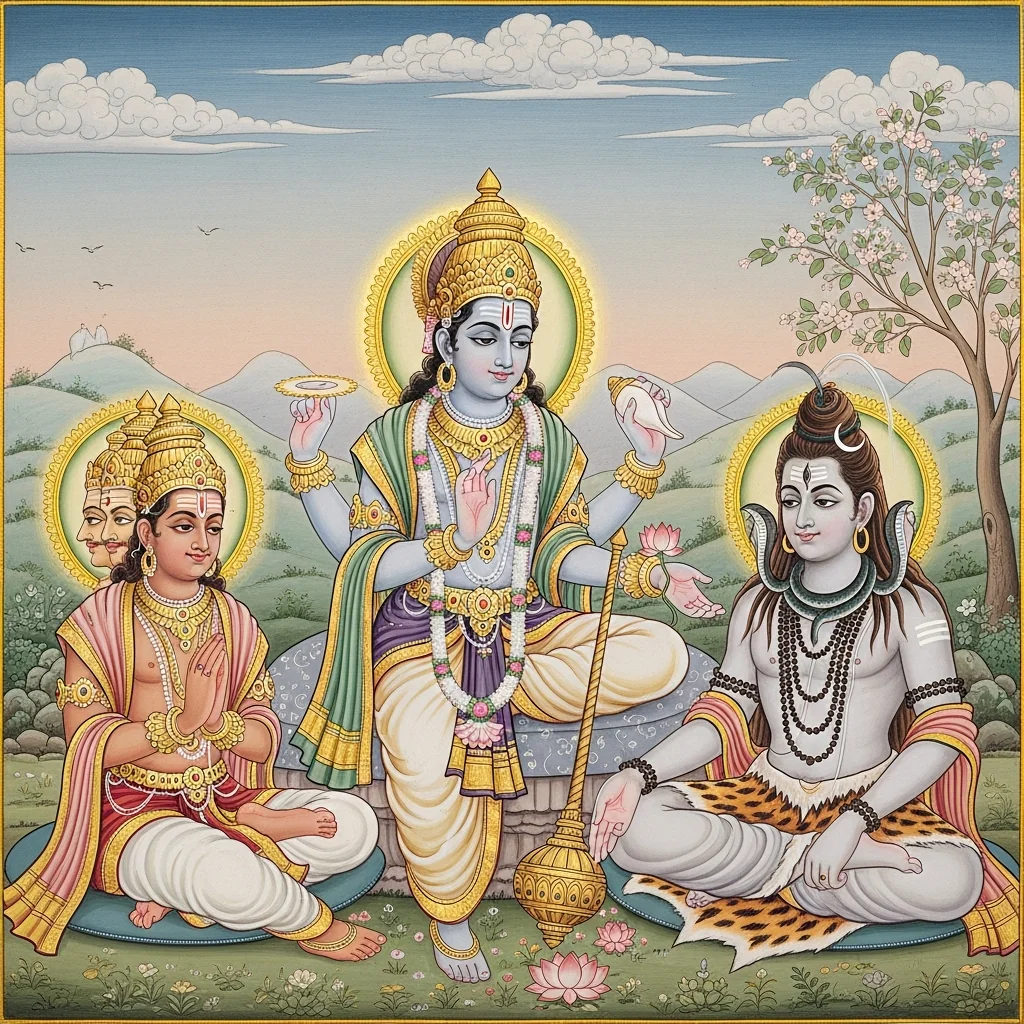
Chapter 8 begins with King Bhoja asking for a full account of Vastrāpatha-kṣetra and Mount Raivataka, and above all the origin (utpatti) and purifying sanctity of the tīrtha-waters called Suvarṇarekhā. He inquires who, among Brahmā, Viṣṇu, and Śiva, is established as supreme in this setting, why the gods gather at the tīrtha, and how it is said that Nārāyaṇa comes there in person. Sārasvata replies that merely hearing this sacred narrative diminishes wrongdoing, and then frames the tīrtha account within cosmogony: at the close of a “day of Brahmā,” Rudra withdraws the world, and the triad is described as briefly unified before differentiating by function—Brahmā as creator, Hari as preserver, and Rudra as dissolver. A dispute over precedence then arises between Brahmā and Rudra on Kailāsa, with Viṣṇu mediating. Viṣṇu’s instruction points to a prior, singular Mahādeva who transcends the cosmos; Brahmā praises Śiva with Vedic-style epithets, and Śiva grants a boon, preparing the ground for the later details of the tīrtha’s origin.
Shlokas
Verse 1
भोजराज उवाच । प्रभो सारस्वत मया श्रुतं माहात्म्यमुत्तमम् । वस्त्रापथस्य क्षेत्रस्य गिरे रैवतकस्य च
Bhojarāja said: O revered Sārasvata, I have heard the excellent māhātmya of Vastrāpatha-kṣetra and of Mount Raivataka as well.
Verse 2
विशेषेण स्वर्णरेखाभवस्य च जलस्य च । इदानीं श्रोतुमिच्छामि तीर्थोत्पत्तिं वदस्व मे
In particular, I now wish to hear about the waters of Svarṇarekhā-bhava. Tell me, please, the origin of this tīrtha.
Verse 3
ब्रह्मविष्णुशिवादीनां मध्ये कोऽयं व्यवस्थितः । केयं नदी स्वर्णरेखा सर्वपातकनाशिनी
Among Brahmā, Viṣṇu, Śiva and the others—who is this One established here? And what is this river Svarṇarekhā, the destroyer of all sins?
Verse 4
कस्माद्ब्रह्मादया देवा अस्मिंस्तीर्थे समागताः । कथं नारायणो देवः स्वयमेव समागतः
For what reason did Brahmā and the other gods assemble at this tīrtha? And how did Lord Nārāyaṇa himself come here in person?
Verse 5
हेमालयं परित्यज्य भवानी गिरिमूर्द्धनि । संस्थिता स्कन्दमादाय देवैरिन्द्रादिभिः सह
Leaving Hemālaya behind, Bhavānī took Skanda and came to dwell upon the mountain’s summit, together with the gods led by Indra.
Verse 6
सारस्वत उवाच । शृणु सर्वं महाराज कथयिष्ये सविस्तरम् । येन वै कथ्यमानेन सर्वपापक्षयो भवेत्
Sārasvata said: “Listen, O great king; I shall narrate everything in detail—by the very telling and hearing of which the destruction of all sins comes about.”
Verse 7
पुरा ब्रह्मदिनस्यांते जगदेतच्चराचरम् । संहृत्य भगवान्रुद्रो ब्रह्मविष्णुपुरस्कृतः
In former times, at the end of Brahmā’s day, the Blessed Rudra—preceded and attended by Brahmā and Viṣṇu—drew back this entire world of the moving and the unmoving into dissolution.
Verse 8
तां च ते सकलां रात्रिमेकमूर्त्तिभवास्त्रयः । तिष्ठन्ति रात्रि पर्यन्ते पुनर्भिन्ना भवंति ते
And throughout that entire night, those three—becoming of a single form—remain so; when the night reaches its end, they again become distinct from one another.
Verse 9
ब्रह्मविष्णुशिवा देवा रजःसत्त्वतमोमयाः । सृष्टिं करोति भगवान्ब्रह्मा पालयते हरिः
The gods Brahmā, Viṣṇu, and Śiva are formed of rajas, sattva, and tamas. The Blessed Brahmā brings forth creation, and Hari (Viṣṇu) preserves.
Verse 10
सर्वं संहरते रुद्रो जगत्कालप्रमाणतः । तेनादौ भगवान्सृष्टो दक्षो नाम प्रजापतिः
Rudra withdraws all things according to the measure of the world’s time. Therefore, in the beginning the venerable Prajāpati named Dakṣa was created.
Verse 11
सर्वे संक्षेपतः कृत्वा ब्रह्माण्डं सचरा चरम् । भिन्ना देवास्त्रयो जाताः सत्यलोकव्यवस्थिताः
Having compacted and re-formed the cosmic egg together with all that moves and does not move, the three gods were born as distinct, and they became established in Satyaloka.
Verse 12
त्रयो भुवं समासाद्य कौतुकाविष्टचेतसः । कैलासं ते गिरिवरं समारूढाः सुरेर्वृताः
Those three, reaching the earth with minds seized by curiosity, ascended the excellent mountain Kailāsa, surrounded by hosts of gods.
Verse 13
अहं ज्येष्ठो अहं ज्येष्ठो वादोऽभूद्ब्रह्मरुद्रयोः । तदा क्रुद्धो महादेवो ब्रह्माणं हन्तुमुद्यतः
“I am the elder! I am the elder!”—thus arose a dispute between Brahmā and Rudra. Then Mahādeva, angered, set out to strike down Brahmā.
Verse 14
विष्णुना वारितो ब्रह्मा न ते वादस्तु युज्यते । तत्त्वं नाहं यदा नेदं ब्रह्मांडं सचराचरम्
Restrained by Viṣṇu, Brahmā was told: “This dispute does not befit you. For in truth, when this cosmos—this brahmāṇḍa with all moving and unmoving beings—had not yet come to be, I too was not as this separate self…”
Verse 15
एक एव तदा देवो जले शेते महेश्वरः । जागर्ति च यदा देवः स्वेच्छया कौतुकात्ततः
At that time the one God—Maheśvara—alone lay upon the waters. And when that Deva awakens, by his own will and through divine līlā, the further unfolding begins.
Verse 16
अनेन त्वं कृतः पूर्वमहं पश्चात्त्वया कृतः । ब्रह्मांडं कूर्मरूपेण धृतमस्य प्रसादतः
“By his grace you were fashioned first, and afterward I was fashioned by you. And by that very grace, the cosmic egg (brahmāṇḍa) was upheld in the form of the Tortoise, Kūrma.”
Verse 17
अनुप्रविष्टा ब्रह्मांडं प्रसादाच्छं करस्य च । सृष्टिस्त्वया कृता सर्वा मयि रक्षा व्यवस्थिता
“By Śaṅkara’s grace I entered into the universe. All creation has been done by you, while in me the protection of the worlds is established.”
Verse 18
उदासीनवदासीनः संसारात्सारमीक्षते । एक एव शिवो देवः सर्वव्यापी महेश्वरः
“Seated as one detached, he beholds the essence within saṃsāra. Śiva alone is the one God—Mahādeva, the all-pervading Lord, Maheśvara.”
Verse 19
पितामहत्वं संजातं प्रसादाच्छंकरस्य ते । प्रसादयामास हरं श्रुत्वा ब्रह्मा वचो हरेः
Your station as Pitāmaha (Grand-sire) arose through Śaṅkara’s grace. Hearing Hari’s words, Brahmā then sought to propitiate Hara (Śiva).
Verse 20
अनादिनिधनो देवो बहुशीर्षो महाभुजः । इत्यादिवेदवचनैस्ततस्तुष्टो महेश्वरः । प्राह ब्रह्मन्वरं यत्ते वृणीष्व मनसि स्थितम्
“The God is without beginning or end, many-headed, mighty-armed”—praised thus with Vedic utterances, Maheśvara was pleased. Then he said: “O Brahman, choose the boon that abides in your mind.”